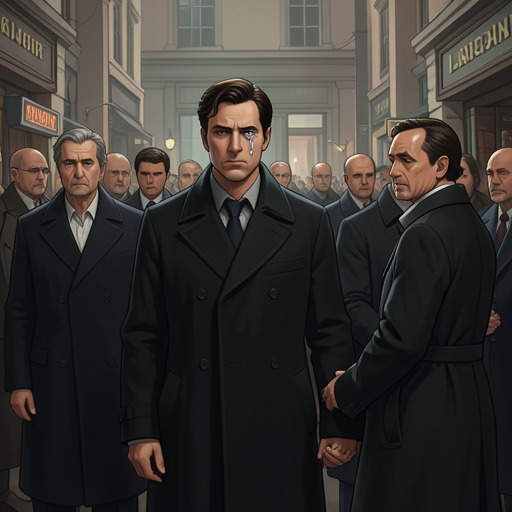
Responsibility over personal interest
Around the World in Eighty DaysResponsibility over personal interest becomes decisive when Phileas Fogg must choose between keeping his journey on schedule and searching for Passepartout. Though a delay will almost certainly cost him the wager, he resolves to look for his companion, treating the obligation to help him as more important than the prize and accepting the danger to himself without hesitation.
The Decision
At the crisis point, Fogg stands with folded arms and remains motionless. That stillness marks a decision not yet made, rather than indifference: he has to weigh the consequences before acting. When he speaks to Aouda, his first resolve is to find Passepartout, whether alive or dead. He then sharpens that intention, insisting that Passepartout can be found alive if no time is lost. The movement from a determination to search under any circumstances to a hope that speed can save his companion gives the choice both moral clarity and urgency.
Aouda’s response presses Fogg toward action. She tells him that he ought to go, while his own question to those present makes the obligation explicit: he cannot simply leave a fellow traveler in peril. The scene presents responsibility not as an abstract principle but as a claim made by another person’s need. Fogg’s decision follows from that claim, even though the facts before him leave no easy way to reconcile it with his journey.
The Cost to the Wager
The cost is concrete. A delay of a single day would cause Fogg to miss the steamer at New York, and the wager would then be lost. The narration treats that outcome as virtually certain, not as a minor inconvenience or a risk he can comfortably absorb. By choosing the search, Fogg knowingly puts the success of the undertaking in jeopardy; in the narrator’s formulation, he sacrifices himself and pronounces his own doom as a competitor in the wager.
That sacrifice makes the scene a direct test of what the wager means to him. Until this point, the journey’s deadline has imposed a strict measure on his actions: a day has an immediate and calculable value. Here, however, the calculation does not decide the matter. Fogg recognizes that his choice may destroy the prospect of winning and still does not hesitate. The value of keeping faith with a companion outweighs the value of preserving his chance at the prize.
Duty in Action
Fogg’s stated reason is duty. He does not present the decision as a bargain, a route to some later advantage, or a way of protecting his reputation. The narration links his thought of duty directly to his lack of hesitation, making it the hinge between the known cost and the chosen action. Responsibility is therefore shown through conduct: he accepts a foreseeable loss because another person must not be abandoned.
The choice also concerns more than the wager. Aouda understands that Fogg is risking his life as well as his fortune, and describes his generosity and courage as tranquil, without display. Her response emphasizes the quietness of his decision: the scene does not make a speech or public recognition the price of doing what he believes he ought to do. Its force comes from the contrast between the enormous personal stakes and the simplicity of the principle he follows.
Aouda as Witness
Afterward, Aouda withdraws to a waiting-room and waits alone, thinking about Fogg’s generosity and courage. Her solitude gives the decision an intimate consequence: she has witnessed not merely that he chose to act, but that he accepted the likely loss without demanding acknowledgment. The narration gives her perception particular weight by connecting the sacrifice of his fortune and the risk to his life with his sense of duty and his silence.
The scene thus defines responsibility over personal interest through a precise conflict, not through a general claim that Fogg is selfless in every circumstance. He is faced with one immediate choice: protect the wager by avoiding delay, or search for the companion whose danger has been brought before him. He chooses the search, while its cost remains plain. The episode places human obligation above punctuality and financial success, and makes that hierarchy visible in the moment when Fogg’s most carefully measured plan can no longer govern his conduct.