Sioux raiders
Around the World in Eighty DaysThe Sioux raiders are the armed attackers who board the Pacific Railroad train and transform a fast westward journey into a struggle for control of the cars, the locomotive, and the passengers. Their attack is presented as a recurring danger to railway travel, not an isolated encounter: the account says they had waylaid trains before. The crisis reaches beyond the immediate violence, leaving travelers captive and requiring Phileas Fogg to lead a rescue on foot with soldiers from Fort Kearney.
Identity and Place in the Narrative
The Sioux raiders appear as a collective rather than as individually developed characters. The narrative gives one of them a specific role: a chief attempts to stop the locomotive, but, not knowing how to operate its controls, opens the steam valve instead of closing it. The result is the opposite of his intention. The train hurtles forward with greater speed, making the assault more perilous for everyone aboard and showing how the railway’s machinery can frustrate an attacker as readily as it can endanger its passengers.
Their appearance follows another interruption to the journey. After a signal halts the train because a bridge is considered unsafe, the passengers resume their route; a planned duel between Fogg and Colonel Stamp Proctor is interrupted when cries and gunshots break out elsewhere along the train. The raiders thus enter at the instant when a private quarrel is about to become a spectacle, redirecting the scene from a formal contest between two men to a collective emergency affecting the whole train.
The Assault on the Train
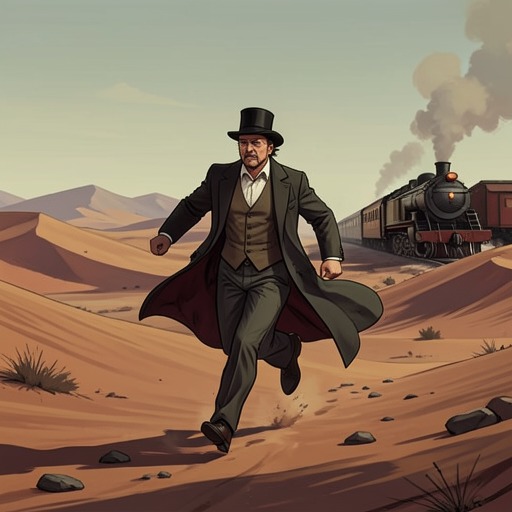
The attack begins while the train is moving. A hundred raiders, according to the account, leap onto the steps without bringing it to a halt. They are armed with guns, and passengers—many of whom also carry weapons—answer with revolver fire. The attackers first reach the engine, where they strike the engineer and stoker with their muskets, leaving them half stunned. The chief’s mistake with the steam valve then sends the locomotive plunging forward rather than stopping it.
The assault spreads through the cars. The raiders move across the roofs, force open doors, and fight passengers at close quarters. They also enter the baggage car and throw trunks from the train. Meanwhile, some travelers barricade individual cars and defend them as the train races onward. The account’s image of these cars as moving forts captures the contradiction at the heart of the scene: the railway carries its occupants away at extraordinary speed, yet its enclosed compartments become besieged spaces from which escape is difficult.
The fighting is not presented as harmless spectacle. Aouda uses a revolver against attackers appearing at broken windows, while passengers are shot or stunned and left on their seats. The narrative reports that twenty Sioux fall mortally wounded and are crushed by the wheels when they land on the rails. The struggle lasts ten minutes, and the danger is sharpened by the train’s position: Fort Kearney, with its garrison, is only two miles away, but if the train passes it, the raiders may command the stretch between the fort and the next station.
Captives and Rescue
The immediate danger does not end with the fighting aboard the train. Passepartout and two other travelers are later found in the raiders’ hands, ten miles south of Fort Kearney. Before help arrives, the captives begin struggling with their captors; Passepartout fells three of them with his fists. Fogg and the soldiers then hasten to their aid, and Fogg returns at the head of the rescued group, with Passepartout and the other two travelers just behind him.
The rescue completes the episode’s reversal of power. The raiders had entered the train in force and carried passengers away, while the captives initially had to defend themselves without assistance. The return to the fort is instead organized around Fogg’s leadership and the soldiers’ intervention. Fogg distributes the reward he had promised the soldiers, and Passepartout privately recognizes how much his rescue has cost his master. The consequences therefore extend beyond the recovered passengers: the attack draws Fogg away from the timetable and makes his willingness to spend money and effort for another person visible in action.
Narrative Role
The raiders function as a force that converts the railway’s apparent speed and efficiency into sudden vulnerability. Their ability to board a moving train, seize the engine, and invade its cars exposes how little security the passengers possess once the journey becomes a battlefield. Yet the machine does not simply become their instrument: the chief’s failed attempt to control it accelerates the train, while the need to stop it before it passes Fort Kearney imposes a strict limit on the time available to resist.
The episode also shifts attention among distinct forms of courage. Aouda defends herself inside the train; passengers barricade cars; Passepartout fights his captors; and Fogg leads the expedition that brings him back. Against these individual actions, the raiders remain a collective threat, defined through their movements and their effect on the journey rather than through personal histories or stated motives. Their narrative significance lies in the disruption they cause and in the chain of action that follows: the attack separates passengers from the train, the captives resist, and Fogg’s rescue turns a timetable-threatening crisis into a demonstration of responsibility toward his companions.