Tankadere
Around the World in Eighty DaysThe Tankadere, pilot-boat No. 43, is the small vessel that carries Phileas Fogg, Aouda, and Fix from Hong Kong toward Shanghai, where they hope to catch the American steamer bound for Yokohama. Its importance rests not on comfort or power but on its ability to make a difficult passage under sail: the boat’s speed, its crew’s labor, John Bunsby’s seamanship, and a final distress signal combine to keep Fogg’s journey in motion when the scheduled connection is about to leave without him.
Identity and purpose
The Tankadere is introduced as the best pilot-boat in the harbour, capable of making between eight and nine knots. Its master, John Bunsby, offers it for the urgent passage. The choice of Shanghai follows from a practical disagreement about the route: Fogg insists that he must take the American steamer at Yokohama, while Bunsby explains that it does not start from Yokohama. It calls there, but begins its voyage from Shanghai. Bunsby proposes going to Shanghai or Nagasaki; Shanghai is the shorter option, only eight hundred miles away, and the route need not go wide of the Chinese coast, where northward currents would help the boat.
The arrangement makes the Tankadere more than hired transport. It is a working craft with a defined purpose in the itinerary: to bring its passengers to the point where they can intercept the steamer. Bunsby is both its master and the person responsible for judging wind, sail, and danger. Fogg’s plan depends on that expertise, even as his composure and deadlines shape the decisions made aboard.
Departure and the race north
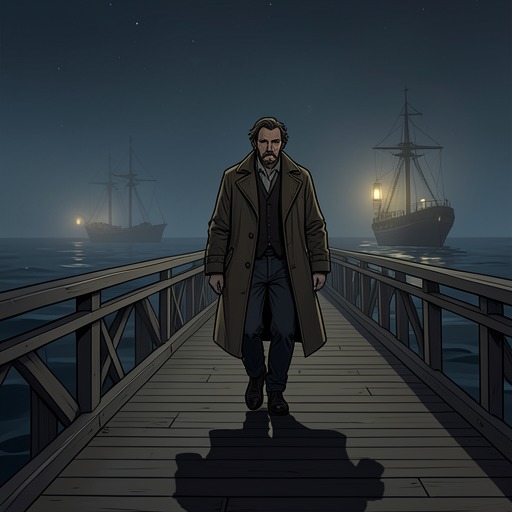
The Tankadere sets out with its sails and English flag raised at ten minutes past three. Fogg and Aouda sit on deck and look back toward the quay, hoping to see Passepartout, who does not appear. The boat starts without him. Bunsby gives the order, and the brigantine, foresail, and standing-jib catch the wind and drive the craft forward.
At sunrise on 8 November, the boat has made more than one hundred miles, with the log showing an average speed between eight and nine miles. It continues under full sail along the coast, sometimes no more than five miles from land. The coastal currents are favourable, and the wind coming off the land leaves the sea less rough than it might otherwise have been for a small boat. The wind weakens near noon, prompting Bunsby to raise his poles, but he takes them down again when the breeze freshens within two hours.
As the passage progresses, Bunsby repeatedly assures Fogg that they will reach Shanghai in time. Fogg says he is counting on it. The crew work hard, tightening every sheet and hoisting the sails vigorously; the account links their effort to the reward at stake. By evening the log records two hundred and twenty miles. The boat’s progress depends on both favourable conditions and sustained work, not simply on the speed promised when it was hired.
The typhoon passage
When a typhoon threatens, Bunsby prepares the boat rather than continuing under its ordinary rig. He reefs all sail, removes the pole-masts, and sends the hands forward. A single triangular storm-jib of strong canvas is set to hold the wind from behind. He asks the passengers to go below, but Fogg, Fix, and Aouda remain on deck. The craft then runs northward with enormous waves, repeatedly appearing close to being overwhelmed; Bunsby’s handling keeps it on course.
The storm changes direction and intensifies. After the wind veers around from the north-west, the Tankadere lies in the trough of the waves and is struck heavily. As darkness falls, Bunsby considers whether to reduce speed and proposes making for a port on the coast. Fogg agrees. This exchange marks a limit to the forward push: the master’s judgment of immediate danger takes precedence over the schedule, while Fogg accepts the need to seek shelter rather than insist on pressing on.
The following day the wind returns from the south-east, and the Tankadere again moves northward through the rough sea. By noon there are signs of a lull; the storm subsides as the sun goes down, allowing the exhausted passengers to eat and rest. The night is comparatively quiet, and some sails are raised again. The storm has cost the party several hours, a delay that later makes the final approach to Shanghai especially precarious.
The signal and transfer
At dawn the next morning, Bunsby estimates that Shanghai is less than one hundred miles away, with only one day remaining before Fogg is due to take the steamer. By noon the Tankadere is forty-five miles from Shanghai, but the wind is calming. Six hours remain to cover that distance, and the boat needs to average nine miles an hour. The sails and currents carry it close: at six o’clock it is ten miles from the mouth of the Shanghai River, and at seven it remains three miles from Shanghai itself, which lies at least twelve miles upstream.
As the Tankadere approaches, a long black funnel and its smoke appear on the horizon: the American steamer is leaving for Yokohama at its appointed time. Bunsby reacts in alarm, but Fogg directs him to signal. A small brass cannon on the forward deck is carried for signalling in fog; it is loaded, but Fogg first calls for the flag to be raised. The flag is run up at half-mast, the distress signal, and the cannon is fired. The boat uses the means available aboard to make its need visible and audible to the departing vessel.
The steamer’s captain sees the signals and changes course toward the Tankadere. Fogg pays Bunsby the agreed passage price and gives him an additional five hundred and fifty pounds. He then boards the steamer with Aouda and Fix, and they set off for Nagasaki and Yokohama. They reach their destination on 14 November, and Fogg loses no time before going aboard the Carnatic.
Narrative significance
The Tankadere’s passage concentrates the journey’s recurring conflict between a fixed timetable and conditions that cannot be controlled. Its speed initially makes Fogg’s plan seem attainable; the typhoon then takes away hours, and the departing steamer turns a near arrival into a possible missed connection. The boat cannot simply overpower these obstacles. Its progress is produced by the crew’s work, Bunsby’s decisions, the winds and currents, and finally the steamer captain’s response to the signal.
The vessel also gives Fogg’s characteristic calm a practical setting. While others feel the pressure of the narrowing margin, he remains composed at the approach to Shanghai and gives the brief instruction that prompts the signal. Yet the episode does not make the boat or its master incidental: Bunsby judges the route, manages the storm, and brings the craft close enough for the signal to matter. The Tankadere thus serves as both a fragile link in the itinerary and the means of restoring the journey when the schedule appears lost.