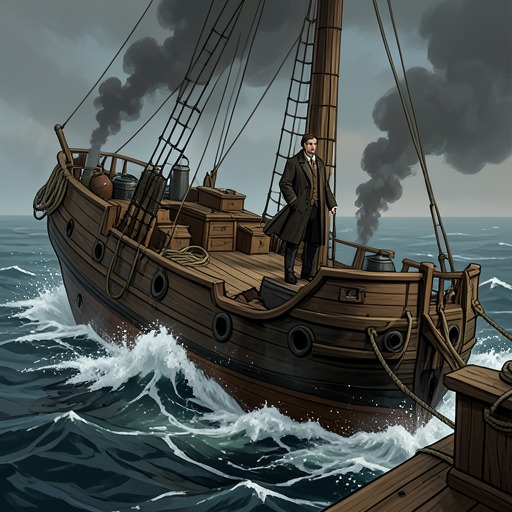
The Queenstown mail transfer
Around the World in Eighty DaysThe Queenstown mail transfer is Phileas Fogg’s final change of route across Ireland: instead of carrying the party onward to Liverpool aboard the Henrietta, he uses the mail train to Dublin and a fast steamer to cross to Liverpool. The connection saves twelve hours, gets him ashore at 11:40 on 21 December, and leaves London within reach before the wager’s evening deadline. It is a practical victory over distance and delay, but not yet a victory over the forces pursuing him: Fix meets him on the quay with an arrest warrant.
The Mail Route as an Alternative
The transfer depends on a service already built into the Atlantic mail system. Transatlantic steamers stop at Queenstown to put off the mails; express trains, kept ready to depart, carry them to Dublin, where the fastest boats take them on to Liverpool. This sequence gains twelve hours compared with continuing across the Atlantic by steamer. The route is therefore more than a convenient connection: it offers Fogg a timetable that can be substituted for his ship’s itinerary.
The opportunity becomes decisive because the Henrietta’s remaining progress is bound to its dwindling steam and the conditions of the voyage. When Captain Andrew Speedy tells Fogg that they are only opposite Queenstown and expresses sympathy for the difficulties facing him, Fogg asks whether the lights they can see belong to Queenstown. His calm attention to the port’s position turns the captain’s bleak assessment into a new calculation. Rather than accept the ship’s expected arrival at Liverpool the next evening, Fogg counts on the mail route and plans to be there by noon.
The transfer belongs to a larger pattern in which the journey’s timetable repeatedly meets obstacles that cannot be overcome by punctuality alone. Earlier in India, when Fogg said he would continue on foot, Passepartout found an elephant belonging to a nearby Indian as an alternative conveyance. In the United States, a red signal stopped the train because the bridge at Medicine Bow was unsafe for its weight. At sea, the engineer’s serious conversation with Fogg on 16 December concerned the limits of the Henrietta’s fuel. These episodes differ in scale and solution, but each makes progress depend on reading circumstances and finding another available means of travel. At Queenstown, that means is not improvised: it is the existing mail connection, taken at the last possible moment.
The Transfer at Queenstown
The port’s tide imposes a final condition. The Henrietta enters Queenstown Harbour at one in the morning, when the tide is high. Fogg and his companions go ashore at once; the train is ready to start at half-past one. The narrow interval between landing and departure gives the plan its urgency in practical terms. There is no extended pause at the port: the value of arriving at Queenstown depends on catching the connection already waiting there.
The party reaches Dublin at dawn and loses no time before embarking on a steamer for Liverpool. The narration emphasizes the boat’s directness, describing it as cutting through the waves rather than rising on them. That brisk image suits the route’s function: the sea crossing is another leg in a timed chain, not a return to the slower Atlantic passage Fogg has left behind. The sequence is precise—harbour, express train, Dublin, steamer—and each successful handoff converts the twelve-hour advantage into actual progress.
Arrival and Arrest
Fogg disembarks on the Liverpool quay at twenty minutes before twelve on 21 December. He is, as the narrative measures the remaining distance, only six hours from London. The transfer has brought him ashore by noon, precisely the time he had anticipated, and has replaced the Henrietta’s later arrival with an opportunity to reach London before a quarter to nine that evening. The gain is substantial, but the available margin remains limited: the mail connection has recovered time, not removed the deadline.
Fix comes up to Fogg on the quay, lays a hand on his shoulder, and shows him the warrant. The arrival that completes the transport plan therefore ends in an arrest rather than an unimpeded dash to London. Fix had been tempted to arrest Fogg at Queenstown but did not do so; he nevertheless stayed with the party through the train journey to Dublin and the steamer crossing. The sequence leaves his hesitation unresolved at the moment of transfer, while making its immediate consequence unmistakable: Fogg has reached Liverpool in time, but his next move is stopped by the law.
Significance
The Queenstown connection is a compressed demonstration of the journey’s governing contest between measured time and contingent travel. A mail system designed to move correspondence quickly becomes a route for a passenger racing a personal deadline. Fogg’s success depends not on making the Henrietta go faster, but on abandoning its timetable for a chain of train and ship connections whose departures are already coordinated.
The scene also separates logistical success from overall success. Fogg’s calculation is borne out: he reaches Liverpool at the intended hour and remains close enough to London for the wager to appear attainable. Yet the arrest warrant, produced at the instant he arrives, makes clear that speed alone cannot determine the outcome. The transfer wins back twelve hours against the Atlantic crossing; it cannot prevent Fix from imposing a new obstacle at the destination. Thus Queenstown marks both the effectiveness of Fogg’s planning and the precariousness of the final approach.