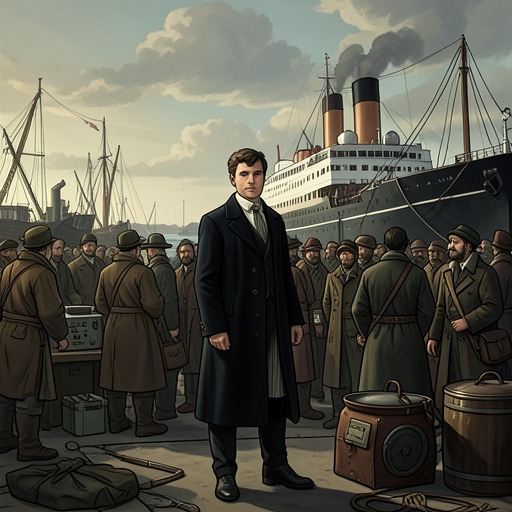
The Tankadere signals the General Grant
Around the World in Eighty DaysThe Tankadere’s distress signal turns a near-missed connection into a rescue and keeps Phileas Fogg’s journey moving. As the pilot-boat approaches Shanghai too late to reach the departing steamer by ordinary means, Fogg’s calm instructions replace panic with a practical appeal: a half-mast flag and a cannon shot. The steamer changes course, and Fogg, Aouda, and Fix transfer aboard for the passage to Japan.
The connection at risk
The Tankadere has survived the storm, and after it passes the sea becomes smooth. Yet the calmer water does not remove the danger to Fogg’s schedule. The light pilot-boat makes good use of its sails and the currents, but at six o’clock it is still ten miles from the mouth of the Shanghai River. Shanghai lies at least twelve miles farther upriver; at seven, the boat remains three miles from the city. Its pilot, John Bunsby, sees the two-hundred-pound reward slipping away, while Fogg remains tranquil even though his entire fortune is at stake.
The delay matters because the American steamer bound for Yokohama is leaving at its appointed time. Its long black funnel appears on the water while the Tankadere is still approaching Shanghai. The vessel’s departure makes the problem immediate: the party cannot simply expect to meet it at the port. The episode narrows the larger journey’s stakes to a visible distance and a vanishing opportunity, with the steamer already under way and the pilot-boat still outside the river mouth.
The signal and response
John Bunsby reacts with a desperate movement of the rudder and an angry exclamation. Fogg instead gives the brief order to signal the steamer. The Tankadere carries a small brass cannon on its forward deck for fog signals. It is loaded, and Bunsby is about to apply a red-hot coal to its touchhole when Fogg changes the proposed method: he orders the flag hoisted first.
The crew runs the flag up at half-mast, the recognized distress signal. Its purpose is to make the departing steamer alter course slightly and come to the pilot-boat’s aid. Fogg then orders the cannon fired, and its report carries the appeal across the water. The sequence is economical but consequential: flag and gun turn the Tankadere’s vulnerable position into a signal that the other vessel can recognize. Rather than trying to force the meeting by speed alone, Fogg makes the predicament legible to the steamer’s captain.
The signal succeeds. The captain of the Yokohama steamer sees the half-mast flag and directs his course toward the Tankadere. What had looked like a missed connection becomes a rescue through recognition and response. The change of course supplies the decisive turn in the scene: the party’s passage onward depends not on arriving in Shanghai before the departure, but on persuading the departing vessel to meet them at sea.
Transfer and consequence
Once the pilot-boat comes in sight of Shanghai, the narrative moves quickly from the signal to its result. Fogg pays John Bunsby the stipulated passage price and gives him an additional five hundred and fifty pounds. He then boards the steamer with Aouda and Fix, and they set off at once for Nagasaki and Yokohama. The payment closes the immediate arrangement with the pilot and marks the transfer from the small craft that brought them toward Shanghai to the vessel that can continue the long-distance journey.
The party reaches its destination on the morning of November 14. Fogg loses no time before going aboard the Carnatic, where he learns news that delights Aouda. The distress signal therefore does more than save the Yokohama connection: it carries the group into the next stage of the route and brings Fogg to the ship associated with their onward passage. The episode’s pressure comes from the contrast between the steamer’s fixed departure time and the party’s remaining distance; its resolution comes from Fogg’s measured intervention, the crew’s signal, and the captain’s decision to answer it.