The Tankadere’s Passage Through the Typhoon
Around the World in Eighty DaysThe Tankadere’s passage through the typhoon is a dangerous interruption in Phileas Fogg’s attempt to keep his journey on schedule, but it also becomes a demonstration of how resolve and skilled seamanship carry the party through uncertainty. The storm drives the pilot-boat northward, forces its crew to consider shelter, and ends with a distress signal that brings help near Shanghai.
Warnings in the Straits
The Tankadere entered the Straits of Fo-Kien, between Formosa and the Chinese coast, during the night and crossed the Tropic of Cancer. The water was already difficult to navigate: counter-currents formed eddies, and the rough sea made it hard to stand on deck. At daybreak, the signs became more ominous. The wind strengthened, the barometer shifted capriciously, and long surges rose in the southeast. The previous evening, the sun had set through a red mist over the phosphorescent ocean; by morning, these observations had become warnings of a coming gale.
John Bunsby examined the sky and identified the approaching storm as a typhoon from the south. Phileas Fogg asked which direction the wind came from and treated its southerly course as potentially useful: it might carry the boat forward. Bunsby was less sanguine. The typhoon’s timing, near the winter equinox, made a violent onset a serious risk. Their exchange establishes the passage’s governing tension: the same wind that could advance the voyage could also overwhelm the small craft.
The Boat Pressed North
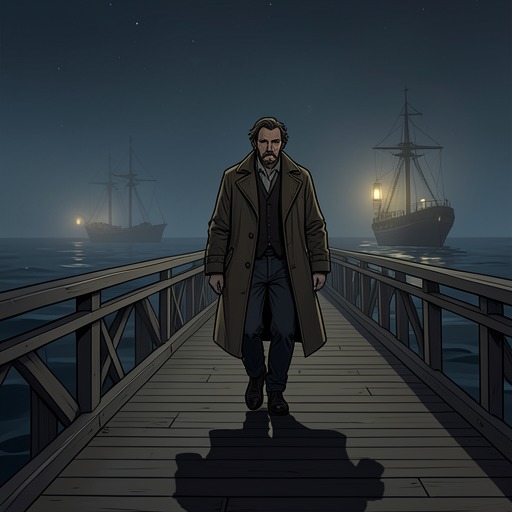
John Bunsby asked the passengers to go below, but Phileas Fogg, Fix, and Aouda stayed on deck. Around eight o’clock, wind and rain descended, and the Tankadere was driven north under a small amount of sail. Its speed was extraordinary, yet the waves repeatedly threatened to engulf it. Bunsby’s handling of the boat kept it moving through the storm, while the passengers endured the spray and the difficulty of remaining aboard.
The storm’s direction changed the terms of the crossing. Until evening, the Tankadere had held its northerly course; then the wind veered three quarters and came from the northwest. The boat fell into the trough of the waves, where it was struck and rolled with increasing violence. As darkness approached, Bunsby reconsidered whether the crew should reduce speed. The passage thus shifts from Fogg’s initial willingness to use the south wind to a more urgent question: whether pressing on remains safer than seeking a port.
The next night was perilous, and the craft twice came close to being lost, according to the account. Aouda was exhausted but did not complain; more than once, Phileas Fogg moved to protect her from the waves. At daybreak, the tempest remained fierce, but the wind had returned to the southeast, a favorable change that again carried the Tankadere forward. The coast appeared intermittently through the mist, but no other vessel was in sight. By noon, signs of calm emerged. The storm had been brief as well as severe, and the exhausted passengers were at last able to eat and rest.
The Decision to Continue to Shanghai
As the storm worsened, John Bunsby proposed making for a port on the coast. Phileas Fogg agreed and specified Shanghai. The pilot initially struggled to accept the determination behind that choice, then accepted it, and the Tankadere continued northward. This decision makes the course more than a matter of simply following the wind: even after Bunsby raises the prospect of shelter, Fogg commits to a named destination.
The passage does not present Fogg’s composure as control over the weather. The typhoon changes direction, threatens the boat, and leaves the crew to manage risks that no timetable can remove. Instead, his steadiness appears in the decisions he makes within those limits: he remains on deck, agrees when Bunsby judges a port necessary, and directs the boat toward Shanghai. Aouda’s attention to her protector and her refusal to complain mark a different form of endurance, while Bunsby’s seamanship remains essential to their survival.
Distress Signal and Transfer
When the Tankadere came within sight of Shanghai, a steamer was visible. Phileas Fogg first ordered a signal, and a small brass cannon on the pilot-boat’s forward deck was prepared for use in the fog. He instead directed the crew to hoist the flag at half-mast, the recognized signal of distress. The cannon was then fired, its report carrying the appeal across the water.
The captain of the Yokohama steamer had seen the signal and altered course toward the Tankadere. After paying John Bunsby the stipulated passage price, Phileas Fogg gave him a further five hundred and fifty pounds. Fogg then boarded the steamer with Aouda and Fix, and they set off for Nagasaki and Yokohama. They reached their destination on the morning of 14 November; Fogg promptly went aboard the Carnatic. The storm therefore ends not with the party stranded or forced to abandon its onward journey, but with a transfer that restores their passage by sea.
Narrative Significance
The typhoon places the wager’s demand for speed against the physical limits of travel. A favorable wind first appears to serve the schedule, then becomes a threat; the decision to make for Shanghai and the distress signal turn danger into a change of route and vessel. Progress depends not on Fogg’s punctuality alone but on Bunsby’s skilled handling, the crew’s watchfulness, and the steamer captain’s response to the flag.
The sequence also distinguishes composure from invulnerability. Phileas Fogg remains characteristically calm, but the boat is still at the mercy of changing winds and waves, and Aouda is exhausted by the crossing. His substantial extra payment to Bunsby follows the stipulated fare and acknowledges the pilot’s role in getting them through. By ending with the party aboard a steamer bound for Nagasaki and Yokohama, the episode converts a threatened delay into a precarious continuation of the journey.