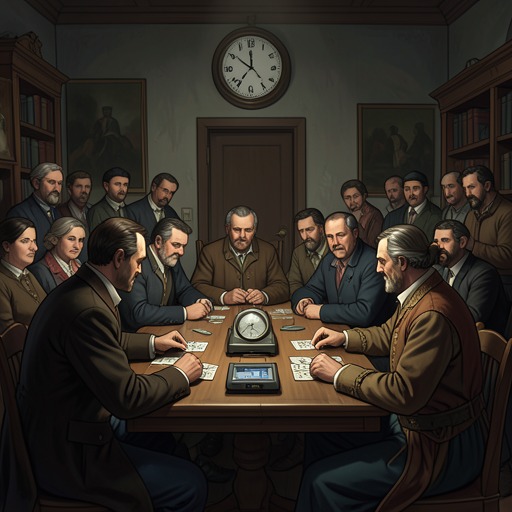
The Theft of £55,000 from the Bank of England
Around the World in Eighty DaysThe Theft of £55,000 from the Bank of England sets a conspicuous absence in motion: a package of banknotes vanishes from a room where valuables are ordinarily left within easy reach. The robbery triggers a nationwide and international search, then reshapes public understanding of Phileas Fogg when detective Fix identifies him as the thief. The accusation makes Fogg’s tightly scheduled journey appear less like a wager than an escape, and follows him toward a return already burdened by other complications.
The Bank and the Missing Notes
The theft had occurred three days before it became the subject of conversation at the Reform Club. A package containing £55,000 was taken from the principal cashier’s table while the cashier was occupied registering the receipt of three shillings and sixpence. The contrast between the enormous sum and the small transaction that briefly held the cashier’s attention gives the crime its defining circumstance: the notes disappeared in a place where routine work, rather than visible barriers, was meant to protect the money.
The Bank of England’s rooms are described as having neither guards nor gratings around their exposed gold, silver, and banknotes. The narrative illustrates this confidence with an account of a gold ingot weighing seven or eight pounds. A visitor lifted it, examined it, and passed it from person to person until it reached the end of a dark entry; for half an hour the ingot was away from its place, while the cashier did not raise his head. That earlier episode supplies a pointed contrast to the £55,000 robbery. The institution’s openness had once allowed an object to travel unnoticed and return; this time, when the notes were missing at five o’clock, there was no recovery to make. Their value was entered to profit and loss.
The Search and the Public Debate
Once the robbery was discovered, selected detectives were sent to Liverpool, Glasgow, Havre, Suez, Brindisi, New York, and other ports. The reward offered them was £2,000, together with five per cent of whatever sum they recovered. Detectives were also instructed to watch closely those arriving in or departing from London by rail, while a judicial examination began. The response treated the theft as a matter of movement as well as concealment: a suspect might leave through a port or pass through the capital’s railway traffic.
The initial description encouraged a particular theory of the crime. Investigators had reason to think the thief was not part of a professional gang. On the day the notes were taken, a well-dressed gentleman with polished manners and an air of prosperity had been seen moving about the paying room. His description was obtained and circulated to the detectives. The apparent refinement of the man became a clue, but also an interpretive trap: a respectable appearance could point toward an individual suspect without establishing his guilt.
The robbery filled newspapers and clubs with speculation about whether the detectives would succeed. The Reform Club was especially stirred because several of its members were Bank officials. Ralph believed that the reward would spur the investigators to action; Stuart doubted that the thief would be caught. Their disagreement framed the case as a contest between institutional pursuit and an elusive offender. Fogg, reading behind his newspapers, referred to the newspaper account that described the suspect as a gentleman, but the available conversation does not establish that he knew anything about the crime beyond what was being discussed publicly.
Fogg Becomes the Suspect
The accusation arrived by telegraph a week after Fogg’s departure. A message sent from Suez to Rowan, the Commissioner of Police at Scotland Yard, declared that Fix had found the bank robber and identified him as Phileas Fogg. Fix requested that a warrant of arrest be sent to Bombay. The dispatch transformed the journey’s meaning almost immediately: the polished gentleman known to the club was recast as a bank robber, and his sudden departure became suspicious in retrospect.
Fogg’s photograph, displayed with those of the other Reform Club members, was examined feature by feature and judged to match the description supplied to the police. His solitary habits and abrupt departure were recalled alongside that resemblance. From these details, observers constructed a complete motive: they supposed that he had undertaken the tour around the world under cover of a wager in order to evade the detectives. The conclusion joined circumstantial likeness to a plausible story, but the dispatch itself records Fix’s identification, not proof that Fogg committed the robbery.
The club’s support then contracted. Members who had backed Fogg withdrew, and the odds against his completing the wager rose to a hundred and fifty or two hundred to one. The episode therefore did more than attach a criminal suspicion to his name. It altered the public stakes of the race: the journey that had seemed a demonstration of punctuality and planning now looked like a fugitive’s attempt to stay ahead of an arrest.
Consequences for the Journey
The robbery’s influence persisted as Fogg crossed the world. At Hong Kong, Fix decided he had to detain him there and made a clean breast of his role to Passepartout, explaining that he was not an agent of the Reform Club. That disclosure belongs to the investigation’s continuing effort to catch Fogg, while also showing how the accusation reaches his travelling party through the detective’s pursuit. The evidence presented here does not establish the actual thief’s identity or the eventual disposition of the case; its immediate consequence is the danger created by Fix’s mistaken certainty.
By the time the party was aboard the Henrietta, the prospect of reaching Liverpool had acquired another shadow. The crossing from New York might cover three thousand miles in nine days, between 12 and 21 December, if the sea, wind, boat, and machinery cooperated. Yet the prospect of arrival carried a warning: the affair aboard the Henrietta, added to the Bank of England case, might create further difficulties for Fogg. The theft thus links the opening public debate to the final approach toward England without making the accusation true. Its narrative force lies in that gap between allegation and fact: a missing package produces a search, a search fixes on Fogg, and a journey undertaken openly as a wager is reinterpreted as flight.