
Edgar’s Repeated Failure to See Others Clearly
AsylumThis flow traces the recurrent pattern in which Edgar replaces uncertainty about another person with a fixed, damaging interpretation.
increasing Bearing strength in each event
 decreasing
Bearing strength in each eventdecreasingRuth Made Unfaithful

Delusion as Certainty
Ordinary Signs
Edgar interprets minor domestic details as evidence that Ruth has many lovers. The accusations expand until his imagined pattern overrides the ordinary facts of their marriage.
Violence After Certainty
He kills Ruth after the delusion has become part of his reality. His inability to recognize uncertainty or another person’s independent truth becomes the foundation of irreversible violence.
Stella as Image and Model
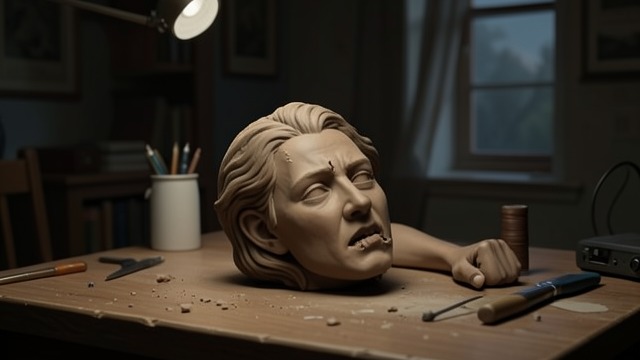
The Beloved Seen Through Art
A New Subject
Edgar draws and sculpts Stella, insisting that he wants a likeness rather than an idealized portrait. His artistic language suggests a desire to see her apart from his feelings.
The Image Breaks Down
As jealousy takes hold, Edgar treats Stella as an unfaithful object and damages the clay likeness. The work that began as an attempt to see her becomes entangled with the failure of that attempt.
A Delusion Repeated

Old Accusations Return
Claims About Nick
Edgar tells Peter that Stella and Nick were sexually involved, presenting suspicion as direct knowledge. Peter recognizes the similarity to the accusations Edgar once made about Ruth.
A Pattern Without Resolution
The novel leaves some elements of Stella’s relationships complicated, but Edgar’s confidence does not make his overall interpretation trustworthy. His fate remains shaped by an enduring inability to distinguish a person from the story his jealousy creates.
During Edgar’s marriage to Ruth
From the garden to the London loft
After Edgar’s recapture
