“What do you see”
Awakening the Angel System: Apocalypse: A LitRPG Progression Fantasy“What do you see?” is one of Jack’s defining expressions because it makes vision a battlefield rather than a passive act of perception. The question appears whenever Jack forces another person to meet his gaze, and each repetition reveals a different relation between sight, memory, guilt, and power. It can expose a victim’s buried hatred, confront a broken mind with the consequences of the past, or become the verbal centerpiece of a political performance in which Jack claims the authority to judge souls.
The Command as Interrogation
“What do you see?” first functions as a coercive demand directed at Lancelot. Jack orders the knight to kneel while a golden glare holds his eyes, then reaches up and forces Lancelot’s face toward him. The question is repeated rather than asked only once: Jack coaxes it, receives refusal, and then drives it into a harsher rhythm—“What. Do. You. See?”—while Lilith’s hand embraces Lancelot from behind and spectral chains rise from the shadows to bind him. The language of inquiry therefore conceals an act of physical and supernatural domination. Lancelot is not being invited to offer an independent interpretation; he is being compelled to look where Jack directs him.
Lancelot’s answer shows what the question unlocks. He sees “those scum,” “those curs,” and “filthy maggots,” but the text clarifies that he is not truly trying to escape Jack’s stare. He is trying to flee the memories flooding his vision. The question thus establishes a distinctive form of psychic violence: Jack’s gaze penetrates the knight’s soul, while the answer exposes the hatred stored within it. Vision becomes involuntary testimony, and the interrogated person’s own memories become the evidence against him.
Memory, Guilt, and the Broken Witness
The same words produce a sharply different result when Jack addresses Camilla. He guides the former queen’s chin upward and prompts her to look into his eye; after their eye contact is established, he whispers, “What do you see?” Camilla giggles and answers, “I see red…” Her response is brief, but Jack’s perspective reveals the larger scene behind it: hands reach toward her, and traces of hatred cling to her as remnants of those who died and cursed her.
Unlike Lancelot, however, Camilla does not experience the memories as punishment. The echoes of her victims remain present, yet she pays them no mind; the memories Jack draws from her bring comfort rather than anguish. The repeated question therefore refuses a simple equation between revelation and remorse. Seeing the dead does not guarantee moral recognition. In Lancelot’s case, memory is unbearable because it threatens to expose him; in Camilla’s, the same kind of exposure has become consoling. The expression measures not only what lies in a person’s past but also how that person has been altered by it.
Jack’s reaction gives the scene its emotional consequence. He furrows his brow, clenches his jaw, and finally pulls away, turning his back on Camilla. The examination has not eased the strain on his heart. The sight of two powerful people he once feared reduced to such damaged states reminds him of the Black King’s reach and of his own sense of helplessness, as though he were merely a puppet on a string. “What do you see?” is consequently directed outward but also rebounds upon Jack: every attempt to inspect another person’s inner life confronts him with the ruin left by forces larger than his own will.
From Personal Power to Public Judgment
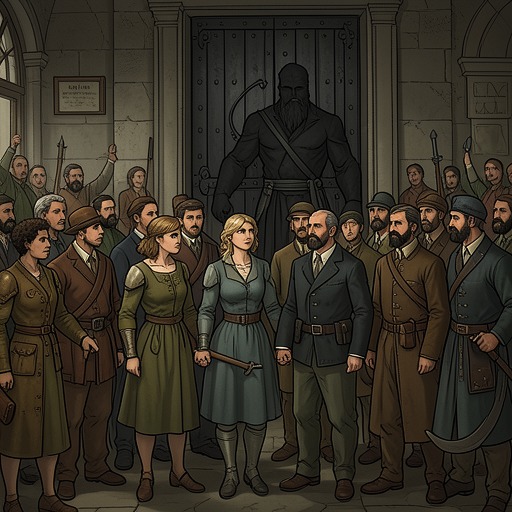
Later, Jack transforms the expression into a formal test for the Cintelli prisoners. He presents judgment as a condition of trust, declaring that their sins must be weighed. Lilith materializes while Sahaqiel descends and lands beside him, and the three take their rehearsed positions with Jack in the center. Some prisoners recognize Sahaqiel and prostrate themselves before their patron saint, giving the examination a religious and ceremonial authority that exceeds Jack’s individual power.
Jack takes a prisoner’s hands and locks eyes with him. The command is now paired with a promise of absolute classification: “Look into my eyes and be judged. You will either stand beside us as a hero, or be cast down as a villain.” Although “What do you see?” is not repeated verbatim in this sentence, the alias “Look into my eye” belongs to the same verbal pattern. Both expressions require the other person to enter Jack’s field of vision, where perception becomes submission and the self becomes legible to an external judge.
The prisoner trembles but allows Jack to peer into his soul and view his data. This detail expands the expression’s meaning beyond mystical intimidation. In Jack’s world, inner life can be treated as information: strife, conflict, turmoil, hopes, desires, lusts, and fears become readable material. Jack does not search this prisoner in the same way he tears apart his usual victims. Instead, he looks for deceit, traces of evil, or anything capable of harming his mission. The question has moved from extracting a confession to conducting an intelligence assessment under the appearance of moral judgment.
The Irony of Seeing and Being Seen
The expression carries an internal irony. Jack asks others what they see, yet the scenes repeatedly emphasize that the decisive vision belongs to him. Lancelot is forced to confront memories Jack has summoned. Camilla’s answer is less important than Jack’s ability to perceive the hands and hatred surrounding her. The Cintelli prisoner does not describe his own vision at all; Jack reads his “data” and silently evaluates the contents of his soul. The interrogated person speaks, but Jack controls what counts as knowledge.
This structure makes the question both intimate and authoritarian. Eye contact appears to promise mutual recognition, but it is arranged as an unequal encounter in which Jack holds the power to open memories, interpret them, and determine their consequences. The face of the other is not allowed to remain opaque. It is seized, chained, examined, and converted into evidence. Even the prisoner tribunal’s language of heroes and villains reduces moral complexity to a binary outcome, while Jack’s search for “anything that could harm his mission” reveals that practical loyalty matters alongside—or perhaps beneath—the rhetoric of sin.
Recurrence and Narrative Function
Across these scenes, “What do you see?” marks a progression in Jack’s use of power. With Lancelot, it is a weapon for breaking resistance. With Camilla, it becomes an attempted examination of damage that leaves Jack more troubled rather than more satisfied. With the Cintelli prisoners, it becomes a rehearsed institution: Lilith and Sahaqiel flank him, the prisoner’s hands are held, and the gaze is incorporated into a public procedure of selection.
The repetition gives the expression the force of a motif. Seeing is never neutral, and the question never seeks only a spoken answer. It summons hidden memory, exposes the persistence of the dead, tests the possibility of deceit, and places the person being examined beneath Jack’s authority. Its decisive significance lies in this convergence of revelation and coercion: Jack can make others look inward, but the scenes also show that knowledge does not restore what has been destroyed. Lancelot remains haunted, Camilla remains broken, and Jack himself turns away under the pressure of what his vision has disclosed. The question promises clarity, yet every answer deepens the moral darkness surrounding the act of judgment.