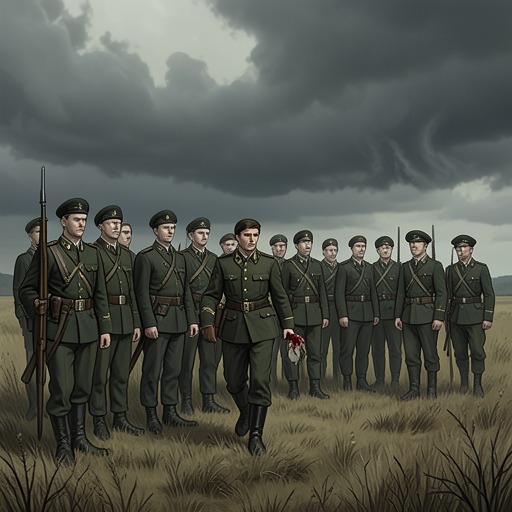
Admiral Skirita
Awakening the Angel System: Apocalypse: A LitRPG Progression FantasyAdmiral Skirita is a veteran Imperial officer whose importance lies less in ceremony than in logistical competence. He understands the practical conditions of war across air, land, and sea, and that expertise makes him indispensable when the surviving forces must cross into the Forgotten Continent, where corruption, demonspawn, poisonous smog, and mana failure render ordinary military assumptions useless. His career is therefore tied to the book’s recurring insistence that battles are decided not only by courage or firepower, but by transport, supplies, filters, ships, and command decisions made under pressure.
Identity and Military Expertise
Admiral Skirita is described as one of the few Imperial officers experienced in sailing airborne, land, and sea ships. That unusual breadth explains why he is assigned a central role in the Zanzibar operation. The expedition cannot rely on the Empire’s ordinary land-based infrastructure: the Forgotten Continent’s smog prevents satellite imaging, starves mana-dependent systems, threatens non-Awakened soldiers without constant filter supplies, and can shut down MECHFrames, airships, and even automated machines. Seafaring craft are also scarce because the Empire is landlocked and has had little reason to maintain a large fleet. Skirita’s value is consequently both military and logistical. He is the officer capable of turning an improvised collection of vessels and expeditionary troops into a coordinated operation.
His presence also places him within a wider military culture shaped by exhaustion and scarcity. The campaign follows the displacement of millions, shortages of food, ammunition, replacement parts, and filters, and conflict among nomad, Paladin, and Imperial survivors. Against that background, Skirita represents institutional knowledge that cannot easily be replaced. He is not introduced as a symbolic aristocrat or a battlefield celebrity, but as an experienced professional whose understanding of different forms of transport becomes a condition of survival.
The Zanzibar Expedition
Selfia’s plan for the Forgotten Continent has three linked objectives: seize Zanzibar, interrogate the Red Rook, and capture the boats needed for continued survival. Skirita is the officer who translates that broad plan into an assault. Studying a portable holotable, he notes that the enemy will probably expect an attack and proposes striking after sunset. Ten ships are docked at the port, and he divides the commandos into six-man teams, assigning one team to each vessel. When Jack questions whether six soldiers can capture a ship, Skirita answers that numbers alone do not win wars, defining his method through concentration, timing, and specialized competence rather than massed force.
The operation succeeds on terms that validate his judgment. Skirita reports eight destroyer-class boats, three cruisers in drydock, and more than two thousand prisoners taken, with only twelve casualties. The result is not merely a battlefield victory. The captured ships solve a strategic shortage that had threatened the expedition before it began, while the prisoners and seized port provide the coalition with resources, information, and a usable foothold. Skirita’s operation turns Zanzibar from an objective on a map into the material base from which the larger campaign can continue.
His success is especially stark beside the expedition’s human cost. The landing on the new continent is marked by poisoned water, red-stained sand, corpses, and soldiers scavenging equipment from the dead. Refugees and supplies converge on Zanzibar, but demonspawn follow them, and Apostles massacre many before Sahaqiel and Selfia’s teams can intervene. Skirita’s careful planning does not remove the brutality of the campaign; it creates the limited space in which survival remains possible.
Command Under Catastrophe
Skirita’s most consequential appearance comes during the later battle against a massive Apostle structure. Python Est reaches the bridge after monsters tear through his barrier and finds Skirita slumped over the command console, while everyone nearby is dead or dying. The admiral’s condition is not presented as a private tragedy detached from the battle. His incapacitation immediately creates a command vacuum at the center of a carrier packed with enough ordnance to level a city.
Yet Skirita has prepared the ship to continue functioning through catastrophe. He has slaved all systems to his command chair, leaving Python with limited executive control even after the crew passes out and the bridge collapses into chaos. This detail gives his command a final, practical form: he has made the vessel survivable as a military instrument beyond the point at which its ordinary chain of command can operate. The system he established allows Python to act, but the possibility of action exists because Skirita’s earlier configuration preserved it.
Python then faces the sight of Jack and Sahaqiel being overwhelmed by a dozen Apostles while attempting to expose weaknesses in the immense structure. The carrier cannot destroy the enemy through a collision, but it can slow it down. Python takes command from the fallen admiral and chooses to sacrifice the air carrier as an obstacle. Skirita therefore becomes part of a reversal in which a vessel designed to project military power is converted into a delaying weapon. His command architecture makes that choice possible, while his collapse embodies the cost already paid to reach it.
Relationships and Narrative Function
Jack treats Skirita as a necessary authority rather than a sentimental companion. He approaches the admiral for the Zanzibar battle plan, listens to the division of ships and commandos, and later watches the expedition’s results unfold. Their relationship is built around professional reliance: Jack supplies decisive force and unusual abilities, while Skirita supplies the operational knowledge that allows those abilities and the wider army to reach their targets.
Skirita’s relation to Python Est is likewise defined through succession under pressure. Python does not replace him through routine promotion; he takes the admiral from his chair after finding the bridge filled with dead and dying personnel. Because Skirita has linked the carrier’s systems to that chair, Python inherits not only a vessel but the consequences of Skirita’s preparation. The transfer of command is thus both practical and elegiac: the younger officer acts through the framework left by the incapacitated veteran.
The admiral also belongs to a chain of military specialists whose work is continually overshadowed by larger figures and monstrous threats. Officers, commandos, refugees, and ship crews make the expedition possible, but their contributions are measured in captured hulls, functioning systems, casualties, and minutes bought against annihilation. Skirita gives that supporting infrastructure a face. His importance lies in the fact that the campaign would fail without people able to make its grand objectives materially executable.
Change, Consequence, and Significance
The evidence does not provide a later recovery or a conventional personal resolution for Admiral Skirita. His last known state is that of a commander found collapsed at his console while the bridge around him has been devastated. Nevertheless, his narrative ending is not passive. His systems remain active, Python assumes limited control, and the carrier becomes capable of the sacrificial maneuver required to slow the Apostle structure. Skirita’s final contribution is therefore expressed through continuity of command rather than survival on the page.
His arc moves from operational mastery to the collapse of the body that embodied it, while preserving the usefulness of the decisions he made beforehand. That pattern mirrors the larger wartime world: people are consumed, cities become refuge systems, ships become weapons, and expertise survives only when embedded in material structures others can inherit. Skirita’s achievement at Zanzibar demonstrates how discipline can convert scarcity into victory; his final command legacy demonstrates the limit of that victory, because even the best planning cannot prevent the battlefield from demanding a human sacrifice.
Admiral Skirita consequently serves as a military and thematic counterweight to the story’s supernatural champions. Jack and Sahaqiel confront Apostles directly, but Skirita’s contribution is the less spectacular labor of making an expedition possible and preserving command when institutions break apart. His captured fleet sustains the advance, his tactical choices limit casualties, and the controls tied to his chair enable the final delaying action. Through him, war is shown as a system of logistics, judgment, and inherited responsibility—and as a system that ultimately turns its most capable servants into expendable instruments.