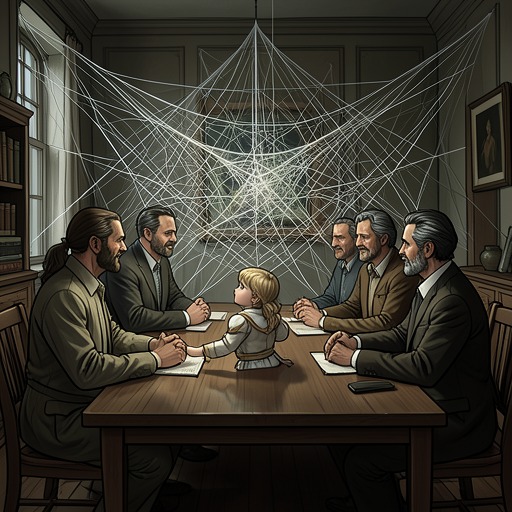
Celeste’s birth certificate
Awakening the Angel System: Apocalypse: A LitRPG Progression FantasyCeleste’s birth certificate is the paper object through which private parentage becomes public law. Presented by Selfia to Jack after his marriage and coronation, it bears Celeste’s name alongside Jack’s and Selfia’s, turning an improvised family arrangement into an officially recognized dynastic one. Its decisive force lies in that conversion: a simple document changes Celeste’s education, title, public identity, and place in the succession.
Creation and Immediate Meaning
Selfia introduces the certificate while discussing Jack’s proposal that Celeste attend a formal school. She has approved the idea but added an amendment, then places the document in Jack’s trembling hands. The certificate is not treated as a mere record of birth. It is the legal foundation for presenting Celeste as part of the royal household and for attaching the crown’s authority to her future.
Jack’s reaction shows that the document carries consequences beyond its physical size. He is stunned, asks whether the arrangement is really acceptable, and sets the certificate on the table while reading the accompanying plans for a crown-sponsored school. The paper therefore links two institutional changes: Celeste’s formal education and her public elevation. Selfia explains that the monarchy may eventually be dissolved, but that, until then, Celeste will be royalty and the kingdom will have an heir.
Title, Heirship, and Public Ceremony
The certificate gives Celeste the title “First Princess Celeste Cordelica.” Selfia presents the abbreviation “CC” as a pleasing name, but the title also carries a political program. Celeste is no longer only Jack’s daughter within a restricted domestic circle; she becomes the first princess of the new royal arrangement and the visible successor around whom the crown can organize public legitimacy.
The document’s effect reaches its fullest expression in the planned opening of the public academy. Jack’s schedule includes Selfia’s announcement of the academy, Celeste’s reveal, and the declaration that she is an heir. The certificate thus operates as the hidden material basis of a public spectacle. Its information will be translated into ceremony, schooling, media attention, and succession politics, while Celeste herself is placed at the center of the kingdom’s attempt to define its future.
Family Names and Conflicting Maternal Roles
The certificate’s naming of Selfia alongside Jack establishes a formal maternal position that does not simply erase the existing bonds around Celeste. During preparations for the announcement, Selfia asks Celeste to recite her lines and receives the child’s answer, “Yes, Mommy.” Leona responds with restrained pain because Celeste addresses Selfia as her mother. The certificate therefore participates in a wider struggle over what motherhood means: legal recognition, daily care, emotional attachment, and political authority do not automatically coincide.
The contrast is sharpened by the surrounding family structure. Jack is publicly and legally placed as Celeste’s father, while Selfia assumes the title of mother and queen; Leona remains emotionally involved in the child’s life, even as the ceremony makes another woman’s maternal claim visible. The certificate does not settle every question of belonging. Instead, it fixes one authoritative version of the family and makes the tensions excluded from that version more legible.
Material Authority in a Controlled Court
The certificate is especially significant because it is a physical paper document in a setting where digital devices are vulnerable. When Leona brings folders, Jack notices that the material is on paper rather than a tablet and recognizes the security advantage: tablets can be hacked and Intellipads compromised, whereas paper remains secure if kept from prying eyes. The certificate consequently belongs to a broader system of guarded records, restricted access, and managed public information.
That atmosphere surrounds Jack’s royal life. Two weeks after the wedding and coronation, he remains confined to his luxurious room, allowed only limited visitors, including Kamila with food, Ada, and scheduled time with Leona and Celeste. Later, his movements are organized through armored transport, security instructions, and an Intellipad listing the day’s appearances. Against this machinery of surveillance and performance, the certificate is small but active: it is the concealed proof that enables a carefully staged revelation.
Later Family Irony and Narrative Significance
The certificate’s promise of an orderly succession is complicated by the later domestic scene in which Celeste and Ito are reprimanded for setting off a smoke bomb. When Ito says that Daddy told them to do it, the household falls into uncomfortable silence and the adults demand an explanation. The moment does not invalidate Celeste’s title, but it places the polished image of the first princess beside the unruly reality of a child growing up inside a heavily managed family and political institution.
As an object, the certificate embodies the story’s contrast between paper permanence and unstable human arrangements. It records a family in a form the state can recognize, while the surrounding scenes reveal that family identity is continually negotiated through care, ceremony, jealousy, secrecy, and political necessity. Its power comes not from magic or spectacle but from its capacity to make a chosen relationship official. By naming Celeste as Jack and Selfia’s daughter and as First Princess Celeste Cordelica, it turns kinship into succession and childhood into the foundation of a regime’s future.