Colette Gemini
Awakening the Angel System: Apocalypse: A LitRPG Progression FantasyColette Gemini is a captain of Roland whose presence gives the late war a distinctly personal face for Jack. She commands troops and MECHs during Roland’s military reversal, yet her defining allegiance is not simply to a failing state: she identifies herself as the stalwart blade of House Light. That distinction shapes her conduct, her refusal to surrender, and the painful contrast between Jack’s memory of her and the armored opponent standing before him.
Identity and Military Position
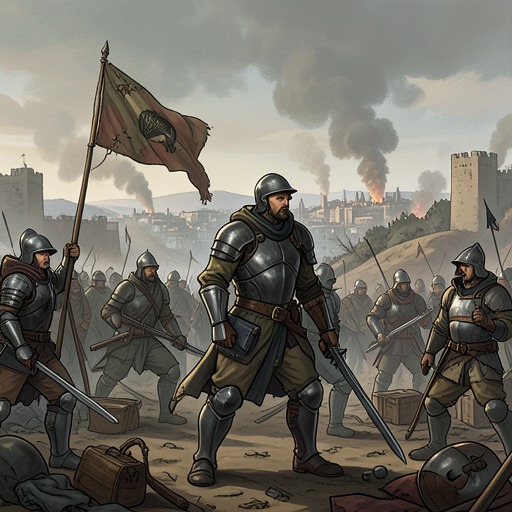
Five days after Roland’s failed counteroffensive, Captain Colette Gemini studies reports by lamplight inside a concrete bunker on the southern front, twelve miles outside Windermere City. She is described as a short-haired blonde with red eyes, and the situation around her is already deteriorating. Selfia’s army is advancing through the marshes with heavy land ships and walkers, while poor logistics, inadequate winter clothing, and deserters have left Roland exposed. The newly unleashed orbital array has further devastated unshielded Roland positions. Colette therefore enters the narrative at a moment when command means holding together a retreating military structure rather than directing an uncomplicated victory.
Her authority extends beyond ordinary infantry. When Jack assesses the force opposing him, he counts eight Awakened and three MECHs before his attention fixes on the blonde woman leading the charge. The machines are especially dangerous because their sealed construction prevents Jack from attacking their operators as easily as he can affect exposed soldiers, while armyrethium-lined blades and heavy weaponry make them anti-demon weapons. Colette’s leadership consequently places her at the center of both the tactical threat and the moral confrontation.
Recognition and Reappearance
Colette’s return matters because Jack already knows her. When Selfia shows him an aerial image of a short-haired blonde woman in red armor, his heart drops and he recognizes her as Colette, Victoria’s former bodyguard. The recognition carries the weight of four years: Jack has not seen her since their last meeting, and the two have not spoken during that interval. The image transforms an approaching military engagement into the return of an unresolved relationship.
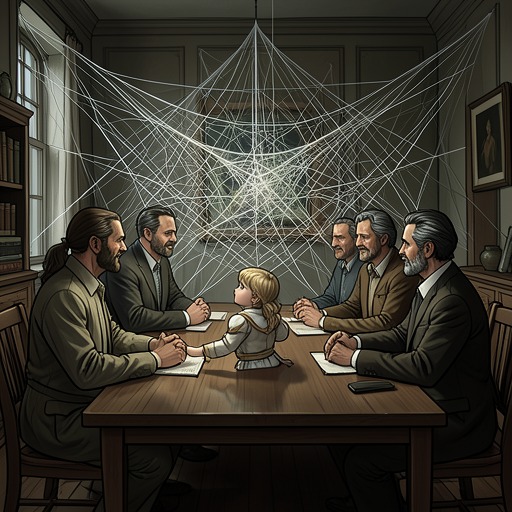
That emotional history is also set against the domestic and dynastic life Jack has acquired elsewhere. The same broader period includes the revelation that Celeste’s birth certificate names Jack and Selfia, and Selfia presents Celeste as the First Princess of Cordelica. In another domestic scene, Celeste addresses Selfia as “Mommy,” while Leona suppresses her own painful reaction. Colette is not directly part of those household moments, but her reappearance reaches into the same web of family, protection, title, and allegiance: Jack is being asked to face someone from an earlier order of his life while acting within the new political and familial order represented by Selfia and Celeste.
The Confrontation at the Front
The battlefield meeting is staged as a literal and emotional threshold. As Jack invokes Sahaqiel and two Anti-Army skills collide, a hurricane forms, tropical-level winds erase Roland cannons, and the storm drowns out the surrounding screams. At its center, Jack and Colette finally stand face-to-face. The supernatural scale of the battle isolates their exchange rather than making it irrelevant; the storm becomes the force surrounding a decision that cannot be settled by force alone.
Jack tells Colette that Roland is a lost cause and urges her to come home. His appeal assumes that their shared history can still outweigh the military structure she serves. Colette rejects that premise. She draws an armyrethium blade and declares that her allegiance belongs to House Light, not to Roland’s shortsighted ruler. So long as House Light requires her, she will remain its stalwart blade, and neither Jack nor anything else will dissuade her from her duty as a knight.
Her answer makes the conflict more precise than a simple battle between opposing armies. Jack speaks from recognition, loss, and the possibility of return; Colette answers through institutionally defined honor. She does not merely deny that Roland is endangered, nor does she claim that victory remains possible. Instead, she accepts the collapse of the wider cause while preserving a narrower obligation to House Light. Her loyalty survives the failure of the state because it has been transferred, or perhaps always belonged, to the house and the knightly identity that stand behind it.
Allegiance, Protection, and Family Structures
Colette’s history as Victoria’s former bodyguard establishes protection as a central feature of her identity. The available scenes do not describe the full nature of her bond with Victoria, but they do define Colette through service: she is a woman who has guarded another and who now describes herself as a house’s blade. Her red armor, armyrethium weapon, and command over a mixed force make that protective role visible as military action rather than abstract sentiment.
The book repeatedly places such protective identities beside unstable parental and dynastic roles. Celeste’s certificate formally links Jack, Selfia, and their daughter; Selfia rehearses Celeste’s lines and receives the child’s address as “Mommy”; later, during a nationwide attack, Jack struggles to get Celeste to school while carrying a crying baby boy. In the household’s next generation, Ito even attributes a dangerous prank to “Daddy.” Against this background, Colette’s self-definition is strikingly non-domestic and explicitly feudal: she does not invoke motherhood, kinship, or personal affection when challenged, but House Light and the duty of a knight. Her chosen language reveals how the narrative distributes care and obligation across family, political marriage, military guardianship, and inherited power.
Narrative Role and Significance
Colette functions as a return from Jack’s suppressed or interrupted past, but the return does not produce reconciliation. In the pattern of a quest narrative, Jack reaches a point where the road back might have included recovering an earlier ally; instead, Colette refuses the offered homecoming. The expected restoration is inverted. Recognition creates intimacy, yet intimacy cannot dissolve the structures that have claimed her loyalty.
Her scene also gives the war a human scale without reducing it to sentiment. The orbital array, the advancing land ships, the MECHs, the Anti-Army storm, and the erased artillery establish forces larger than any individual. Nevertheless, the decisive exchange turns on a woman’s answer to the question of whom she serves. Colette is therefore both an obstacle and a moral counterpoint to Jack: he believes personal history may call her back, while she insists that duty can remain binding even after the cause around it has become a lost cause. Her ending in the supplied material is not a confirmed death or conversion, but a deliberate refusal—she remains House Light’s blade and stands against Jack at the center of the storm.