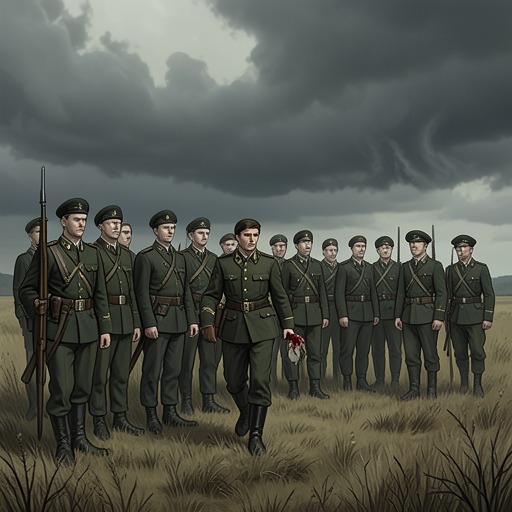
Gamma Squad
Awakening the Angel System: Apocalypse: A LitRPG Progression FantasyGamma Squad is a Selfian tactical team formed around soldiers and operatives whose careers are defined by repeated deployment, sudden reversals, and the lasting consequences of war. The group matters not only because it protects Jack, but because its members carry the continuity of conflicts that otherwise appear as disconnected battles: Gamma Station, the Battle of Frelia, the Roland–Selfian front, and raids against High Table facilities. Their history turns a military unit into a human archive of the wider crisis.
Identity and Formation
Gamma Squad is associated with Checkmate, whose agents receive Special Tactics and Rescue training. When Jack encounters the team again after nearly four years, he learns that almost the entire protection detail assigned to him comes from Gamma, with Elena absent on maternity leave and a replacement drawn from Saber Team. The reunion is therefore both personal and institutional: the soldiers he once knew have been promoted, reassigned, and absorbed into the security structure surrounding him.
Jessica Ashfield embodies that change. Jack recognizes her as the sergeant he had not seen in years, but she corrects the old designation by identifying herself as Lieutenant Jessica Ashfield and announcing that she will command his security detail. Her formal invitation into the waiting black armored vehicle makes the team’s evolution visible: former field operatives now stand between Jack and danger as an organized protective force.
Campaign History
The squad’s members have spent the intervening years moving through the principal theaters of the war. Yun and the others fought from the Battle of Frelia to the Roland versus Selfian front lines, while also raiding High Table facilities. Their accidental encounter with a teenage Jack altered their destinies, linking the unit’s military history to the personal and political transformation that follows him.
Gamma Squad’s service aboard The All Under Heaven further connects it to Selfia’s broader war machine. After the Battle of Frelia and the confrontation with the former Queen’s Flying Fortress, the tactical command airship was scuttled. Since the Battle of Gamma Station, Yun, Elena, Jessica Ashfield, Tyrah, and Jena had served aboard it, placing the squad at the center of operations rather than at the margins of the conflict. Their service included ship-defense duty and DECOM, and Yun recalls an outbreak aboard the vessel as frightening enough to remain vivid years later.
The group’s shared history is not presented as uncomplicated triumph. Yun describes the soldiers as having been lucky to survive Frelia, and her account stops when she notices Jack and Leona’s troubled expressions. The interruption suggests that Gamma Squad’s memories are inseparable from what cannot comfortably be recounted: the scale of the danger, the outbreak, and the losses embedded in the team’s victories.
Combat Culture and Recurring Trauma
When Gamma Squad operates in an apparently deserted corridor, Yun immediately recognizes the pattern as resembling Gamma Station. There should have been another team nearby, yet the communications systems are down, the defenses have been bypassed, and the guards have vanished. Her reaction shows how the organization’s past functions as a tactical instinct: the earlier disaster is not merely remembered but used as a warning against assuming that silence means safety.
The same recurrence gives Gamma Squad a distinctly psychological dimension. Its veterans read present danger through old catastrophe, while Tyrah’s request not to be reminded of Gamma Station confirms that the memory remains painful for more than one member. The team’s competence is therefore built alongside apprehension. Experience makes them alert, but it also makes new failures echo with the force of the old one.
Gamma Squad’s history also intersects with Jack’s survivor’s guilt and moral injury. He remembers former classmates and fallen comrades in a widening catalogue of death, including Ivan Petroff, who had once been a joking, prank-playing classmate kept in check by Mai. Jack’s inability to discuss Ivan easily, and Ada’s discovery that Mai died during a training mission, show how the unit’s personnel are connected to losses that Jack cannot separate from his own past. Gamma is thus not only a team of living fighters; it is also a network through which absent people continue to exert pressure on the survivors.
Relationship to Jack
The squad’s relationship with Jack changes from accidental encounter to protective assignment. Its members first meet him as a teenage boy whose presence redirects their destinies; years later, they return as trained veterans responsible for escorting and guarding him. That reversal places Jack inside the institutional world that once surrounded him from the outside. He is no longer simply someone the team happens to encounter. He is now the protected figure at the center of its mission.
Yet the protection detail cannot erase the team’s shared vulnerability. Jack’s fear of losing those around him includes the possibility of losing Ada, Leona, Kamila, his children, and his home, while his memories also gather the dead and wounded connected to his journey. Gamma Squad’s presence gives that fear a concrete military context: these are the people who have survived the same machinery of war, and their continued survival is never guaranteed.
Jack’s later confession that he feels a weight on his chest whenever he kills or witnesses death places Gamma Squad within the novel’s larger conflict between strength and humanity. He fears that every death removes a piece of his soul and admits that he has killed thousands and begun to resemble his enemies. Against that moral collapse, Gamma’s veterans represent neither untouched innocence nor simple heroism. They are trained, promoted survivors whose service has made them effective while leaving them marked by what they have seen.
Narrative Significance
Gamma Squad gives the military history emotional continuity. Battles that could otherwise function as distant strategic landmarks are refracted through Yun’s memories, Jessica Ashfield’s promotion, Tyrah’s reluctance to revisit Gamma Station, and the team’s return as Jack’s guards. The organization’s identity is therefore defined by movement through war and by the persistence of what war refuses to leave behind.
Its most important contrast is between institutional advancement and personal cost. Jessica Ashfield has risen from sergeant to lieutenant; the team has served on a tactical command airship and taken part in raids across multiple fronts. On the other hand, its members still speak from the position of people who were lucky to survive, who recognize new disasters by the shape of old ones, and who carry the names of the dead into every later assignment. Gamma Squad’s significance lies in that tension: it is a functioning military unit, but also a collective memory of how survival can become another form of exposure to loss.