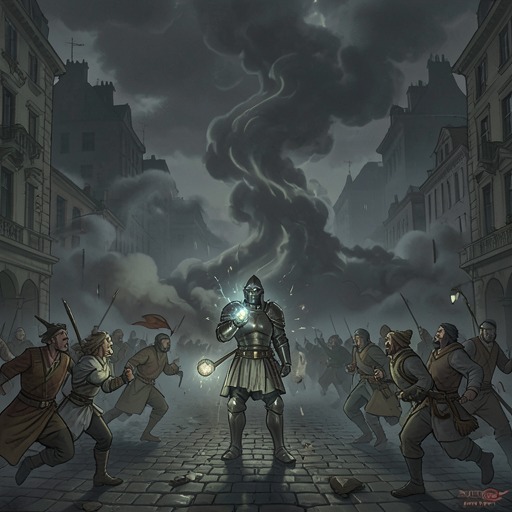
Global Red-Eye Crisis
Awakening the Angel System: Apocalypse: A LitRPG Progression FantasyGlobal Red-Eye Crisis is the state of worldwide biological-looking collapse in which civilians suddenly spasm and die across multiple territories. Its decisive significance lies in the reversal from apparent terrorist or medical emergency to an organized supernatural crisis: the bodies are not merely casualties, but part of a mass exodus of souls that may be feeding the Black King’s power and preparing a catastrophe beyond the scale of ordinary war.
Outbreak and Immediate Setting
Global Red-Eye Crisis begins amid the political and military pressures surrounding the Empire. Selfia is already governing from a palace balcony while the sounds of screaming rise from the capital below, and her first response is anger at an interruption to the war rather than an understanding of what has begun. The disturbance is therefore introduced through the machinery of rule: a monarch confronting disorder in the city while still measuring events against the demands of an ongoing campaign.
The emergency rapidly becomes visible inside Selfia’s sanctum. After Jin and the royal guards report that an attack has occurred, Selfia orders an immediate situation update and activates the network connected to her command center. A dozen floating arms surround her as the room fills with screens showing thousands of camera feeds. The surveillance system turns the crisis into a simultaneous spectacle, allowing her to see that the event is not confined to one street, building, or military target.
The Worldwide Pattern
The surveillance feeds reveal the defining pattern of the crisis. Everywhere Selfia looks, people are spasming, and the same phenomenon appears among citizens of the Empire, in Hoshido village, and across the Corporate Alliance. The geographical spread matters because it defeats any interpretation of the event as an isolated attack on the imperial capital. The crisis crosses political borders and affects populations that otherwise belong to different jurisdictions and systems of power.
The immediate consequence is death on a mass scale. The narrative does not frame the victims as combatants or identify them as participants in the war; people simply convulse and die while the authorities struggle to restore order. Selfia responds by issuing orders, attempting to convert omnipresent visual information into administrative control. Yet the screens also expose the limits of that control: the more completely the government sees the disaster, the less capable it appears of stopping it.
From Biological Attack to Soul Exodus
The first public account gives the crisis a conventional explanation. A news report identifies the incident as a devastating attack attributed by the Selfian administration to the High Table. The Empire’s General Surgeon describes it as biological, while stressing that it is not infectious or transmissible. Civilians are told to shelter in place as officials and security forces attempt to restore order, and Imperial academy students are deployed to assist with security.
This explanation produces an emergency framework built from containment, official messaging, and public obedience. The population is instructed to remain indoors, while the authorities present the event as a dangerous but administratively manageable attack. The insistence that the agent is non-transmissible narrows the medical threat even as the scale of death widens the political one. The crisis becomes a test of whether institutions can preserve order when their own account of the event is incomplete.
Jack senses that the deaths are connected to the Black King, and Sahaqiel confirms that the visible destruction is only the beginning of a larger operation. She describes the phenomenon as a mass exodus of souls and identifies it as a prelude to the gathering of power. Her interpretation changes the meaning of every earlier image: the spasms are not simply symptoms, the deaths are not merely collateral damage, and the spread across territories is not random. If the process continues, the final danger is not only the number of dead but the possibility that no one will remain to care about the dead at all.
Political and Apocalyptic Consequences
The crisis intensifies an already dangerous politics of emergency. Selfia’s administration has previously justified purges by invoking the survival of mankind, killing political opponents, rivals, and dissidents while claiming that such measures are necessary to secure a new order. Jack has rejected that logic, condemning the hundreds of deaths and the inclusion of bystanders and innocents. Global Red-Eye Crisis enters this world where protection and violence are repeatedly made indistinguishable: governments respond to danger by expanding surveillance, militarizing public space, and demanding compliance, while the true source of the threat remains hidden.
The event also exposes the fragility of Jack’s new royal existence. He has moved from a life of public transit to one of security teams, chauffeurs, a child, and political responsibility, yet he experiences an unsettling hollowness after Lilith’s tampering has removed much of his guilt, remorse, and accompanying dread. Against that emotional suppression, the crisis supplies an external horror that cannot be reduced to ordinary political calculation. Jack’s insistence that the Black King is present becomes the point at which personal intuition and Sahaqiel’s supernatural knowledge converge.
The danger ultimately extends beyond the immediate outbreak. Michael reveals that he intends to awaken Adam, the first Awakened and the first hunter, despite Sahaqiel’s warning that Adam would kill the angels, doom the world, and destroy every living being. His claim that he is “fixing” the world converts salvation into another form of extermination. In that wider context, Global Red-Eye Crisis functions as a threshold: a seemingly biological disaster that signals the movement toward soul harvest, the release of Adam, and a world in which conventional political and medical explanations can no longer contain the threat.