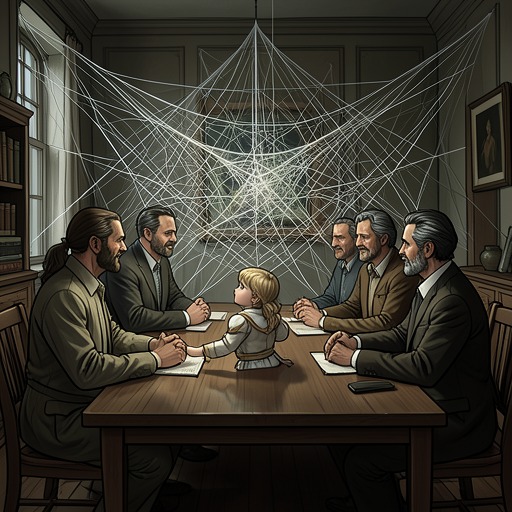
Jack Knight and Colette Gemini
Awakening the Angel System: Apocalypse: A LitRPG Progression FantasyJack Knight and Colette Gemini are connected by former love, coercive magic, parenthood, and an irreconcilable conflict between family and allegiance. Their relationship is most decisive when Jack encounters Colette after four years apart and discovers that the woman commanding a defense line at Windermere is also the absent mother of his daughter. The reunion does not restore their past; it exposes how deeply that past has damaged both of them and ends with Jack forced to defeat Colette while carrying her final request concerning Celeste.
Origin and Fractured Intimacy
The relationship’s history is not presented as an uncomplicated romance. During their confrontation, Colette accuses Jack of twisting her mind, making her fall in love with him, and then leaving her with the consequences. Her anger shows that the bond she once experienced as love has become, in retrospect, a violation of her autonomy. She says that she gave Celeste up so she would not have to be reminded of Jack or of what he had done to her. The child therefore becomes both the material proof of their former intimacy and the emotional reminder Colette has tried to escape.
Their separation lasts four years, a period that includes Celeste’s birth. Jack reacts to the news of Colette’s presence with shock when he sees her image in red armor, immediately looking from the picture of his former companion to their nearly five-year-old daughter. The contrast is stark: Colette has remained a soldier and commander, while Celeste has grown up in Jack’s household under Selfia’s care. The relationship is consequently organized around an absence that is both romantic and maternal.
Parenthood and Competing Mothers
Celeste’s birth certificate names Jack, Selfia, and Celeste, making the document a formal sign of the family structure Selfia has helped establish. Selfia presents Celeste as the First Princess of House Cordelica, while the certificate gives Jack’s daughter a new political and personal trajectory. Colette’s biological motherhood remains central to the relationship, but it has not translated into daily care. In one domestic scene, Celeste addresses Selfia as “Mommy,” a moment that visibly wounds Leona and also clarifies the role Selfia occupies in the child’s lived world.
Jack’s appeal to Colette is therefore not merely an attempt to revive an old romance. He tells her that Celeste is being educated to become something other than a soldier or killer, and he asks Colette to take part in their daughter’s future. His offer recognizes that Celeste deserves a living mother rather than a mother imprisoned, hunted, or dead on a battlefield. Colette, however, understands motherhood through the demands of House Light and believes that abandoning its people would expose her adopted family to assassination, punishment, and pursuit by House Bell. Her attachment to the house is described as the source of her home and purpose: it adopted her when she considered herself worthless and gave her a life. The exchange places biological kinship, adoptive kinship, political duty, and actual child-rearing into direct competition.
The Windermere Confrontation
Jack and Colette meet face-to-face in the center of a hurricane created when two Anti-Army skills react to Jack’s command. The storm erases the surrounding military noise and makes their encounter feel like a private reckoning enclosed within a public battle. Jack tells Colette that Roland is lost and urges her to come home. Colette rejects the premise, insisting that her allegiance belongs to House Light rather than to the ruler Jack wants defeated. She draws an armyrethium blade and presents herself as a knight whose duty cannot be displaced by personal history.
Colette’s resistance is formidable even inside a mana-dampening field. She manifests a whip of lightning, but Ruby intervenes with a black chain, allowing Jack to catch Colette’s blade. Jack tries to guide her into releasing the weapon and assures her that he is present now, adding that Celeste is waiting for her. The assurance is met not with relief but with panic and rage. Colette says that Jack cannot return to her life after so many years, that she had forgotten him and left him behind. Her language turns reunion into an intrusion: Jack’s attempt to reclaim family becomes, from her perspective, the reopening of a wound she deliberately sealed.
The battle’s immediate value shift is from possible reconciliation to renewed estrangement. Jack begins by offering return, shared parenthood, and a future for Celeste. Colette answers with the survival of House Light, declaring that even surrender would not save its members from the Bell family. Jack counters that Celeste is her family too, but Colette refuses to let that claim outweigh the people who adopted and protected her. Her statement that she will cut through every obstacle, including Jack, makes their personal conflict inseparable from the larger war.
Sacrifice and the Unfinished Bond
At the moment when Colette accepts that she will not abandon House Light, her defiance breaks into a contradictory farewell. She raises her sword with sparks radiating from her body, puts on a false smile while tears run down her face, and asks Jack to protect her baby. The request does not reconcile them, but it acknowledges Celeste as their shared responsibility and entrusts Jack with the future Colette cannot enter herself.
Jack responds by using wind to wrap around Colette’s head and deprive her of breath. He says goodnight and asks forgiveness for what he is about to do. The killing is thus framed neither as triumph nor as simple punishment. It is an act performed against a former lover, a child’s absent mother, and a knight who has chosen an adopted family and military duty over survival with Jack. Colette’s final request preserves a thread between them even as Jack’s action severs their physical relationship.
The broader narrative repeatedly places parenthood under pressure from war and militarization. Jack is shown struggling to care for Celeste and a crying baby during a nationwide attack, carrying the child while trying to get the household ready for school. Later, even domestic family life remains connected to Jack’s authority: Ito attributes a smoke-bomb prank to “Daddy said,” drawing an uncomfortable silence from the adults. Against this background, Colette’s request that Jack protect Celeste is not an isolated sentimental gesture; it belongs to a recurring pattern in which children inherit the consequences of adult violence while adults attempt, imperfectly, to define what protection means.
Narrative Significance
Jack and Colette’s relationship combines a love plot with a rescue attempt that cannot succeed. Jack seeks to rescue Colette from House Light and restore her to their daughter, but Colette experiences that appeal as another attempt by Jack to dictate the meaning of their past. The resulting conflict resists a simple division between a loving parent and a cruel deserter. Jack’s concern for Celeste is genuine, yet Colette’s accusation establishes that their original bond was shaped by mind manipulation; Colette’s abandonment harms Celeste, yet her loyalty to House Light arises from gratitude, belonging, and fear for an adopted family that she regards as her own.
Their encounter therefore marks a tragic integration of opposing truths rather than a clean reconciliation. Colette is simultaneously Celeste’s mother, Jack’s former lover, Jack’s accuser, a knight of House Light, and an enemy commander. Jack is simultaneously the person offering her a homecoming and the person who kills her. The relationship’s decisive image is not their first embrace but their face-to-face meeting inside the storm: two people whose shared child makes separation impossible in principle, while history, coercion, and allegiance make reunion impossible in practice.