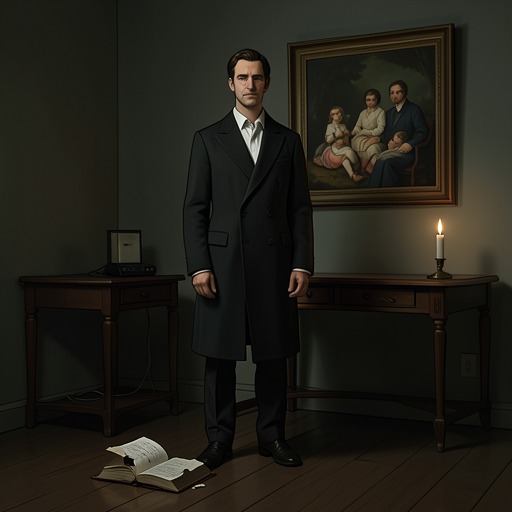
Jack Knight and Ivan Petroff
Awakening the Angel System: Apocalypse: A LitRPG Progression FantasyJack Knight and Ivan Petroff are former classmates whose relationship becomes one of the story’s clearest studies in how war converts familiarity into vengeance without erasing recognition. Jack remembers Ivan as a decent prankster, while Ivan’s grief and infiltration work turn him into a ruthless gunslinger whom Jack can neither wholly condemn nor safely forgive. Their encounters repeatedly force the same question into a harsher form: when a familiar person becomes an enemy, does memory preserve a bond, or merely sharpen the wound?
Shared Past and the Making of an Enemy
Jack’s account of Ivan begins before their later confrontation. Ivan had been a former classmate, known for jokes and practical pranks that sometimes brought him into trouble with Sergeant Dave and the other teachers. Mai helped restrain him, and her presence links Ivan’s earlier identity to the decisive loss that followed. When Mai died during a training mission, Ivan changed. Jack describes the change not as a gradual moral decline but as the extinguishing of whatever light remained in Ivan’s eyes: Ivan began hunting Theocracy soldiers without restraint and became ruthless.
The past is not presented as sentimental proof of Ivan’s innocence. Jack explicitly separates the classmate he knew from the man standing before him, telling Ada that Ivan is no longer the person he once knew. Yet Jack also refuses the simpler judgment that Ivan’s brutality is incomprehensible. He cannot blame Ivan entirely for what he became because the war had taken Mai and had made children into killers. The Theocracy’s violence created the conditions for Ivan’s hatred, but Jack insists that Ivan still made a choice. That distinction becomes the moral structure of their relationship: Ivan is both shaped by violence and responsible for passing it onward.
Recognition, Surveillance, and Hidden Allegiance
Ivan’s place in the political network around Jack is deliberately obscured before it is disclosed. A strategic file identifies an unknown Black King or Smiling Man, while other figures are assigned symbolic positions, including Hugo Fitz as the Green Bishop and Roland Cordelica as the White Knight. Against this backdrop of coded actors and concealed loyalties, Ivan’s apparent role cannot be read only from his battlefield behavior.
Selfia later reveals that Ivan is an embedded agent involved in a deep infiltration. She says that she did not know Jack had survived, nor did she know the relevant details until later; in her account, Jack and Ivan were never supposed to meet again. This disclosure reclassifies Ivan’s presence. He is not merely a former classmate who crossed into enemy service, but an operative positioned inside a larger covert struggle. The revelation does not absolve him or undo the harm he has caused. Instead, it adds another layer of danger to their relationship: Jack is confronting both a personal betrayer and a concealed political instrument.
The wider crisis confirms that Ivan’s activities are connected to the disappearance of people on multiple sides. Reports describe personnel being taken, while Lita’s resistance forces encounter a black MECHFrame and discover that people have vanished from their own ranks as well. The intelligence trail points toward a facility where Jack’s sister may be held. Although the evidence does not assign every disappearance directly to Ivan, it places his relationship with Jack inside a world where abduction, infiltration, and hidden command structures make personal identity inseparable from military operations.
Encounters as Repeated Value Reversals
Their first decisive reunion is triggered by sound. During a battle marked by explosions, screams, gunfire, and violin strings, Jack recognizes the roar of familiar revolvers and immediately identifies the shooter as Ivan. Recognition turns into action: Jack orders the others to stay behind, summons large electrified silver wings, and moves toward the unfinished battle. The old classmate is not approached as a lost friend but as the source of a threat to Jack’s loved ones.
When Jack finally confronts Ivan, Selfia pleads for the gunslinger to remain alive because he may be useful against the High Table. Sahaqiel likewise argues that Ivan should be spared, at least temporarily, if he can help the fight. Lilith urges the opposite impulse, whispering that Ivan deserves death. The scene stages Jack between competing claims: strategic necessity, another person’s appeal for mercy, and the private demand for vengeance. The decision appears to move toward restraint when Jack says Ivan is lucky not to be his to kill. The value shift is immediately reversed. Jack spares Ivan’s life but rips off his arm, making survival itself a mutilated form of punishment.
That act defines the relationship more precisely than either reconciliation or execution would have done. Jack refuses to grant Ivan the clean finality of death, yet he also refuses to treat continued life as mercy. Selfia and Jin are horrified and try to save Ivan, but Ruby blocks their path, while Violet lands before her sister. The physical arrangement turns the former classmates’ conflict into a networked confrontation among allies, protectors, and witnesses. Ivan’s body becomes the site where Jack’s unresolved memory is converted into visible violence.
Tactical Cooperation Without Reconciliation
Ivan later appears capable of cooperation even while remaining dangerous. In an encounter with Purple Pawn, he teleports and fires his revolvers from different angles, but the Pawn mocks the weapons as inadequate and catches his wrist during the attack. Ivan’s response reveals a tactical objective rather than a straightforward attempt to win: he admits that his plan is to stall her, not kill her. Tenno then enters the opening and drives Purple Pawn into the tunnel wall.
This exchange complicates Ivan’s image as an isolated avenger. His gunplay serves a coordinated operation, and his willingness to absorb ridicule and risk allows another fighter to land the decisive blow. Yet the scene does not restore trust between Ivan and Jack. Cooperation exists at the level of immediate military necessity, while the older emotional conflict remains unresolved. Ivan can be useful to the same coalition that Jack serves without becoming safe, forgiven, or familiar again.
The Relationship’s Larger Meaning
The contrast between Jack and Ivan lies less in whether either man has suffered than in how each converts suffering into action. Ivan responds to Mai’s death by hunting Theocracy soldiers indiscriminately; Jack recognizes the logic of that transformation because he has also seen children made into killers, but he answers Ivan’s violence with a chosen act of his own. Jack’s declaration that he must take from Ivan because Ivan took from them makes revenge reciprocal rather than heroic. Each man becomes both victim and agent within the same machinery of loss.
Their relationship also mirrors the changing political order. Early scenes place individuals inside hidden structures of coded kings, bishops, knights, resistance forces, and disappearing soldiers. Later, Selfia relocates her operations after Lunacrypt Capital becomes a ruin filled with dead bodies, demonspawn, and abandoned debris. The displacement of millions forces surviving authorities into improvised arrangements, while the emerging Coalition to Free Earth gathers the remaining armies of the world. In that environment, Ivan’s value is measured alongside everyone else’s by whether he can contribute to survival. The former classmates’ bond is therefore never purely private: it is repeatedly reprocessed by intelligence, monarchy, resistance, and coalition warfare.
The relationship ends in suspension rather than healing. Ivan remains alive after Jack’s attack, but survival is accompanied by permanent evidence of their rupture. Jack does not recover the joking classmate remembered from school, and the evidence does not show Ivan receiving forgiveness or abandoning his covert role. What remains is an uneasy configuration of recognition, injury, and conditional usefulness. Jack Knight and Ivan Petroff matter as a pair because neither can reduce the other to a single category: friend, enemy, victim, traitor, or weapon. Their history survives precisely as a contradiction, and every later encounter makes that contradiction more violent.