Jack–Sahaqiel relationship
Awakening the Angel System: Apocalypse: A LitRPG Progression FantasyThe Jack–Sahaqiel relationship joins spiritual symbiosis to romantic attachment and moral conflict. Sahaqiel knows Jack’s soul and desires, loves the man he has been since adolescence, and repeatedly tries to preserve the peaceful protector hidden beneath his violence. Jack, in turn, experiences their bond as both refuge and exposure: it gives him an ally who understands him beyond ordinary speech, but also entangles him with secrets, manipulation, and the deaths he cannot forgive.
Bond and Recognition
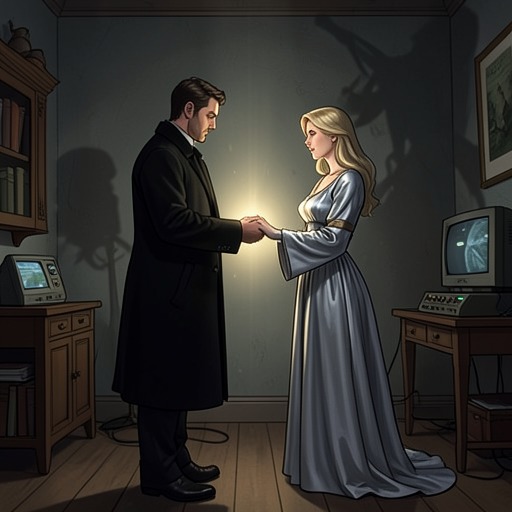
Sahaqiel’s connection to Jack is established as more than companionship. When she finds him amid the rubble of the place he once called home, she reaches toward the man she has known since he was a teenager, the man who understands her soul and desires. Her gesture is intimate, but Jack has become unreachable. She finds no warmth in him, only venom, hatred, and a void where joy had been. The contrast defines the relationship’s crisis: Sahaqiel still recognizes the person she loves, while Jack’s suffering has made recognition itself painful.
Their bond also carries the memory of a former life shaped by violence and loss. Jack speaks of Ivan Petroff as a former classmate, a decent prankster who was sometimes restrained by Sergeant Dave and by Mai, and Ada’s mention of Mai’s death during a training mission forces open a buried part of his history. Jack’s reluctance to explain who Ivan was, followed by his startled question about how Ada knows about Mai, shows how much of his past remains protected by silence. Sahaqiel’s intimacy with him therefore exists against a background of memories that cannot remain harmlessly sealed away.
Shared Burden and Emotional Rupture
War changes the way Jack inhabits the relationship. He admits that every killing and every death places a weight on his chest, as if a small piece of his soul were being carved away. The image of the wilted Nest and the remembered voices of millions intensify that burden, while the deaths connected to Selfia’s order make Jack fear that Ada and everyone else he loves could suffer the same fate. Sahaqiel understands that Lilith’s blunt demand for endurance is correct, yet Jack’s agreement does not relieve the terror; knowing what survival requires only makes the cost more visible.
The relationship breaks most sharply when Jack confronts Sahaqiel in the nursery. With Lilith boxing him in, he accuses Sahaqiel of abandoning him, concealing that she had a body, and allowing Selfia to cover up the truth. He also holds her responsible for using his hand to kill Jill and fears that his children, Celeste and Ito, will be hunted once they Awaken. Sahaqiel answers that she has always done what she believed was best for him, but Jack measures good intentions against the accumulating list of the dead: Eleanor, Mike, Mai, Fujimaru, Itadori, Hoffman, Yun, Tyrah, Jena, and Jill. His fear of losing Sahaqiel, Ada, Leona, Kamila, his children, and his home becomes inseparable from his hatred of what he has become.
Sahaqiel’s response is not another argument. She promises that Jack has not lost everything and will not lose everything, then turns to Lilith and gives the signal for the next step. Lilith produces a small sphere flickering with green and red, whose mere sight sends pain through Jack. Sahaqiel explains that she had to leave in order to give Lilith time to secure it and place it safely in a coma. The revelation reframes her absence as an act of protection without erasing the deception that made Jack feel abandoned. Love remains present, but it can no longer restore innocence.
Forgiveness Without Forgetting
Jack eventually states the precise terms on which the relationship can continue. He forgives Sahaqiel, but refuses to forget what she and Selfia did. Even with Jill’s soul living within him, he will never forget the sensation of his own hand piercing Jill’s heart or the trauma to which Sahaqiel contributed. He then turns away and flies off with his silver wings, leaving a sonic boom behind him. Forgiveness here is not reconciliation by erasure; it is an admission that attachment and accusation can coexist.
The later meeting reveals that the separation has not destroyed their physical and emotional need for one another. When Jack embraces Sahaqiel, she is initially shocked and then holds him tightly, refusing to release him even when he tries to pull away. Her body longs to remain within the touch and scent of the embrace forever, while Jack insists that he has things to do. The scene preserves the relationship’s asymmetry: Sahaqiel seeks duration and closeness, whereas Jack accepts the tenderness but remains driven by unfinished obligations. The embrace is therefore neither a return to the past nor a clean break, but a brief embodied truce.
Betrayal, Sacrifice, and Fusion
Sahaqiel’s bond with Jack is placed under its greatest strain when Azrael appears transformed. He steps from darkness with six black wings, matching armor, and a barbed trident radiating power. Sahaqiel recognizes the angel once known as Azrael, but the familiar smirk and bright blue eyes are gone; the figure before her radiates vile power rather than the comfort of the ally she remembered. This encounter echoes her relationship with Jack, because recognition persists even when the beloved or trusted being has become frighteningly altered.
At the decisive confrontation, Jack calls Sahaqiel to him while blood pours from his mouth and Adam and the Black King are held back. She obeys by racing toward him with a bronze lightning bolt and impaling him through the chest and into the Infinity Machine. Mi’shka Domino and Selfia witness what appears to be Sahaqiel killing Jack, while Ada cries out and attacks her. The act is the most violent expression of their bond: Sahaqiel can become Jack’s apparent murderer because Jack commands her to perform the act, and because their connection permits an action that would otherwise signify only betrayal.
The apparent death becomes another transformation rather than an ending. Jack rises with lightning coursing around his glowing body and runic tattoos covering him from head to toe. When he declares that the new state feels better, Sahaqiel manifests her spiritual form and embraces him from behind. They merge again, recalling their first meeting, but the nature of the union has changed: this time it is the conjoining of an archangel and an angel, placing them beyond the false Awakened and ordinary humans. Their relationship thus reaches its fullest literal form as a shared body and power, even though that transcendence is achieved through violence, sacrifice, and the risk of Jack’s death.
Narrative Significance
The Jack–Sahaqiel relationship gives the larger conflict an intimate measure. Jack’s fear is not merely fear of military defeat; it is the terror that every attachment will become another name in the catalogue of the dead. Sahaqiel’s love cannot prevent that history, and her concealment of the truth helps produce the very mistrust she later tries to repair. Yet she remains the person who can find Jack in his hatred, promise that he has not lost everything, accept his anger, embrace him after separation, and answer his final summons.
The relationship also rejects a simple opposition between love and harm. Sahaqiel loves Jack while contributing to his trauma; Jack forgives her while retaining the memory of Jill’s death; she kills him while acting at his command; and their reunion depends on a fusion that surpasses their earlier bond. Their intimacy is therefore both restorative and dangerous. It carries affection through bodies, souls, memories, and power, but every form of closeness also exposes the injuries that power has inflicted. By the end, Jack and Sahaqiel are not returned to an untouched romance. They become partners in a transformed existence, joined by love that has survived betrayal without pretending betrayal never occurred.