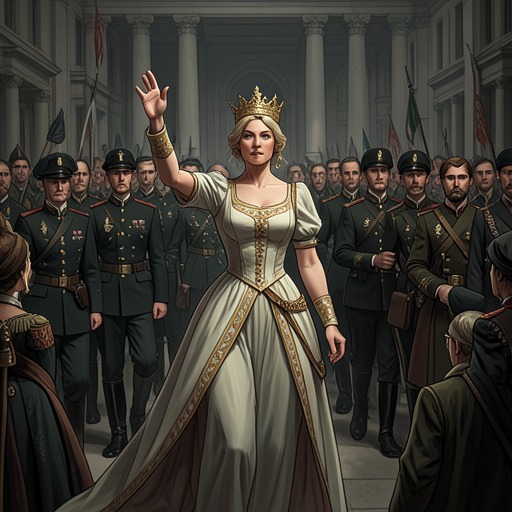
Jack–Selfia relationship
Awakening the Angel System: Apocalypse: A LitRPG Progression FantasyJack–Selfia relationship begins as a marriage that joins personal commitment to the machinery of kingship. Two weeks after marrying Selfia and being crowned king, Jack is confined to his luxurious room, unable to leave and permitted only tightly controlled visitors, including Ada, Kamila, and scheduled time with Leona and Celeste. The marriage therefore places him inside the royal household while also exposing how completely the monarchy can regulate his body, movements, and access to others. Selfia is not merely Jack’s wife: she is the queen whose political authority helps define the limits of his new life.
Marriage Under Royal Control
Jack’s early royal existence is marked by the contradiction at the center of the relationship. He has gained a crown, but not freedom. From his balcony he can observe a city full of life while remaining effectively imprisoned inside the palace. The marriage and coronation have elevated him publicly while isolating him privately, making Selfia’s court both his political home and the institution responsible for his confinement. The relationship consequently carries an implicit power imbalance: Jack is king in title, yet his daily movements are controlled by royal security and protocol.
That controlled public role later expands into an exhausting schedule of appearances. Jack travels in a specially engineered armored limousine while an Intellipad lists the day’s obligations: Selfia is to announce the opening of the First Public Academy, Celeste is to be publicly revealed, and the royal party is to attend a museum opening, meet investors, support local businesses, and visit El Negro Gato. The itinerary culminates in the announcement of the heir to the throne. The marriage thus functions as a public instrument of legitimacy, family presentation, and political continuity, even as Jack’s personal life is organized like an official program rather than a private partnership.
Alliance, Secrecy, and Family Stakes
The relationship is defined most sharply by what Selfia and Jack do not tell one another. When Jack reaches the Citadel, Selfia appears beside a golden throne in armor, accompanied by Sahaqiel, Jin, and blue-armored commandos. She explains that she has come to check on him after six months of silence, joking that a married woman becomes lonely when her husband neither calls nor writes. Beneath the complaint lies the extent of their estrangement: Jack has withdrawn from ordinary marital communication, while Selfia continues to approach him through a mixture of familiarity, political authority, and strategic calculation.
Selfia then reveals the practical core of her visit. She knows Jack intends to confront her father, but asks him to leave her mother alive because the woman possesses Imperial secrets, lost arts, and techniques. Selfia’s appeal is not only emotional. She treats her mother as a repository of knowledge whose survival may have value for the political struggle. Her request turns the marriage into a negotiation between Jack’s campaign and Selfia’s dynastic obligations: he seeks to destroy the power threatening his family, while she attempts to preserve an asset tied to her own house.
The deepest breach concerns Jill. Selfia had known, or strongly suspected, where Jack’s sister was after the Khloros began attacking her troops. The suspicion became nearly certain when Lydia died obtaining intelligence. Selfia consulted Sahaqiel upon entering the palace, and the two devised a plan that resulted in Jack’s house arrest. Jack consequently discovers that his journey to the Theocracy was, from his perspective, built on manipulated information. He concludes that the entire expedition was wasted and that Selfia also lied about Lydia’s whereabouts. The marriage’s political alliance is therefore sustained through concealment, with Selfia believing that withholding the truth is necessary to protect the larger plan.
Selfia later states the logic of that concealment without softening it: she wanted to kill Jill before Jack could meet her, because she believed Jack could never do what had to be done when family was involved and wanted to spare them the suffering. Her decision transforms secrecy into a form of ruthless, pre-emptive protection. Selfia is not simply betraying Jack; she is claiming that betrayal is an act of mercy, undertaken because she understands his attachment better than he can act upon it. The claim also exposes the fatal contradiction in their alliance: Selfia says she is protecting Jack from an unbearable choice while simultaneously removing his right to make it.
Estrangement and Confrontation
By the time Sahaqiel finds Jack during the attack on the city, the distance between Jack and Selfia has become part of a wider emotional collapse. Sahaqiel sees a man consumed by venom and hatred, no longer resembling the tormented person who wanted peace and wished to protect his family. Jack’s altered state is not presented as a simple marital quarrel, but Selfia’s absence and secrecy form part of the family structure he has abandoned. He has already missed the births of his daughter and son, and his campaign has displaced the domestic future that the marriage was meant to establish.
Jack nevertheless frames his violence as a responsibility to that family. Pointing toward Cordell Plaza, the headquarters of Cordell Engineering and a supplier of parts for High Table projects, he argues that Ada, Celeste, and Ito will have no life unless he does what must be done. The building is also connected to the machinery that created the monster Jill became. His reasoning turns the marriage into a paradox: he is absent from his wife and children in order to secure their future, while the methods used to secure that future make reunion increasingly difficult. Selfia’s political secrecy and Jack’s militant absence are opposing strategies of protection that produce the same emotional result—separation.
When Selfia later confronts him, Jack does not respond as a husband returning to an estranged spouse. He faces her as a potential enemy and demands to know why she is present. Selfia acknowledges that they have not agreed on much and that she understands what he thinks of her and of the institutions she represents. Before it is too late, she tells him that she is sorry. The apology is intimate in its phrasing but powerless in context: Jack’s answer indicates that words alone cannot repair the accumulated consequences of confinement, deception, and the handling of Jill’s fate.
The encounter becomes an explicit test of survival. Jack tells Selfia that he is satisfied, then warns her that a different response would have resulted in her death on the spot. His statement converts the political alliance into a conditional truce. Selfia remains alive not because the underlying conflict has been resolved, but because Jack has judged her answer sufficient for the moment. Their marriage therefore reaches its most extreme point as a relationship in which forgiveness and execution stand immediately beside each other.
Competing Visions of Duty
Jack and Selfia share a language of necessity, but they assign necessity to different objects. Selfia prioritizes the survival of her mother as a source of Imperial knowledge, the prevention of Jack’s encounter with Jill, and the preservation of a strategic plan. Jack prioritizes the destruction of Michael’s remaining infrastructure and the future of his children. Both present themselves as acting for others rather than for personal desire, yet their decisions repeatedly deny the other’s agency. Selfia confines and deceives Jack to prevent a family catastrophe; Jack abandons communication and approaches Selfia as someone who may need to be killed.
Their conflict also extends into the war’s public theater. After the Citadel falls, Selfia uses the megaphone of her MECHFrame to command all forces to charge, declaring that the fate of humanity has been decided and that the war is nearly won. Jack hears her call while survivors rush past him, and Sahaqiel urges him forward because the soldiers depend on them. Selfia’s voice here is no longer the voice of a wife seeking private reconciliation. It is the voice of a queen mobilizing a broken army, turning the personal crisis surrounding her marriage into a collective demand for one final effort.
The relationship is consequently neither a conventional romance nor a stable royal partnership. Its marriage supplies a public alliance, but the plot repeatedly tests whether that alliance can survive incompatible definitions of protection. Jack’s family-centered violence and Selfia’s dynastic pragmatism are not opposites in their willingness to sacrifice; they differ in whom they sacrifice, what knowledge they preserve, and who is allowed to decide.
Later Echoes and Narrative Significance
After the catastrophic struggles, Selfia’s perspective remains linked to recognition, survival, and the reconstruction of identity. She sees a white-haired officer reunite tearfully with Eleanor, then recognizes Ruby alive among the officers and finally identifies Python. These recognitions place Selfia within a world where people thought lost can reappear, while the marriage with Jack remains marked by damage that cannot be repaired simply through survival. Her attention to returning faces contrasts with the unresolved question of whether Jack and Selfia can recover the relationship that existed before secrecy and war consumed it.
Jack–Selfia relationship is significant because it makes political power visible through intimate life. The marriage grants Jack a crown, a family position, and a place at the center of public ritual, but it also subjects him to surveillance, restricted movement, scheduled appearances, and the demands of dynastic continuity. Selfia embodies the monarchy’s capacity to care through control: she seeks to protect Jack and the wider cause, yet her protection takes the form of confinement, secrecy, and contemplated murder. Jack’s response is the mirror image of that logic. He pursues freedom and safety for his family through escalating violence, until the husband who once belonged within the royal household can look at the queen and make her continued life conditional on a single answer.