Khloros Project
Awakening the Angel System: Apocalypse: A LitRPG Progression FantasyKhloros Project is a clandestine weapons program represented most visibly by Khloros, also called the WolfFrame: a black, wolf-featured MECHFrame with a tail, autonomous armor, and a reputation for slaughtering trained soldiers. The project’s significance lies not only in the machine’s battlefield power but in the way it turns technology into an embodied horror. Its presence links political secrecy, military experimentation, personal trauma, and the increasingly unstable boundary between organic life and engineered war machines.
Definition and Known Form
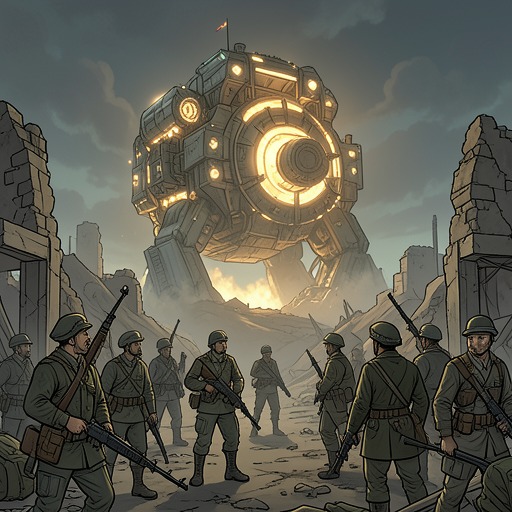
Khloros Project is never presented as an ordinary procurement program. Its known product is a black MECHFrame with wolfish features, a tail, and autonomous armor. Selfia identifies the machine from a file containing a stapled image and asks Jack whether he remembers it; Jack confirms that the machine attacked him during their reunion, recalling its howl and the aura surrounding it. The image, the manila folder, and the act of asking for recognition establish Khloros as an object of investigation as well as a battlefield weapon.
The machine’s appearance is deliberately hybrid. It retains the recognizable framework of military equipment, yet its wolf-like silhouette, howl, and apparent fusion of metal with flesh make it resemble an animal, a cyborg, and a constructed monster at once. Jack later remembers it as “a sickening twist of metal and flesh,” a description that places Khloros beyond the clean distinction between weapon and organism. The project therefore embodies a posthuman military logic in which autonomy and biological imitation increase lethality while also producing revulsion.
Military Record and Trauma
Khloros is associated with mass violence rather than an isolated malfunction. Jessica Ashfield explains that Tangerine has sat alone since losing his entire squadron against the WolfFrame. When Jack asks what WolfFrame means, Jessica identifies it as Khloros, and Jack immediately recalls the machine’s disturbing mixture of metal and flesh. The project’s history is thus carried through the survivor’s behavior: Tangerine’s isolation is not an abstract consequence of war but the visible remainder of a unit destroyed by this particular weapon.
That history becomes physically and psychologically present when Tangerine encounters Khloros again. A wolf-like MECHFrame soars through the air while his sensors struggle to lock onto it. He does not need his system to register the machine as a Named entity; he recognizes the same machine that slaughtered his companions and shouts its name as his heart rate spikes and red warning lights flash across the cockpit. Khloros’s return collapses the distance between military detection and traumatic recognition. The machine is not merely identified by instruments; it is recognized by memory before technology can finish measuring it.
Khloros also enters the story through the violence surrounding Jack. During an attack, Ada’s enchanted nodachi protects her from an assailant’s surprise gunfire while the firearm continues to roar. Elsewhere, Jack’s enormous scar runs from his chest to his back, an unusual mark for an Awakened because of their healing factor, and the scar remains a reminder of his defeat. Although these scenes do not establish every detail of the project’s operation, they place Khloros within a wider military world where enchanted weapons, MECHFrames, exceptional bodies, and permanent injury coexist. The project’s threat is measured both by the squadron it destroys and by the rare wounds it leaves behind.
Secrecy, Files, and Preparation
The investigation of Khloros is conducted through controlled information. Selfia’s folder is made of paper rather than a tablet, and Jack immediately recognizes the security value of that choice: tablets can be hacked and Intellipads compromised, whereas paper remains secure if kept away from prying eyes. The Khloros file consequently belongs to a broader system of secrecy in which the medium of information matters. The machine is dangerous, but so is the record that explains or tracks it.
Jack responds to the disclosure by requesting a report on Tangerine’s augments, training, and the Damocles. This request widens Khloros Project from a single machine into a network of military preparation involving altered bodies, specialized instruction, and related strategic assets. The project’s surrounding bureaucracy is therefore as important as its battlefield form: Khloros is produced, remembered, classified, and investigated through institutions that regulate both bodies and knowledge.
The project is also shown in a preparatory phase. A chapter heading marks “Phase 1,” followed by the Black King’s instruction that the Khloros should be prepared while the first phase begins. The wording about a “little bird” finding its mate suggests that the weapon’s activation is coordinated with another relationship or development, although the available evidence does not disclose the full plan. What is clear is that Khloros is not simply wandering through the plot as a detached monster. Someone is monitoring circumstances, timing its preparation, and treating its deployment as part of a staged operation.
The Machine as Political and Psychological Threat
Khloros Project develops its force through controlled visibility. Jack, newly crowned after marrying Selfia, is confined to a luxurious room and permitted only limited visits, while official activity is managed through folders, Intellipads, security teams, armored transport, and scheduled public appearances. In this environment, Khloros functions as the concealed counterpart to royal spectacle. The king is displayed, protected, and instructed; the weapon is hidden, documented, and released when its handlers decide that the conditions are right.
The contrast is especially sharp because Jack’s public life is organized around impact. He observes the city from a balcony, reflects on his confinement, and later embraces the idea that the larger the splash he makes, the farther the ripples will travel. Khloros is another kind of ripple-maker: instead of speeches, ceremonies, or public appearances, it produces shock through sudden violence. Its wolf-like form turns military power into an image that cannot be contained by official language. Even when authorities call it a Khloros or a WolfFrame, the survivors perceive the howl, the slaughter, and the fused body beneath the designation.
Khloros also mirrors the story’s anxiety about agency. Its autonomous armor suggests a weapon able to act beyond a human pilot’s immediate control, while its animal styling gives that autonomy a predatory shape. Yet the Phase 1 scene shows that autonomy does not eliminate human responsibility: the Black King orders its preparation. The project therefore holds two forms of power together. The machine appears as an independent hunter, but its existence depends on planners, records, military training, and a concealed command structure.
Narrative Role and Significance
Within the narrative, Khloros Project is a recurring threat whose identity is disclosed gradually through files, scars, survivor testimony, remembered violence, and renewed contact. The sequence moves from uncertain recognition to confirmed naming and finally to direct confrontation. Selfia’s image and question make Khloros an object of inquiry; Jessica’s report connects it to Tangerine’s lost squadron; Jack’s memory supplies the grotesque material image; the Black King’s order reveals deliberate preparation; and Tangerine’s cry confirms that the machine has returned as the same personal nightmare.
The project’s deepest significance comes from its refusal to remain only a piece of hardware. Khloros is an instrument of military power, a source of trauma, a classified object, and a visual emblem of technological dehumanization. Its metal-and-flesh construction literalizes a world in which bodies can be augmented, scarred, trained, imprisoned, or converted into weapons. The WolfFrame’s animal form intensifies that unease rather than resolving it: the machine is neither truly beast nor purely machine, and its uncertain status makes the violence it represents feel both engineered and instinctive.
Khloros Project consequently marks the point where institutional secrecy and bodily horror meet. It transforms hidden files into battlefield memory, battlefield memory into renewed panic, and a military designation into an almost mythic predator. The available evidence leaves the project’s full origins and ultimate purpose undisclosed, but it establishes its essential function in the story: Khloros is the engineered shadow cast by a society that treats autonomy, augmentation, and lethal force as instruments of power.