Lost Lands
Awakening the Angel System: Apocalypse: A LitRPG Progression FantasyLost Lands, formerly called Africa, is a continent transformed from the cradle of humanity into a poisoned frontier. It is the destination of the Solomon expeditions, a region overrun by demonspawn and concealed beneath seemingly endless corruptive smog, and later the site of catastrophic battles, the emergence of Heaven, and a difficult civic rebirth. Its history compresses the book’s largest contradiction: the same land treated as an object of military-industrial exploration becomes the place where the consequences of that exploitation are most visibly left behind.
Definition and Historical Role
Lost Lands is presented as a vast continent once known to the world as Africa. The Solomon expeditions were organized as Imperial-led coalitions joining corporations, military industrialists, and nations in an effort to navigate and scout the territory. Their repeated expeditions were not merely geographical ventures. The records Jack discovers indicate that the Black King was searching for something buried beneath the continent, described as lying beneath humanity’s cradle, and that every expedition had been undertaken according to his orders.
The continent therefore functions as both a physical unknown and a concealed center of power. Information about it is scarce, while the expeditions’ institutional scale suggests that the Empire, the corporate powers, and allied nations possessed far more knowledge than ordinary people. Jack’s discovery of the Project Solomon directory reveals that the exploration program was connected to a larger political arrangement: the Theocracy, the Corporate Alliance, and the Empire were all secretly subject to an Archangel’s control. Lost Lands is consequently not an isolated wilderness but the hidden ground beneath an international system of authority.
Environmental Devastation and the Solomon Expeditions
The land has been overrun by demonspawn and covered in never-ending corruptive smog. The same kind of miasma that transformed the citizens of Frelia into mindless beasts has made the continent dangerous to approach and difficult to inhabit. The environment is not simply hostile in a natural sense; it bears the consequences of supernatural corruption and of the powers seeking to exploit or contain it.
The continent’s danger also changes the meaning of the Solomon expeditions. What may have been publicly framed as exploration, scouting, or strategic research was directed by the Black King toward a buried objective. Jack’s examination of the Seventh Solomon expedition connects that secret history with a murdered mercenary whose tattoo carried a staff and the number seven. The mark implies that the expedition system reached into the lives of individual soldiers and mercenaries, while the unanswered question of where the angels and demons had gone turns the continent’s past into a threat still active in the present.
War-Torn Shore and the Rise of Heaven
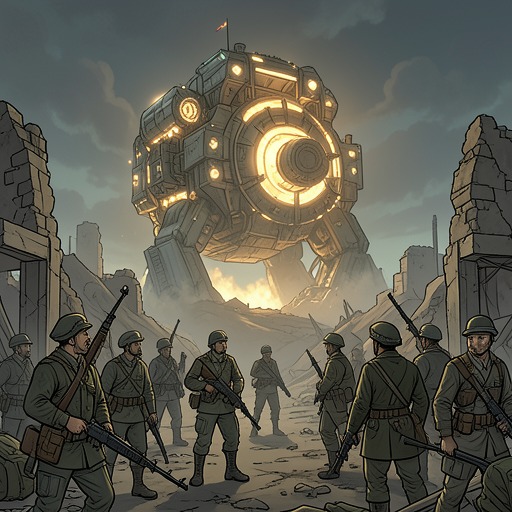
Lost Lands becomes a battlefield when Ada reaches a new continent and encounters a shore covered with corpses, flesh, and sinew. Poisoned water, mixed with sand and stained red by the dead, touches the boots of the arriving party. Imperial soldiers and Paladins immediately scavenge the bodies, removing masks and taking equipment. The landing thus begins not as a clean military arrival but amid mass death, contamination, and the practical stripping of the fallen.
The violence of the beachhead is followed by a revelation beneath the blood-soaked soil. As miasma and mana swirl and the earth violently shakes, the ground ruptures and a structure of enormous size rises from below. Heaven, identified by Sahaqiel with dismay, floats into the air before Jack and the others. Its emergence demonstrates that Lost Lands contains more than ruins or buried artifacts: the continent itself conceals structures capable of altering the scale and direction of the war. The expedition’s destination becomes an active power, and the response that the forces present are too late gives the discovery an immediate sense of irreversible consequence.
The shoreline also becomes a site of direct superhuman conflict. In Windermere, amid humid air, abundant water, and sand that can be turned against an opponent, Jack fights Athena. Their movements are so violent that they leave craters, split the earth, turn sand into smoldering glass, and drive Jack’s feathered spear against Athena’s shield. The landscape’s physical materials become part of Jack’s means of survival: the same environment devastated by the battle offers him the resources needed to resist the fallen goddess.
Transformation and Postwar Settlement
Five years later, the continent is no longer presented only as a place of poison, corpses, and buried enemies. A rebuilt coastal settlement called Jacksonville, also known as the Bastion of the New Frontier, stands on unexplored land established as a sovereign country by Lita and the Hoshido. The debris left by battles and expeditions has been cleared from the shoreline, which has become a summer destination where families and children play and fishermen use the piers. The poisoned frontier has not returned to an untouched natural state; it has been reorganized into a civic and recreational landscape.
The former bastion of the demonspawn, or at least what remains of it after transformation, becomes even more radically repurposed. Heaven is converted into the capital of the Frontier’s government and a forward base for explorers and treasure-seekers. Gold walls and marble pillars remain, but electric signs and wires now run through them, while former ruins are turned into homes and shops. Silver-wing banners circle twelve chairs representing the Frontier council. The image joins remnants of supernatural architecture to ordinary infrastructure and government, making the rebuilt city a visible negotiation between inherited danger and human settlement.
This reconstruction gives Lost Lands a double chronology. The continent retains the scars of the Solomon expeditions, demonic occupation, battlefield slaughter, and Heaven’s emergence, yet those ruins are made to support homes, commerce, administration, and tourism. Recovery is therefore material and political at once: roads, signs, shops, and public institutions make the land inhabitable, while the new sovereign Frontier claims authority over a territory once treated as an object of imperial and supernatural control.
Narrative Significance
Lost Lands is the book’s major geography of buried history. It is where the Black King’s hidden objective, the Solomon expeditions, the relation between human institutions and Archangel power, and the uncertain whereabouts of angels and demons converge. Its apparent distance from the familiar political world conceals its centrality to that world; the continent is the place from which the governing powers’ deepest secret emerges.
Its environmental imagery also tracks the movement from horror to reconstruction. Corruptive smog turns populations into mindless beasts; poisoned water and red sand receive the dead; battle turns sand to glass; and the buried structure of Heaven rises through violently disturbed earth. Against these images, the later shoreline offers gentle waves, sapphire water, families, children, piers, and a city sustained by electric light. Lost Lands does not erase its devastation, but it changes the function of what remains. The continent becomes both memorial and future: a landscape in which ruined power is converted into the institutional center of a new society.