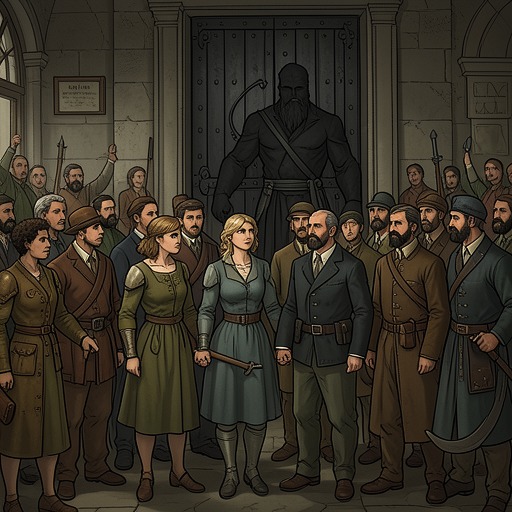
Madam Hightower
Awakening the Angel System: Apocalypse: A LitRPG Progression FantasyMadam Hightower is a former principal of Almus Academy and one of the principal figures behind its successor, Frelia Public Academy. She represents education as both a public institution and a protective structure: she helps establish a school intended to strengthen the nation, personally reassures Jack that Celeste will be safe there, and evaluates the child’s extraordinary intellectual development. Her role joins institutional reconstruction to intimate guardianship, making her one of the figures who converts survival after Almus’s destruction into a future for the next generation.
Identity and Institutional Background
Madam Hightower is identified as the former principal of Almus Academy when she appears at the opening of Frelia Public Academy. Her presence connects the new institution to the teachers and students who survived the destruction of Almus. She stands beside Duchess Belia Bell and a familiar cyborg teacher named Peter, who teaches metalworking with Brigid. The wider faculty includes a former police officer, a reformed meth maker, a disowned noblewoman, and other Almus teachers, giving the academy a deliberately varied staff shaped by experiences outside conventional education.
Her authority is therefore presented as inherited from a damaged institution but not confined by its old boundaries. Frelia Public Academy is described as the first of a planned national network of public schools, and Madam Hightower belongs to the generation charged with carrying knowledge forward after catastrophe. The school’s staff embodies reconstruction through continuity: Almus has been destroyed, but its educators have not disappeared, and its successor is built from what they learned and who they managed to save.
The Academy’s Public Mission
At the academy’s grand opening, Madam Hightower stands with the faculty while Selfia delivers the formal announcement. Selfia frames the school as a national initiative opposed by doubt and political resistance, then invokes the principle that knowledge is power. She defines education as a form of strength grounded in understanding the world and the threats surrounding the nation, concluding that the people are only as strong as the weakest among them.
Madam Hightower’s importance in this scene lies in the institutional reality behind that declaration. Selfia supplies the public political language, but Madam Hightower is the experienced educator who gives the project operational credibility. The academy is not merely a ceremonial royal program: it has a principal, teachers with specialized skills, surviving Almus personnel, and a curriculum intended to create normality as well as capability. The school’s educational mission consequently has two dimensions. It prepares citizens to understand a dangerous society, while also restoring ordinary childhood and communal life after violence.
Guardian of Celeste
Madam Hightower’s most personal responsibility concerns Celeste. When Jack is preparing to leave, he guides his daughter toward Madam Hightower and acknowledges that they have not spoken for some time. Madam Hightower expresses sadness that she could not speak with him during the academy’s public announcement, but her deeper response is relief: she is happy to see another of her students survive. The statement reveals her continuing emotional connection to Almus and to the young people who passed through it.
Jack’s reaction is guarded. He asks her to take care of Celeste, and Madam Hightower answers with a direct promise that the girl will be safe under her care. She emphasizes that the academy is enchanted throughout, protected by the Royal Guard, and subject to her own scrutiny, then swears that no harm will come to Celeste or her friend. Her assurance is significant because Jack remains uneasy despite the guards, hidden Black Hearts personnel, and other safeguards surrounding the school. Madam Hightower cannot erase the danger Jack perceives, but she gives the danger a responsible human custodian rather than leaving Celeste to impersonal security systems.
This exchange also places Madam Hightower in a relationship of trust that exceeds her formal office. Jack’s request treats her as someone accountable for his child, while her promise turns the academy into a moral obligation. The school’s enchantments and defenses matter, but the scene gives equal weight to her vigilance. Protection is presented as something achieved through institutions and through a person willing to stand behind them.
Educator and Evaluator of Exceptional Ability
Madam Hightower later monitors Celeste’s development and administers an intelligence test. At four years old, Celeste reads at a first-grade level, articulates her thoughts unusually well, and solves second-grade mathematics. She receives an IQ score of 140, and Madam Hightower continues testing her while recommending additional courses.
The recommendation is carefully balanced. Madam Hightower does not remove Celeste from her regular classes. Instead, she proposes supplementary education while preserving the child’s contact with classmates and opportunities to play. Her decision recognizes exceptional ability without treating Celeste solely as a specimen or strategic resource. The academy’s task is not simply to accelerate a gifted child into isolation; it is also to establish a measure of normality for her.
This approach clarifies Madam Hightower’s educational philosophy. Assessment produces knowledge about Celeste, but that knowledge does not automatically dictate total separation from ordinary social life. Madam Hightower uses expertise to expand the child’s opportunities while maintaining the relationships and routines that allow her to remain a child. In that sense, her authority is disciplinary but not merely punitive: testing, coursework, and supervision become means of protection and development.
Narrative Role and Significance
Madam Hightower functions as a bridge between the past and the future. She carries the memory of Almus Academy, whose destruction has scattered its surviving educators, into Frelia Public Academy, which promises a national educational system. Her recollection that Almus students survived gives the academy’s opening an undertone of mourning, while her care for Celeste turns reconstruction into inheritance.
She also embodies the book’s contrast between visible ceremony and hidden control. The academy is opened before crowds and cameras, with royal speeches and public promises, yet its actual security depends on enchantments, guards, concealed Black Hearts personnel, and the principal’s scrutiny. Elsewhere, Jack experiences royal life as confinement: after his marriage to Selfia and coronation, he is kept in his room, permitted only limited visitors, and treated almost as a prisoner. He notices the preference for paper folders over hackable tablets, armored vehicles designed to resist mana attacks, and the constant itinerary imposed by public duties. Against this atmosphere of surveillance and managed movement, Madam Hightower’s institution offers a more constructive form of oversight. She watches, tests, and protects, but her stated purpose is to preserve learning, friendship, and safety.
Her character therefore gives the educational project a human face without making it naïve. She is connected to authority, security, evaluation, and royal policy, yet her defining actions are promises of care and decisions intended to protect a child’s ordinary life. Through her, the academy becomes more than a political announcement: it is a vessel for surviving memory, a guarded refuge, and an attempt to make knowledge serve collective resilience rather than merely reproduce power.