Magna Galla Attack
Awakening the Angel System: Apocalypse: A LitRPG Progression FantasyThe Magna Galla Attack is the catastrophic assault on the royal gala at Castle Morne, where an event advertised as a prestigious celebration hosted by the Queen and her benefactors becomes a coordinated attack on the imperial center. The attack breaks the protective surface of masks, ceremony, music, and aristocratic order: guests are first absorbed into a supernatural performance, then trapped inside a burning, collapsing building. For Jack, the event is both a public disaster and a private trauma, because Ada is inside the castle when the explosions begin and his immediate response is not political calculation but an attempt to save her.
Political and Ceremonial Background
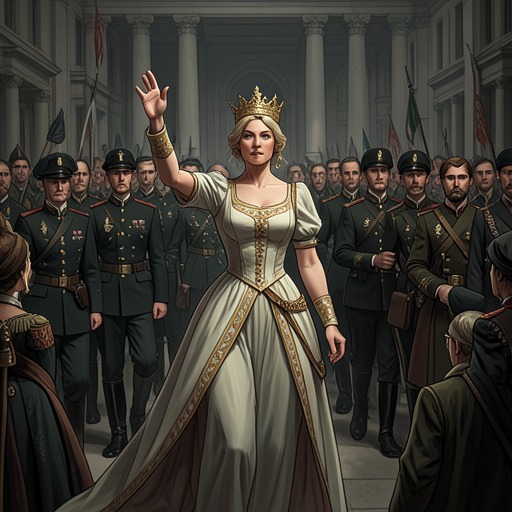
The attack is prepared against a deliberately theatrical political setting. News reports announce that the city of Lunacrypt is preparing for the Magna Galla, while the Royal Guard patrols the streets to display the strength and vigilance of the regime. The gala itself is a controlled spectacle of imperial identity. Hundreds of strangers watch Jack enter the ceremonial chamber, and Jack arrives in a pristine black uniform bearing the insignia of a major. Duchess Belia Bell leads him by the hand, following the imperial custom in which a mother, or a mother-figure, escorts a son down the aisle. Because Jack’s mother is dead and Duchess Belia Bell is the head of his mother’s noble house, she occupies the nearest available place to a parent. The gesture gives the ceremony an intimate foundation even as the surrounding crowd turns him into a political object.
The formal procession also places Jack inside the machinery of the monarchy. He walks beside Duchess Belia Bell as the double doors open to orchestral music, his boots keeping time with her red heels while hundreds of unfamiliar eyes settle on him. The event therefore begins with an image of continuity: family substitution, noble inheritance, public ritual, and disciplined movement all combine to make imperial authority appear stable. The later destruction of the castle reverses that image. What seems to be a celebration of order becomes proof that the palace itself can be penetrated, manipulated, and annihilated.
The Masquerade and the Jester’s Performance
Inside the ballroom, the ceremony gives way to masquerade. The floor is covered by black gowns, black masks, and elaborate jewelry, while the guests discuss weather reports, business transactions, trade agreements, and the condition of the Imperium. Jack has been ordered by Selfia to mingle, socialize, and remain discreet, but he stands apart because he has little to say to people whose safe conversation conceals the political tensions of the empire. He is pretending to be one of the red-eyed Imperials, and the mask becomes more than an accessory: it marks his uneasy participation in a society whose language and loyalties he does not share.
Ada Nguyen reaches him within this setting in disguise, wearing a floral-patterned black dress with lace sleeves and a cat-shaped mask topped by a black bow. Her appearance briefly brings personal recognition into the public spectacle. Jack identifies her immediately and asks what she is doing there, while the surrounding ballroom continues to operate according to the rules of anonymity and display. The encounter makes the gala’s danger more concentrated: the person Jack most needs to protect is not an abstract member of the court but Ada Nguyen, physically present in the same enclosed space.
The mood changes when a flash interrupts the music and draws every eye toward the stage. A woman in a jester’s outfit appears, her face hidden by a smiling white mask. Jack recognizes the figure as familiar, and his blood runs cold beneath his own disguise. The Jester plays a violin, producing music that fills the ballroom despite the absence of a visible band. Her red eyes remain fixed on Jack, and the narration makes clear that she recognizes him at once, even through his mask. The performance is thus an act of exposure concealed within an act of disguise: the audience believes it is attending entertainment, but the performer has already identified the one person who resists her control.
The Jester’s music becomes an instrument of mass enthrallment. Jack receives the notification that he has resisted the Maestro’s Music, while the guests fall under the performance’s influence and move in synchrony. The crowd becomes an ocean of dancing bodies, and Jack stands as the lone unmoving figure, an island staring at the woman onstage as the tempo increases and mana touches his skin. This is the attack’s first decisive value shift. A ballroom associated with leisure, status, and social connection becomes a mechanism for stripping the guests of agency. The music does not merely accompany the assault; it converts the victims into part of its choreography.
Detonation and Castle Collapse
The supernatural spectacle gives way to physical destruction when the ballroom loses all light and the chandelier shuts off, casting the room into darkness. The Pawns then make their hostility explicit. The Man Maid, bloodied but defiant, spits an insult at Tenno and gives him the middle finger just before the world is illuminated by a small sun. The crude gesture and the apocalyptic blast occupy the same beat, collapsing the distance between grotesque mockery and mass violence. The attack refuses the dignity expected of a royal gala; its agents turn the court’s polished ceremony into an obscene and uncontrolled rupture.
Jack’s first cry is for Ada. Ruby Viole Lamperouge seizes his shoulder and pulls him back as Ada is caught in the blast, while Ruby’s shield absorbs the force of the explosion. Jack and Ruby are thrown through the impact, but Jack unfurls his silver wings and takes flight. They dive through a window and turn in midair, giving Jack a clear view of the castle already engulfed in flames. The distance offers no safety or emotional detachment. It shows him the scale of the disaster while leaving Ada inside it.
The building is not merely damaged; it is already collapsing inward under multiple detonations at its base. Jack cries out again and dives into the red mushroom cloud, ignoring the heat as it burns away what remains of his expensive clothes. His clothing, status, and disguise are discarded almost incidentally as he presses toward the wreckage. Sahaqiel clears a path through rubble and debris, turning Jack’s flight into a rescue attempt directed against the collapsing architecture itself. The castle becomes a hostile enclosure whose walls, floors, and ceremonial chambers are being erased around the trapped survivors.
Immediate Consequences and Political Violence
The destruction of the gala cannot be separated from the wider purge that follows. Selfia later reveals to Jack that the regime killed its own guards and that a purge was taking place across the empire. Three hundred and sixty-nine lives had been marked for elimination, possibly more: political opponents, rivals, dissidents, and anyone who might obstruct the advent of the New Republic. Selfia explains that removing those figures would allow her to solidify power. The revelation changes the meaning of the gala’s security failure. The absence of guards and Awakened forces was not simply an enemy triumph; it was connected to a deliberate political operation.
Selfia insists that she did not lie when she promised to arrest the people on the list. She had intended to remove them from the political field, but her method was killing rather than lawful detention. The Magna Galla Attack therefore stands at the intersection of external assault and internal purification. The castle’s destruction is spectacular, but the quieter purge is broader in scope: it turns the entire empire into a potential crime scene and makes the language of survival inseparable from authoritarian consolidation.
The attack also contributes to the collapse of the old imperial order that Jack later invokes in his address to the citizens of the empire. He offers surrender on the grounds that the old Imperium is dead and that a future society can be built from its ashes, promising humane treatment and free citizenship in the Cordelica Democracy to those who lay down their arms. The offer gains force from the gala’s destruction. Castle Morne has demonstrated that the existing system cannot guarantee security, preserve its own sacred spaces, or protect the people gathered under its authority.
Memory, Power, and Narrative Significance
The event’s power comes from the collision of ritual and violation. The opening procession presents monarchy as a family structure enacted through the substitute mother-figure of Duchess Belia Bell; the masked ballroom presents aristocracy as a community bound by coded behavior and safe conversation; the Jester’s music reveals that the community can be made to move as one body; and the explosions reduce the palace to rubble. Each stage removes another layer of apparent control. Ceremony becomes masquerade, masquerade becomes enchantment, enchantment becomes helplessness, and helplessness becomes destruction.
The attack also foreshadows the story’s recurring use of sacred or symbolic images to authorize political action. In the Theocracy, a statue identified as Saint Citri, founder of the Theocracy, is said to limit the power of demonspawn attacking the city, and the statue is secretly a likeness of Sahaqiel. Elsewhere, Selfia frames a later military expedition as humanity’s necessary response to apocalypse, declaring that the only option in the darkest hour is to attack. These later appeals to saints, human survival, and the future echo the Magna Galla’s transformation of public ritual into political violence. The gala is not an isolated spectacle; it establishes a pattern in which institutions manufacture legitimacy through ceremony while violence determines who controls the future.
In the longer political aftermath, Jack’s public identity shifts from royal consort and participant in imperial ritual toward revolutionary spokesman. Selfia is eventually addressed as Madam President, signaling the emergence of a republican order after the imperial world has been dismantled and remade. The Magna Galla Attack is the hinge between those forms of rule. It leaves the court physically ruined, exposes the regime’s willingness to kill its opponents, and gives Jack a personal reason to reject the safety and performance of the old order. The masquerade ends not when the masks are removed, but when the building that sustained them falls.