New Republic
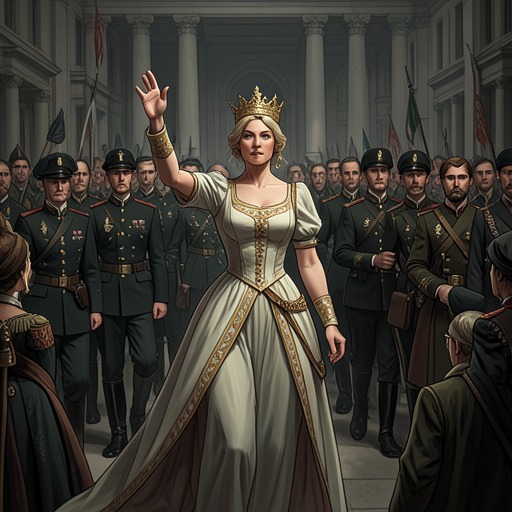
Awakening the Angel System: Apocalypse: A LitRPG Progression FantasyThe New Republic is the successor state imagined by Selfia as the answer to imperial stagnation, political obstruction, and the existential threat facing humanity. Its declared purpose is to secure mankind’s future, but its emergence exposes a central contradiction: the new order promises freedom and democracy while its founder authorizes executions, city-destroying violence, and total war to make that future possible. The concept therefore gives the political plot its defining tension between emancipation and control.
Origins in Crisis
The New Republic takes shape during a period when Selfia treats ordinary politics as an obstacle to species survival. She explains that political opponents, rivals, dissidents, and anyone capable of slowing the transition are being killed in an empire-wide purge. The immediate toll is stated as three hundred and sixty-nine lives, with the possibility of more deaths as the operation continues. Selfia does not present the purge as a temporary lapse or a personal vendetta; she identifies it as the means by which she can solidify power and guarantee the New Republic’s arrival.
Her justification is openly utilitarian. She insists that humanity’s continuity outweighs the lives of individuals and declares that she would repeat the killings without hesitation, even if the victims included infants or entire bloodlines. In her account, she has sacrificed her arms, morals, heart, and any possibility of love to create a future in which monsters like herself will no longer need to exist. The New Republic is thus born from a politics of emergency in which the promised humane future authorizes present inhumanity.
The Political Meaning of the New Order
The contrast between the old Imperium and the New Republic is articulated most clearly in Jack’s surrender broadcast. Jack identifies himself as the son of the Queen Slayer and as King Consort to Selfia, then tells the empire that the old imperial order is dead and that citizens can become part of a future beyond it. He invokes the imperial war doctrine, which forbids surrender while an opponent retains the means to resist, only to announce that this doctrine no longer governs the political world being created. Those who surrender are promised humane treatment and life as free citizens in the Cordelica Democracy.
That promise gives the New Republic a civic vocabulary absent from the purge: surrender is reframed as entry into citizenship rather than submission to an enemy. Yet the circumstances make the language unstable. Jack speaks while an imperial city faces a battle capable of laying it waste, and Selfia’s forces have already destroyed cities. The proposed democracy therefore arrives through an invasion that its defenders reasonably understand as conquest. Captain Hoffman calls Jack an invader because Jack has brought an army to raze Hoffman’s home even after offering a tour. The word exposes the gap between the new government’s self-description and the experience of those being absorbed into it.
Methods of Foundation
Selfia’s methods combine political cleansing, covert elimination, and overwhelming force. She describes Checkmate as an organization created for the strategic elimination of High Table assets and proposes sending tier-one units against the sites of a genocidal cult. She treats the enormous resources of the Imperium as available for rapid, decisive action, even joking about destroying buildings in territory she owns. Her plan is to prevent opponents from gaining the opening needed to deploy their own schemes, making speed and concentration of force the practical instruments of political transformation.
The New Republic’s violence also depends on systems that regulate information and resistance. During Jack’s confinement after his marriage to Selfia and coronation as king, he is effectively imprisoned in a luxurious room, allowed only restricted visitors. Elsewhere, security personnel prefer paper folders to tablets because tablets can be hacked and Intellipads compromised. These details place the political transition within a world of surveillance, controlled movement, guarded records, and distrust of communication networks. The republic’s promised freedom is consequently surrounded by institutions that decide who may move, speak, organize, or safely possess information.
Its founding rhetoric reaches its fullest military expression in Selfia’s address to the empire. She names Lunacrypt, Soldaer, and Clausterfiell as monuments already reduced to rubble and describes Solarus, the crown jewel of the Imperium, as ruined. Against this catalogue of destruction, she presents attack as humanity’s only remaining option. The expedition is described as the greatest undertaken since humanity went into space; its stated objectives are to end the threat of the demonspawn, ensure survival, and seize control of humanity’s future. The New Republic is therefore not merely a constitutional replacement. It is a wartime project that makes collective survival its source of legitimacy.
Bodies, Symbols, and Sovereignty
The New Republic’s political symbolism is layered over older forms of authority rather than replacing them cleanly. Jack enters the imperial chamber in a dress uniform bearing a major’s insignia, escorted by Duchess Belia Bell in a ceremony where a mother or mother-figure traditionally leads a son down the aisle. He is simultaneously a military officer, a royal consort, and a figure being incorporated into a dynastic order. The ceremony reveals how the new political arrangement remains dependent on inherited ritual and noble mediation even as it claims to supersede the Imperium.
Religious imagery creates a similar complication. In the Theocracy, a statue identified as Saint Citri, the founding patron saint, is said to limit the power of demonspawn attacking the city. Jack recognizes the statue as bearing Sahaqiel’s likeness, while Sahaqiel herself is unable to explain why her image has been sanctified. This confusion between living person, sacred founder, and political symbol shows how regimes manufacture legitimacy through bodies and images. The New Republic inherits a world in which sovereignty is already expressed through coronations, saints, military insignia, and public spectacle; its claim to modern democracy does not erase those older symbolic technologies.
The later appearance of Jack with six wings, alongside Sahaqiel and Lilith, intensifies the problem. Ada recognizes him after five years, while Selfia identifies the mana surrounding the transformed figure and reacts through her prosthetic arms. Jack’s body has become a visible convergence of human, angelic, technological, familial, and political histories. The New Republic’s future is consequently represented not by an abstract citizen alone, but by bodies altered by war, experimentation, sacrifice, and fusion.
Contradiction and Legacy
The New Republic remains deliberately unsettled because its stated ideals and founding practices continually undermine one another. It promises free citizenship and an end to imperial doctrine, yet begins with a purge whose victims include dissidents and children. It claims to protect humanity from extermination, yet its leader accepts the leveling of cities and the killing of thousands as an acceptable cost. It presents itself as the future, but it relies on royal marriage, coronation, military hierarchy, sacred imagery, intelligence operations, and restricted movement.
This contradiction is not incidental to the concept; it is the New Republic’s narrative significance. Selfia imagines a political order in which the violence required to create it will eventually become unnecessary, but the story repeatedly shows that the future is being constructed through the same forms of domination it claims to abolish. Jack becomes the public voice of humane surrender, while Selfia remains the architect of exterminatory necessity. Their divided roles make the New Republic legible as both a genuine project of human survival and a dangerous concentration of power justified by an apocalyptic horizon.