Project Solomon
Awakening the Angel System: Apocalypse: A LitRPG Progression FantasyProject Solomon is the Imperial-led expeditionary program that turns the Lost Lands into the central frontier of the book’s hidden history. Presented at first as a coalition devoted to navigation, scouting, and securing a route through a continent overrun by demonspawn and corruptive smog, it ultimately points toward the buried origins of humanity, the missing angels and demons of legend, and the Infinity Machine’s power to classify, manipulate, revive, or eliminate life.
Definition and Imperial Purpose
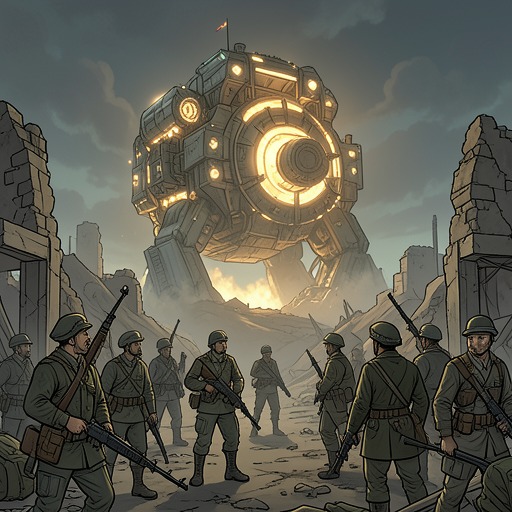
Project Solomon is not a single mission but a sequence of Solomon Expeditions organized by an alliance of corporations, military industrialists, nations, and Imperial forces. Jack learns this when he searches the airship’s main data vault and finds a directory labeled Project Solomon, including a folder for the Seventh Solomon expedition. The expeditions were intended to navigate and scout the continent once called Africa and known to the wider world as the Lost Lands, creating the conditions for a secure beachhead in territory otherwise made nearly inaccessible by demonspawn and an unending veil of corruptive smog.
The Lost Lands are described as the cradle of humanity, but the phrase is not merely geographical. The continent is also the place where the Black King’s objective has been buried. Each expedition therefore carries a double function: its public or military justification is reconnaissance and territorial access, while its deeper purpose is the search for a prize concealed beneath humanity’s origin. The project’s scale reflects that ambiguity. It is too extensive to be a private hunt and too secretive to be ordinary exploration; it joins state power, industrial capacity, military force, and forbidden knowledge around a destination presented as both strategic frontier and ancestral underworld.
The Seventh Expedition and the Hidden Search
The Seventh Solomon expedition is identified as the last expedition undertaken by Imperial forces. Its records include Jack’s Uncle Mike and Mi'shika, linking the project directly to the personal history of the central characters rather than leaving it as an abstract government undertaking. Jack’s discovery changes the meaning of earlier violence: the mercenary murdered by Uncle Mike bore a tattoo depicting a staff and the number seven, a sign that Jack associates with the Seventh Solomon expedition while examining its files.
That recognition produces the project’s most important question. If angels and demons from lore exist, Jack asks where they all went. The question transforms Project Solomon from a campaign of geographic exploration into an investigation of disappearance. The expeditions may have been searching not only for land or resources but for traces of beings and forces removed from ordinary history. Python’s startled response—whether there are worse things beyond the known adversaries—registers the same reversal from imperial adventure to cosmic threat.
The project also exposes the strategic dependence of the Black King on human institutions. Jack explains that the Black King seeks something in the Lost Lands but lacks the resources and manpower to secure a beachhead and search safely for it. The existence of Solomon Expeditions thus reveals a power structure in which a seemingly autonomous imperial enterprise can serve a hidden sovereign objective. Exploration supplies the logistical reach, military protection, and territorial access that the Black King cannot create alone.
Technology, Mana, and the Infinity Machine
Project Solomon’s deepest significance emerges through its connection to the Infinity Machine. Sahaqiel explains that the machine was created in an earlier age and taps into all data flow. What people call mana is, in her account, data: the machine reads the molecular structure of the world, translates it, and connects living beings through a planetary system resembling a vast server and router. This explanation recasts the expedition’s supernatural vocabulary as technological infrastructure. Demonspawn, angels, souls, and mana are not separate realms of myth but phenomena that can be recorded, routed, altered, and selected by a machine.
The original outbreak gives this system an especially disturbing political meaning. Sahaqiel states that the machine was used to halt and reverse the flow of mana, drawing in a specific spectrum of data and eliminating those who exhibited mana capability. The project’s exploration of the Lost Lands therefore stands against the background of an earlier technological purge. The language of cataloging and control makes life appear administratively legible, while the word eliminated strips away any comforting distinction between treatment, containment, and execution.
Eve’s recorded legacy supplies another layer to the same history. She identifies herself as the creator of the Infinity Machine and says that she designed it to resuscitate those who fell in the great war, cataloging and guiding lost souls back to the living world after victims of petty wars and grandiose schemes had died. The machine was consequently conceived as an instrument of restoration, but its later use could also suppress mana and remove entire categories of people. Project Solomon inherits this contradiction: the search for humanity’s beginnings leads toward a technology created to preserve the dead, yet capable of treating persons as data to be filtered.
Revelation at the Lost Lands’ Threshold
The expedition’s destination is not an open field of discovery but a sealed threshold. After Jack and Sahaqiel pass through corrupted data and encounter an immense source of mana, Jack’s angel senses perceive a blinding concentration of power. They reach a large sealed stone door covered in intricate carvings, and Sahaqiel recognizes that the source lies beyond it. The physical barrier gives the project’s accumulated secrecy an architectural form: centuries of records, military expeditions, and personal murders converge at a door whose surface is smooth except for the signs of an older order.
The project’s revelations also disturb the boundaries between sacred image and living identity. In the Theocracy, Lita explains that a human-sized statue of Sahaqiel is regarded as the statue of the patron saint Saint Citri, founder of the Theocracy. Outsiders rarely receive permission to witness the maiden, whose presence limits demonspawn power during attacks, while traitors search the city for her. Sahaqiel, confronted with her own likeness, insists that she does not know why a statue of her stands there. The scene connects Solomon’s hidden history to institutions of worship: an angel can become a saint, a living person can be transformed into an object of devotion, and political power can preserve the resulting confusion as sacred tradition.
Political Afterlife and Narrative Significance
The knowledge surrounding Project Solomon repeatedly enters public speech through war and state-making. Jack, speaking as the son of the Queen Slayer and King Consort of Queen Selfia Cordelica, offers Imperial citizens a chance to surrender before a battle that will devastate the city. He contrasts the dead Imperial war doctrine, which forbids surrender while resistance remains possible, with a future in which citizens may live freely in the Cordelica Democracy. His appeal shows how information about the old empire is converted into a new political legitimacy: the past is declared ashes, while surrender becomes participation in a promised future.
Selfia’s later address enlarges that political conversion into a survival myth. She names fallen strongholds, including Lunacrypt and Solarus, and presents humanity as facing extermination by demonspawn. Her conclusion is that the only option is to attack, framing the next expedition as the greatest undertaken since humanity went to space and as the means by which humanity will seize its future. In this rhetoric, the expeditionary form associated with Project Solomon returns as a public act of collective destiny. The concealed search and the open campaign differ in declared purpose, but both use exploration, military mobilization, and the language of survival to authorize extraordinary action.
The project therefore functions as a bridge between scales that the narrative initially keeps apart. It links Jack’s family history to Uncle Mike and Mi'shika, the empire’s logistical machinery to the Black King’s private search, the Lost Lands to humanity’s cradle, and ancient angelic history to contemporary systems of war and governance. Its most consequential discovery is not simply that a powerful object lies beneath a ruined continent. Project Solomon reveals that the world’s political orders, supernatural categories, and technological systems have always been entangled—and that the same machine capable of restoring lost souls can also turn living humanity into a selectable stream of data.