Saint Citri statue
Awakening the Angel System: Apocalypse: A LitRPG Progression FantasyThe Saint Citri statue is a marble monument at the center of a refugee camp built into the sewer lines, but it is far more than a devotional image. Depicting a praying, winged woman whose six wings spread over the settlement, it serves as the Theocracy’s patron relic and projects a protective force that weakens demonspawn. Its decisive mystery is that the statue’s face and spiritual resonance belong to Sahaqiel, who is alive and present within Jack when the monument is discovered. The statue therefore stands at the intersection of faith, military defense, buried history, and the unstable boundary between a saint’s image and the being treated as divine.
Appearance and Location
The statue is made of marble and depicts a woman in prayer, with her wings unfurled so that they cast a shadow over the surrounding town. Jack first sees it after emerging from a pipe into a junktown metropolis constructed through the sewer lines. The monument dominates the refugee camp and immediately draws his attention more powerfully than the settlement itself. From a distance he recognizes the human-sized likeness as Sahaqiel, and the recognition carries an unexpected feeling of comfort.
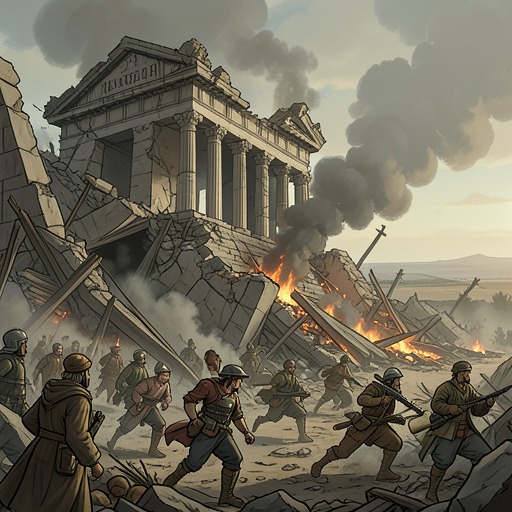
A chapel lies beneath the statue’s massive six wings. The sacred center is not unguarded or purely ceremonial: around the ice-covered church stand armed Paladins and Templars, accompanied by black-robed clergywomen carrying submachine guns and staves. The arrangement makes the monument both sanctuary and military position. Religious architecture, armed guardians, and a refugee population are gathered into one defensive structure, suggesting that the statue’s importance is measured not only by the devotion it inspires but also by the protection it makes possible.
Religious Identity and Protection
The Theocracy identifies the monument as the statue of its patron saint, Saint Citri, whom it calls the founder of the Theocracy. Lita tells Jack that outsiders rarely receive the grace of witnessing the maiden and that the saint’s presence limits demonspawn power when they attack the city. The statue is consequently treated as a visible channel of sacred authority, while its disappearance or destruction would threaten the community’s survival.
The protection is understood by the inhabitants as the grace of Lady Citri. Her blessing flows through the city, and the outer edge of the walls marks the point where the divine protection ends. In practical terms, the relic creates a perimeter: inside it, the city is shielded; beyond it, that defense no longer applies. The religious explanation is therefore inseparable from urban planning and military strategy. The monument does not merely comfort refugees. It determines where the city can safely exist and where its defenses cease to function.
The city’s population reinforces the statue’s unusual importance. Jack observes hundreds of residents who, although individually weak, possess the equivalent of low-ranking mage-officer ability. That concentration is far beyond what natural distribution would suggest: the Empire has only one Awakened person per hundred thousand citizens, and the Alliance has even fewer. The statue is thus encountered in a settlement whose abnormal magical density and survival appear connected to the sacred infrastructure surrounding it, even though the precise mechanism is initially hidden from the people who worship it.
Sahaqiel’s Resemblance and the Hidden Mechanism
The statue’s likeness produces confusion because the people around it do not know that the supposed saint is present in another form. Lita interprets Jack’s stunned reaction as an outsider’s amazement at seeing Saint Citri. Sahaqiel, however, cannot explain why her own image stands below the city. She reacts with bewilderment rather than recognition, insisting that she does not know why a statue of her exists there. The scene turns an apparent religious revelation into a personal mystery for the being represented by the image.
Sahaqiel senses a resonance when she examines the statue. She describes it as resembling a mirror of herself and says that placing a hand on its face feels like touching herself. She can tell that the object is ancient, perhaps at least a thousand years old and possibly as much as five thousand, although she cannot establish its exact age. The uncertainty gives the statue a historical depth that exceeds Sahaqiel’s immediate understanding and prevents the likeness from being reduced to a recent portrait or simple imitation.
The resonance also has a technical effect. Sahaqiel explains that the statue scrambles rune code, weakens demonspawn, and disrupts their connection to the Infinity Machine. Its influence extends across a substantial radius, protecting the city from creatures tied to that machine. The supposed blessing therefore has a material and systemic operation: it interferes with the code-based connection that empowers the enemy. The statue converts sacred presence into an anti-demonspawn field without erasing the religious interpretation through which the inhabitants understand it.
Jack immediately recognizes the strategic implications. A statue with the same protective radius could make high walls and gun emplacements unnecessary in many settlements, and he considers how useful such monuments might be to Hoshido. Yet the possibility of removal carries an equally clear danger. Taking the statue away would probably end the Theocracy’s protection and expose the city to the demonspawn it has kept at bay. The relic is therefore both a potential military technology and an immovable foundation of communal survival.
Devotion, Violence, and Recurring Authority
The statue’s chapel is a place of worship, but the surrounding scene is shaped by armed readiness. Paladins, Templars, clergywomen, submachine guns, and staves occupy the same sacred perimeter. The image of the praying woman does not oppose violence in this setting; it authorizes a defensive order that depends on sanctified force. The statue’s religious meaning is expressed through protection, exclusion, and the ability to weaken an enemy whose power is otherwise linked to the Infinity Machine.
Its authority also extends beyond the original refugee camp. Later, when Jack confronts Cintelli prisoners and declares that their sins will be weighed, Sahaqiel descends beside him while Lilith materializes on his other side. Several prisoners recognize Sahaqiel and prostrate themselves when they see the patron saint clearly. The reaction demonstrates that the statue has created a devotional image powerful enough to shape behavior even when the living archangel appears in person. Sahaqiel’s body becomes the confirmation of the monument, while the monument has already prepared the prisoners to interpret her as a sacred authority.
The episode also changes the balance between symbol and person. At the refugee camp, worshippers direct their faith toward marble and cannot see the invisible Sahaqiel unless she chooses to reveal herself. At the later confrontation, her visible presence produces immediate submission. In both cases, religious recognition functions politically: the statue protects a city, and Sahaqiel’s manifested likeness helps establish Jack’s authority over prisoners. The same image can therefore operate as shield, doctrine, and instrument of command.
Narrative Significance
The Saint Citri statue embodies the story’s collision between ancient sanctity and technological war. Its wings and prayerful posture place it within a tradition of saintly protection, while its actual effect is to scramble rune code and sever demonspawn from the Infinity Machine. The contrast does not make the religious interpretation false; instead, it shows how a sacred institution can preserve and ritualize a power whose operation is intelligible in technical terms. Faith supplies the language, community, and authority through which the defensive mechanism remains meaningful.
The monument also turns identity into a historical question. Sahaqiel is not simply an angel looking at an image of herself; she is confronted with evidence of a past she cannot fully remember or explain. The statue may be thousands of years old, yet its presence has become the foundation of a living Theocracy whose citizens understand it through the figure of Saint Citri. Its mystery links personal memory, collective religion, and the long history of the conflict with the Infinity Machine.
Finally, the statue makes protection inseparable from vulnerability. Its divine radius keeps the city alive, but that dependence creates a single point of failure. Traitors search for the statue because they know that the Theocracy’s safety is concentrated in one sacred object. The monument’s grandeur thus carries an undertone of siege: the praying figure shelters the settlement, while armed guardians defend the shelter itself. In the narrative, the Saint Citri statue is consequently both a miracle and a target, both an icon of permanence and a reminder that every refuge built around inherited power can be threatened at its foundation.