Templars
Awakening the Angel System: Apocalypse: A LitRPG Progression FantasyThe Templars are the Theocracy’s principal religious-military order, a force that turns doctrine into organized defense. Their ranks include specialized Awakened who control War Golems, heal the wounded, or fight as Paladins, while Judicators operate as both inquisitors and special forces. Their presence links the protection of the frozen Theocracy to a sacred system centered on Saint Citri, whose statue is understood by outsiders as a holy image but is, in fact, a likeness of Sahaqiel. The order therefore stands at the intersection of religion, warfare, and the struggle over who may define humanity’s future.
Nature and Military Structure
The Templars operate in a landscape where winter is itself a defensive barrier against the monsters roaming the surface. Jack’s reports describe the Theocracy’s frigid environment as a harsh counter to demonspawn, but the climate alone is not enough to preserve its settlements. Templar Awakened maintain the balance through distinct military roles: some control golems, some serve as healers, and others fight on the front line as Paladins. The organization is consequently not a single type of soldier but a specialized system in which supernatural ability is assigned to practical defense.
The order also includes Judicators, an uncommon class whose responsibilities extend beyond ordinary battlefield service. They resemble the Imperial Black Hearts and Black Roses in their combination of elite combat work and exceptional abilities, yet the Judicators possess a specifically theocratic mandate: they serve as inquisitors as well as special forces. The Jester of the High Table had once been a Judicator, and the Green Bishop apparently belonged to the same class, revealing that the order’s identity can be appropriated, concealed, or turned against the society it claims to protect.
Sacred Authority and the Saint’s Image
The Templars’ military authority is reinforced by an elaborate sacred geography. In a ruined, snow-covered village, Jack finds deactivated War Golems scattered among the remains, an image of a defense system that has been exhausted or destroyed. Elsewhere, the order gathers around an ice-covered church beneath a massive six-winged statue. Armed Paladins and Templars stand alongside black-robed clergywomen, carrying submachine guns and staves. The scene makes the order’s central principle visible: religious ceremony and armed readiness are not separate spheres.
The statue is identified as the Saint Citri statue, the image of the Theocracy’s patron saint and founder. Lita explains that few outsiders are granted the privilege of seeing the figure and that the saint’s presence limits demonspawn power when they attack the city. The statue is therefore not merely commemorative. It functions as a protective resource, a sacred object whose location has direct military consequences. Because traitors know that the statue is hidden in the city and are searching for it, the image becomes a strategic target as well as an object of devotion.
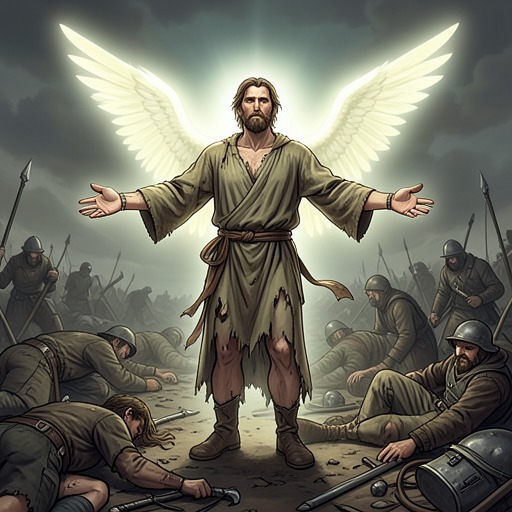
The revelation is more unsettling because Sahaqiel recognizes herself in the statue. Jack senses the identity immediately, even before the explanation is given, while Sahaqiel is flustered and insists that she does not know why her likeness stands below the city. The Templars worship an angel through the figure of a saint without necessarily possessing the truth of that identity. Their faith thus preserves a real connection to Sahaqiel while also transforming her into an institutionally useful symbol: maiden, patron, and defense against demonspawn.
Combat and Alliance with Jack
When the High Table threatens the Holy City, the Templars become frontline allies of Jack and his Imperial commandos. The two forces emerge from a sewer beneath a metropolis of ivory and stone covered in ice, preparing to fight together against a shared enemy. Their alliance is practical rather than fully reconciled. Jack’s commandos occupy one side of the formation and the Templar soldiers the other, with the old hostility between former enemies remaining palpable even in the confined sewer air.
The campaign quickly becomes a large-scale battle over the city. Three days after the initial preparation, flames and ash cover the megacity while lead and ionized bolts pass between massive human-commanded machines contesting control of the sky. Jack urges the assault forward, declaring that the battle must end that day. The Templars’ role in this offensive is not passive defense: they fight to retake their sacred center and to break the forces that have violated it.
The resistance is severe. At the citadel, Captain Verlance reports that traitorous forces have withdrawn into the audience chamber and erected an apparently unbreakable golden barrier through the power of their choirmen. Hellspawn defend the position, and two agents have already killed scores of Templar soldiers. The report establishes the cost of the order’s defense while also showing its tactical dependence on allies such as Jack, Lita, and Tangerine’s Damocles MECHFrame.
Inside the chamber, the conflict acquires a ritual dimension. Jack hears children singing in an unfamiliar language, but Sahaqiel understands it as the language of the angels and weeps because she has not heard it since childhood. The choir’s sacred sound is thus weaponized by the enemy, turning memory and religious inheritance into a source of power. The Templars’ struggle is not simply against hostile troops; it is also against rival claimants who manipulate the same sacred materials—angels, choirs, saints, and holy spaces—to control the city.
Political Loyalty and Transformation
The Templars’ position changes as the wider political order collapses. Jack later addresses imperial citizens and offers them the chance to surrender, explicitly rejecting the old Imperial war doctrine that forbids surrender while an enemy retains the means to resist. He promises humane treatment and life as free citizens in the Cordelica Democracy. This language contrasts with the military culture surrounding the Templars, where religious and political legitimacy have traditionally been defended through absolute resistance and armed sacrifice.
At the same time, Sahaqiel’s authority becomes increasingly difficult for the Templars to separate from Jack’s. During a confrontation with Cintelli prisoners, Jack has Lilith and Sahaqiel flank him as he weighs the prisoners’ sins. Several prisoners recognize Sahaqiel and prostrate themselves before her, seeing the patron saint in living form. The response demonstrates the order’s deepest vulnerability and greatest source of power: its theology can command immediate submission when embodied, but that sacred recognition also exposes how much the Templars’ authority depends on a truth they have only partially understood.
Later, when Sahaqiel confirms that the Infinity Machine is the answer to the red-sun crisis, her claim provokes skepticism from a red-haired man who questions how anyone can know that an ancient angel is telling the truth. The Paladins react with anger, showing that disagreement with Sahaqiel is treated not as ordinary debate but as a challenge to the religious order itself. Yet Sahaqiel’s testimony also helps redirect the Templars from defending an isolated sacred city toward participating in a broader expedition intended to preserve humanity.
Narrative Significance
The Templars embody the book’s recurring tension between sacred tradition and modern warfare. They carry guns and staves, deploy specialized Awakened and War Golems, guard churches, protect a saint’s image, and fight beneath a six-winged symbol that is also a hidden portrait of Sahaqiel. Their world does not resolve the opposition between religion and technology; it makes the opposition unstable. The holy object operates like military infrastructure, while the military order performs its defense as a religious obligation.
Their history also complicates the distinction between protection and domination. The Templars preserve cities from demonspawn, but their Judicators can serve as inquisitors and special forces, and their sacred symbols can be used by traitors and enemies. Former enemies can become allies without erasing their earlier antagonism, just as a saint can be revealed as a living angel without making the institution built around her disappear. Through the Templars, the narrative presents faith as both refuge and apparatus: a source of courage, a means of organizing violence, and a political language that must be reinterpreted when the old empires and doctrines no longer promise survival.