The Final Battle with Michael and Adam
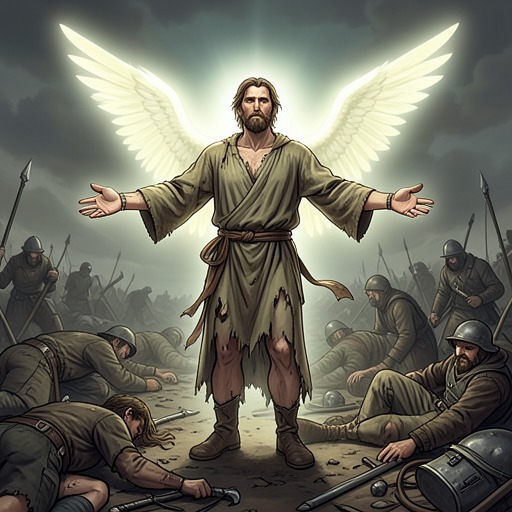
Awakening the Angel System: Apocalypse: A LitRPG Progression FantasyThe Final Battle with Michael and Adam, also associated with “Catharsis” and Michael’s Defeat, is the decisive confrontation at the end of the Infinity Machine crisis. Jack begins it as a personal reckoning with Michael, the archangel who claims to have created and guided him, but the conflict expands into a contest over whether humanity will be reshaped by a self-appointed architect or allowed to survive without his design. The battle’s immediate result is Michael’s defeat and the continuation of the struggle against Adam, while its wider aftermath is a mana-starved world forced to reconstruct its political and technological order.
Causes and Background
The confrontation follows Michael’s attempt to awaken or unleash Adam, the first Awakened and the first hunter. Michael explains that Adam can pursue magically gifted beings anywhere in the world and that even in a weakened condition a direct encounter with him could end the life of any living being. He has nevertheless chosen to use Adam against beings powerful enough to attract his attention, including Jack and Sahaqiel, presenting their deaths as the foundation of a supposedly improved human order. Sahaqiel recognizes the true danger immediately: freeing Adam could kill the angels, destroy humanity, and doom the world.
Michael’s justification is inseparable from his belief that humanity must be cultivated into something “glorious.” He tells Jack that he made Sahaqiel and insists that, had she followed his vision, he could have fixed the world. His plan treats persons, powers, and even catastrophe as instruments in a historical design. The same logic appears elsewhere in the political crisis surrounding Jack: Selfia authorizes a purge of three hundred and sixty-nine lives or more to secure the New Republic, while Jack condemns the killing of opponents, bystanders, and innocents as murder disguised as necessity. His later command to evacuate the Theocracy’s remaining citizens and his insistence that Roland forces receive a call to surrender show the alternative that he tries to enact in the final conflict: survival without granting rulers or prophets unlimited permission to sacrifice others.
The battle also grows out of accumulated deception. Jack addresses the Lost battalion by telling the Solomon expedition soldiers that they were deceived by leaders who converted grief and pain into chaos. Dorian Jazz’s account records the same pattern from inside the defeated movement: the expeditions returned to praise without a war, purpose, or lasting support, and the Black King supplied a cause while concealing his responsibility for their abandonment. Against that background, Jack’s final opposition to Michael is not only a physical revolt against an archangel but a refusal of every grand explanation that makes human beings expendable.
Opening Clash and Michael’s Unmasking
The battle opens in a field of reeds, where Jack attacks before Michael can establish control. Jack delivers a flying knee to Michael’s chin, follows with a punch and spinning kick, and then continues the assault after Michael attempts to answer with a blast that no longer functions. With Sahaqiel and Lilith flanking him, Jack wraps his hands with improvised tape and declares that he had promised to hurt Michael and had not lied. The gesture makes the confrontation brutally immediate: there is no formal duel, sacred ritual, or strategic distance, only a reckoning carried out at close range.
Jack, Michael, Sahaqiel, and Lilith exchange fists, kicks, throws, and strikes from Lilith’s chain. Michael asks what purpose the catharsis serves, then condemns Jack for returning humanity to another cycle of mediocrity and unenlightenment. He claims that billions will die because Jack has undone thousands of years of cultivation, and he repeats that Jack was meant to be the ultimate weapon against Adam. Michael’s accusation reveals the scale of his ownership fantasy. He does not regard Jack’s power as Jack’s own achievement or choice; he sees it as a project whose intended function has been betrayed.
Michael’s anger becomes more revealing when Jack dismisses the failure of his plans. Michael says that Jack held the power of the entire world and the controls to reshape humanity, yet used them to construct an illusion and indulge self-serving delusions. He imagines himself making Jack the greatest hero, the one who would destroy Adam and end generations of suffering. The speech exposes the contradiction at the center of Michael’s salvation: he condemns Jack’s supposed selfishness while demanding that Jack become the instrument of Michael’s own heroic design.
Michael then loses control of his body. His face contorts, his white suit tears, and his form stretches before abruptly recoiling. His body erupts in light and separates into three figures: Michael, a clone of Sahaqiel, and an unknown, sickly winged man with a thin frame and long golden hair. Sahaqiel recognizes the winged figure as Michael’s real form. The revelation strips away the imposing body that had represented his authority, leaving a frail figure whose diminished appearance Jack immediately mocks. Michael’s physical unmasking parallels his ideological exposure: the grand architect is revealed as a smaller and more desperate being than the image he imposed on others.
The Infinity Machine and the Return of Adam
Michael explains that an angel can arise only when a being with the potential for awakening undergoes an outburst of extreme emotion. He claims responsibility for making Sahaqiel and continues to describe creation as manufacture, as though awakening grants him permanent authorship over the awakened person. Jack answers that Michael did make him, but that the result is now standing against its maker. He then lifts Michael by the throat and declares that the cycle will not continue.
At that moment, the field of reeds disappears. The combatants are transferred into a space of fleshy tendrils, twitching black masses, and corrupted data drawn into the Infinity Machine from across the world. All of the world’s mana has been concentrated there, bottled into one unstable mass of power. The machine’s interior transforms the final battle from a confrontation in an ordinary landscape into an encounter with the material residue of an entire civilization’s accumulated magic, corruption, and suffering.
Adam hangs at the far end of this space, suspended above the Infinity Machine’s core in Lilith’s chains. Jack tells Michael that Adam is the rest of his life, converting Michael’s threat into a sentence directed back at him. The statement is both literal and symbolic: Michael’s future is now inseparable from the entity he intended to weaponize, and the first Awakened becomes the instrument through which Michael’s own project is forced to confront its consequences.
Michael’s augmented body draws on the Infinity Machine’s power, and he asks how anyone can defeat Adam, warning that the struggle could take millennia. Jack’s response is not a promise of quick victory but a rejection of Michael’s timetable: there will be time. Adam momentarily vanishes and decapitates Michael, yet Michael reforms almost immediately. The regeneration confirms that the battle cannot be resolved by a single blow and that the machine has made Michael part of a system larger than his remaining body.
Allies, Catharsis, and the Continuing Battle
Jack’s power rises as golden tattoos move across his skin. Sahaqiel and Lilith stand with him, their bodies glowing in unison, while Sahaqiel readies her lightning staff and Lilith summons a black scythe bound with obsidian chains. Their alignment matters because Michael’s original scheme depended on isolating, controlling, and repurposing exceptional beings. In the final confrontation, the same figures he sought to turn into weapons act beside Jack through shared purpose rather than obedience.
Jack is not entirely alone even beyond the visible battlefield. He looks toward the soul of a young green-haired girl gestating in a dream where she can walk, an image that links the immediate violence to a future still forming. He then summons Gram and charges Adam, the First Awakened. The battle therefore ends its opening movement not with a simple execution of Michael but with a new objective: Jack, Sahaqiel, and Lilith must face Adam within the Infinity Machine’s corrupted interior, accepting that the work may be prolonged while refusing to surrender the future to Michael’s design.
The value shift is fundamental. Michael begins with overwhelming conceptual authority: he claims to know what humanity must become, who must die, and which beings may be used to achieve salvation. By the end of the confrontation, his power is unstable, his true body is exposed, his intended weapon is turned against the structure he built, and Jack determines the terms of continued resistance. The title’s catharsis is therefore not merely the satisfaction of striking an enemy. It is the release of a relationship built on coercion, creation, manipulation, and inherited purpose.
Consequences and Aftermath
The wider consequence is the Infinity Machine’s shutdown. When the flying city crashes into the sea, Selfia confirms that Jack activated the kill switch. The corruptive purple smog disappears, and thousands of people stand across the landscape in outdated uniforms and armor. Their appearance indicates that the machine’s operation has affected the boundary between death, history, and the present, while Selfia’s immediate concern shifts from metaphysical victory to the practical problem of identifying and managing the newly returned population.
The shutdown also destroys the mana-dependent infrastructure that had organized modern power. Airships, mechs, and generators become inoperable, and the world enters a period of chaos as hundreds of thousands of resurrected people appear in unpredictable locations, including bathrooms, ship engine compartments, water wells, and old military installations. The victory over Michael thus does not restore the former order. It removes the mechanism that sustained that order and leaves living governments to handle the consequences.
Despite conflict among groups with different political systems, most of the violence and chaos is eventually quelled. Ada and the Republic, Selfia and her Republic, and the Frontier under Speaker Lita von Strongarm, with Kenichi and other tribal chiefs serving as a council, become part of the post-Shutdown political landscape. Ada and Selfia meet each year at the remains of Heaven under an agreement between their nations. The final battle consequently produces neither Michael’s perfected humanity nor a clean return to the past. It produces a damaged, mana-starved world in which survival depends on negotiation, administration, and the difficult acceptance that no single architect can control what humanity becomes.