Theocracy’s Collapse
Awakening the Angel System: Apocalypse: A LitRPG Progression FantasyTheocracy’s Collapse is the defining condition of a nation ruined from within by experimentation and then consumed from without by demonspawn. Its immediate cause is Hugo Fritz’s attempt to escape the Judicators after his experiments and obsession with souls were discovered, but its consequences extend far beyond a single attack: seventy percent of the Theocracy’s population is lost, strategic bastions disappear, much of the armed forces is transformed into night terrors, and the survivors are left without adequate food, shelter, or ammunition. The catastrophe turns the Theocracy’s remaining population into a refugee crisis and forces the surrounding powers to decide whether “saving” them means protection, annexation, or another form of domination.
Destruction and Causes
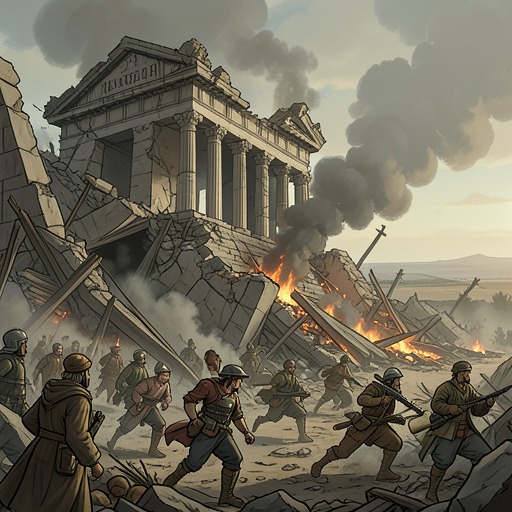
The collapse begins with the Theocracy’s own authorities recognizing a danger in Hugo Fritz’s work. Before his death, Cardinal Veltrilli assigned Judicators to investigate Fritz because of concerns about his experiments and his fixation on souls. By the time the Judicators understood what he was doing, intervention was impossible. Fritz activated bombs to escape them, destroying most of the Theocracy’s strategic bastions and converting the bulk of its armed forces into night terrors. The attack therefore annihilates both defensive capacity and institutional stability at once: the state loses its fortifications, its soldiers, and the authority that might have organized an effective response.
The demographic loss is catastrophic rather than symbolic. Lita reports that the attack kills seventy percent of the total population. Those who remain are not restored to ordinary civic life; they must either bend the knee to Fritz’s Neo-Crusaders or face execution. The Theocracy thus survives only as a fractured remnant, with political obedience imposed through terror and military resistance made nearly impossible. The later infestation is concentrated in city centers and along the borders rather than evenly distributed across the whole country, but that geographical distinction offers little relief to the population gathered in exposed settlements.
Life in the Ruined Theocracy
When Jack’s group enters the old city waterways, the landscape above is overrun by hordes of demonspawn, while the survivors move through frozen tunnels and frigid catacombs. The contrast between the devastated surface and the improvised underground routes makes the collapse material and immediate: the remaining people are not merely governed by a defeated regime but are navigating a country whose ordinary spaces have become lethal. Lita’s partisan guides use a lighting spell to move through the sewer system, and Jack’s Battle Chariot must crawl through a pipe large enough for a truck but barely suitable for a MECHFrame.
The survivors’ political position is equally precarious. Lita is a Judicator-in-training sent to the Imperium by Cardinal Veltrilli to seek aid, yet the institution that sent her has been crippled by Fritz’s attack. Her group continues resisting, but it does so without the food, shelter, ammunition, and military depth required for a prolonged defense. Jack eventually tells Lita that the choice is no longer a negotiation: the remaining citizens must evacuate to the Flying City and accept settlement in Imperial territory, or wait for the demonspawn to arrive and die. His ultimatum is coercive, but it is grounded in the collapse’s central fact that remaining in place offers no viable future.
The Theocracy’s religious identity persists amid the ruins through the hidden statue of Sahaqiel, identified by Lita as the statue of Saint Citri, founder and patron saint of the Theocracy. The statue’s presence is believed to limit demonspawn power during attacks, making it both a sacred relic and a strategic resource. The traitors know it exists and search the ruined city for it, so the object embodies the overlap between faith, survival, and military vulnerability. Jack recognizes Sahaqiel’s likeness before its significance is explained, while Sahaqiel herself is bewildered by the revelation, exposing a hidden connection between the Theocracy’s founding mythology and the angel traveling with Jack.
Refugees and the Flying City
Jack’s response to the collapse is not simply to extract individuals. He proposes bringing the city itself with its inhabitants. Because the land is lost, the country is in ruin, and demonspawn already crawl across the surrounding landscape, he argues that the Theocracy’s people will eventually be killed if they remain. Relocating them to neutral territory within the Empire would preserve their lives while also securing the Flying City, potential allies, and whatever secrets remain beneath it. The plan transforms the refugee crisis into a project of political reconstruction, although it also reveals the strategic value attached to the displaced population and its city.
The proposal is opposed by practical and cultural objections. Python points out that settling thousands of refugees requires materials and logistics, while much of the Empire dislikes the Theocracy and its religious “quirks.” Jack answers that most of the Empire dislikes his own people as well, yet he knows a place outside the Imperial cities that needs manpower and resources and will not discriminate against them. His argument recasts exile as a chance to build a new community away from established prejudice. Even so, the relocation remains an unequal bargain: Jack presents it as salvation, but Lita is ordered to accept it because the ruined Theocracy no longer possesses the means to choose freely.
Collapse as Political Justification
The Theocracy’s destruction becomes part of a wider pattern in which rulers describe emergency violence as necessary for humanity’s survival. Selfia admits that a purge is taking place across the Empire, with three hundred and sixty-nine lives already being extinguished, possibly more, including political opponents, rivals, dissidents, and anyone who might obstruct the New Republic. Jack is horrified because the language of survival conceals deliberate murder. When Selfia says she acted to remove obstacles and consolidate power, he rejects the claim that mass killing can be made legitimate by calling it necessary, especially when bystanders and innocents are endangered and Ada’s pregnancy is placed at risk.
That conflict gives the Theocracy’s Collapse a political meaning beyond its local devastation. Jack’s evacuation plan also contains force, but it aims to preserve a population whose choices have been narrowed by disaster. Selfia’s purge, by contrast, manufactures an emergency in order to eliminate opposition. The two approaches expose the unstable boundary between protection and control: a ruler can claim to be saving lives while deciding who may be sacrificed, displaced, arrested, or erased. The ruined Theocracy supplies the most visible warning of what happens when institutions fail, yet its suffering is repeatedly used by stronger powers to authorize new forms of exceptional rule.
The same survival rhetoric later expands into open war. Jack urges Imperial citizens to surrender before the coming battle, promising humane treatment and life as free citizens in the Cordelica Democracy, while Selfia tells humanity that devastated strongholds and the approach of extinction leave only one option: attack. Her speech names ruined cities and the threat of demonspawn before presenting military action as the necessary path to peace and survival. The Theocracy’s collapse therefore becomes a precedent in the story’s political imagination: catastrophe is real, but its reality does not prevent leaders from turning it into a language of conquest.
Lasting Significance
The collapse also connects local disaster to the deepest supernatural conflict. Michael intends to awaken Adam, the first Awakened and a hunter capable of pursuing the magically gifted across the globe. Sahaqiel warns that freeing Adam would kill the angels and doom the world, while Michael calls their deaths the foundation of a newer world. In this context, the Theocracy’s ruined cities and transformed soldiers are not an isolated calamity but part of a world in which human and supernatural powers repeatedly treat populations as expendable material for a supposedly improved future.
The condition persists as a defining background to later political life. Even after the immediate evacuation crisis, the Theocracy is remembered through its refugees, its sacred statue, its lost population, and the demonspawn-infested territory that could no longer sustain them. The collapse’s decisive consequence is therefore double: it destroys a country’s ability to remain where it is, and it forces the survivors into a new political order whose promise of safety cannot be separated from the coercion used to deliver it. The Flying City becomes a vessel of continuity, but the ruined homeland remains the measure against which every later claim of protection, unity, and human survival is judged.