Windermere
Awakening the Angel System: Apocalypse: A LitRPG Progression FantasyWindermere is both a military objective and a transformed landscape of war. Once the southern hub of Roland’s forces and the home of Adolf Hoffman, the city is first presented as the prize of Selfia’s advance, then as a ruined port whose destruction gives Jack the terrain he needs to face Athena. Its decisive significance lies in that reversal: Windermere changes from defended stronghold to devastated battlefield, and from a place associated with Hoffman’s life into a silent setting for Jack’s supernatural conflict.
Strategic Setting and Roland’s Defeat
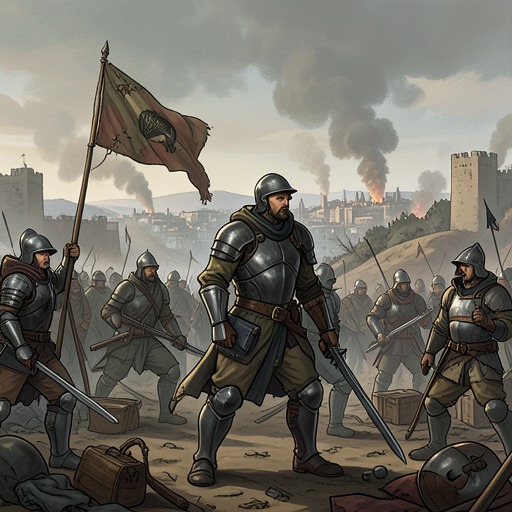
Windermere stands at the center of the southern front, with Roland’s forces positioned twelve miles outside the city while Selfia’s army closes in through the marshes. The Selfian advance includes heavy land ships and walkers, making the approach not merely an infantry movement but a full mechanized offensive. Roland’s intended counteroffensive collapses into a bloody reversal because of poor logistics, inadequate winter clothing, and desertions. The army is already being forced onto the defensive before the final struggle for the city begins.
The military imbalance is intensified by Selfia’s newly activated orbital array. Weaponized satellites strike Roland positions and decimate locations without shielding, turning the old Earth orbital relays into instruments of battlefield annihilation. A public briefing describes the Selfian forces as having brought the Roland army to its knees and identifies Windermere as the location of the last major Roland bastions. The city therefore functions as the visible endpoint of a wider technological and political defeat: its siege follows the collapse of Roland’s ability to contest the war on equal terms.
A City at the Center of Personal History
Windermere is not only a strategic name on a military map. When Jack sees an aerial image of a short-haired blonde woman in red armor, he recognizes Colette Gemini, Victoria’s former bodyguard. The sight reopens a separation that has lasted four years, including four years since the two last spoke. Windermere thus brings an old personal connection back into the same frame as the final stages of the war, making the city a point where Jack’s political campaign and unresolved human history intersect.
The city is also defined through its association with Adolf Hoffman. Jack later stands on the beach and identifies Windermere as the southern center of Roland’s forces and Hoffman’s home, immediately qualifying that description: it had once been those things, before Jack marched through it with his army. The distinction between what Windermere was and what remains is central to its portrayal. Military conquest has not simply transferred control of an intact city; it has erased the civic and domestic world that once gave the place its identity.
Ruin, Coastline, and the Final Battleground
By the time Jack returns to Windermere’s shore, the city is a field of destruction. The sea is filled with ruined boats, while the remains of piers, harbors, and docks lie broken along the coast. Jack walks through the sand and buries a canister there before approaching the water. The act is deliberate and quiet, contrasting with the scale of the devastation around him and suggesting that his purpose has moved beyond ordinary military occupation.
From the beach, Jack looks across a city now devoid of life. He says that he wishes Hoffman could have shown him around, a remark that gives the ruined landscape a mournful human measure. The city’s beauty survives in spite of its destruction: Jack acknowledges that Hoffman was right about it, even though Hoffman can no longer guide him through it. Windermere becomes a place where appreciation and annihilation coexist, its natural setting enduring while its inhabited spaces have been emptied.
Jack chooses the ruined environment as the site of his coming battle with Athena. The humidity, abundant water, and sand are not incidental scenery; he regards them as tactical resources against the angel. Windermere’s destruction, which might otherwise signify only loss, becomes Jack’s salvation because the terrain can be turned against the enemy. The port’s geography therefore enters directly into the combat logic: water and sand offer Jack possibilities that a different battlefield might not provide.
Athena and the City’s Supernatural Transformation
The silence of Windermere ends when the sound of beating wings announces Athena’s arrival. Jack turns to face a seven-foot-tall, four-winged Dullahan-type Apostle. She carries a tarnished gold shield and holds her obscured head beneath one arm, her face hidden behind black plates except for the mouth. Athena was once an angel but was consumed by the Infinity Machine; after Jack’s awakening, she became one of the Apostles of the End summoned into the world.
Her presence changes the meaning of Windermere again. The city is no longer merely the site of Roland’s defeat or a memorial to Hoffman. It becomes one of the places that prevent Jack from returning home, because the supernatural consequences of his awakening follow him into the ruins. The former military hub is converted into a threshold between the human war and the larger catastrophe represented by the Infinity Machine and the Apostles of the End.
The battle begins with such force that ordinary observers cannot follow the combatants. Jack and Athena vanish from human sight, leaving craters in the earth; their impacts split the ground, turn sand into smoldering glass, and drive Jack’s feathered spear against Athena’s shield. Windermere’s physical devastation is therefore extended rather than replaced by the duel. The city’s ruined piers and empty streets give way to fractured earth and vitrified sand, making the landscape a visible record of forces beyond conventional warfare.
Narrative Significance
Windermere embodies the passage from organized war to aftermath and from political conquest to personal reckoning. Its siege is enabled by Selfia’s superior logistics and orbital firepower, but its later scenes are governed by Jack’s memories, his regret over Hoffman, and the danger created by his awakening. The same location holds the collapse of Roland’s army, the return of Colette Gemini to Jack’s awareness, the memory of Hoffman’s home, and the arrival of Athena.
Its recurring contrast between beauty and ruin gives the city a distinctive narrative role. Jack can see the appeal Hoffman once recognized even while looking over a city emptied of life; he can use the wreckage of Windermere as protection even though that wreckage records the destruction he helped cause. The location is therefore not a static backdrop but a material expression of the story’s cost of victory. Windermere is conquered, destroyed, remembered, and weaponized in succession, becoming the clearest geographic symbol of how triumph in Jack’s campaign leaves no simple return to the world that existed before it.