Awakened
Awakening the Angel System: Apocalypse: A LitRPG Progression FantasyAwakened are the book’s superhuman population and one of its most consequential political categories. Their abilities transform military balance, make them objects of surveillance and experimentation, and place them at the boundary between humanity, angels, demonspawn, and the systems that govern magical power. The story repeatedly treats the Awakened as both people with individual choices and as a population to be classified, controlled, purged, recruited, or erased.
Definition and Display
The practical difference between Awakened people and ordinary humans is made unmistakable during Jack Tanjihiro Chae-wong’s training with the Hundred and Fifth. The soldiers march for hours through the woods and around the military base, exercise in full gear under severe heat, and struggle through gun drills. Pellet guns are fired at Jack, yet he moves so slowly that his ease in dodging them becomes more revealing than a show of speed. Afterward, the regular soldiers are exhausted and panting, while Jack and Leona remain unbothered, sitting on a bench and watching them as they wait for the next exercise. Awakened status is therefore not merely a hidden talent or an abstract designation: it is a bodily difference visible in endurance, reflexes, and the unequal experience of exertion.
The category also includes powers that operate on a battlefield scale. In recovered body-camera footage, Python Est and a dozen other Awakened fight Pawn number 5, Cobalt Claw, whose distinctive luna energy forms claws capable of tearing through CHECKMATE agents. The engagement ends with Python killing him by strangling him with vines. The episode places Awakened combat within a global conflict against CHECKMATE, an organization supported by nations and possessing the reach of an army. Their powers make them valuable combatants, but also make every encounter between them exceptionally lethal.
Awakened abilities are connected to a visible, game-like system of levels, titles, and skills. Jack’s body emits electrical sparks as his Authority of Gehenna advances from level two to level three. Later, the Angel System identifies him as a level-ten Nephilim and lists enhanced regeneration and mana synthesis. The system can also fail or expose damage: an attempted intervention involving Jill produces a warning of data corruption, while a later crisis unlocks a Radiant Skill and makes an Anti-Army Class Skill available. These displays translate bodily transformation, danger, and potential into programmable information without reducing their consequences to something harmless.
Military and Political Uses
Because Awakened people can determine the outcome of battles, governments treat them as strategic assets and security risks at once. During the campaign against Roland, Jack asks for a formal call of surrender before the assault and requests a unit specifically assigned to receive and house prisoners. His proposal reflects a recurring distinction between military necessity and the treatment of people caught inside it: even when Awakened power is being mobilized for war, Jack argues that surrender should reduce casualties rather than turn every opponent into a target.
The same political world uses emergency language to justify violence against Awakened and non-Awakened alike. Selfia Cordelica admits that guards and Awakened defenders were absent because they had been killed as a purge swept across the empire. Three hundred and sixty-nine lives had already been extinguished, with more potentially to follow; the victims included political opponents, rivals, and dissidents who might obstruct the advent of the New Republic. Selfia presents the killings as necessary to guarantee humanity’s survival and consolidate power, but Jack identifies the practical result as chaos, mass death, and danger to Ada Nguyen’s pregnancy. The Awakened thus become part of a state of exception in which the language of protection permits the suspension of ordinary protections.
Jack’s confrontation with Selfia makes that contradiction explicit. He rejects the claim that murder can be dressed up as necessity, emphasizing that bystanders and innocents were killed and that Ada Nguyen and his unborn child were placed in danger. The political question is not simply whether Awakened power should be used, but who receives authority to decide which lives may be sacrificed for a promised future. Selfia’s later strategic discussions continue this tension: when Jack asks what should be done about the High Table’s possible move during a period of military chaos, the proposed answer is to strike every enemy position and leave nowhere untouched. Awakened power is consequently embedded in a wider logic of preemption, intelligence operations, and total war.
Purge, Classification, and the Infinity Machine
The book eventually reveals that the fate of the Awakened has been shaped by an older disaster. Sahaqiel explains that the Awakened of the present are not identical to those of the past. Earlier authorities used a broad-spectrum targeting sequence because they did not understand the threat and feared that humanity might succumb to it. That policy stripped many people of their potential and eliminated those whose genes could produce more true-Awakened individuals. The distinction between ordinary Awakened and “true-Awakened” therefore has a history of institutional violence behind it: power was not merely inherited or awakened, but deliberately suppressed.
Sahaqiel claims that a more precise method is now possible. She believes she can target demonspawn and pure-blooded angels rather than wipe out every Awakened person. The proposed measure would spare the broader population while condemning the two people who fit the angelic criteria, including Jack and Sahaqiel herself. The category is thus revealed as unstable from the inside: the same abilities that make someone an Awakened person can, under another classification, mark that individual for extermination.
Her explanation also changes the meaning of the current crisis. The Infinity Machine functions as a computer with finite storage and processing capacity. Across the eons, accumulated data built up pressure; like a cork leaking from an overfilled vessel, the machine began releasing increasingly large amounts of corruptive code. The return of demonspawn and the existence of angels are connected to this failure. Awakened life is therefore entangled with an infrastructure that stores, processes, and leaks the conditions of existence itself. The machine does not simply provide abilities; it helps determine whether those abilities can appear, persist, or be removed.
War, Recruitment, and Human Purpose
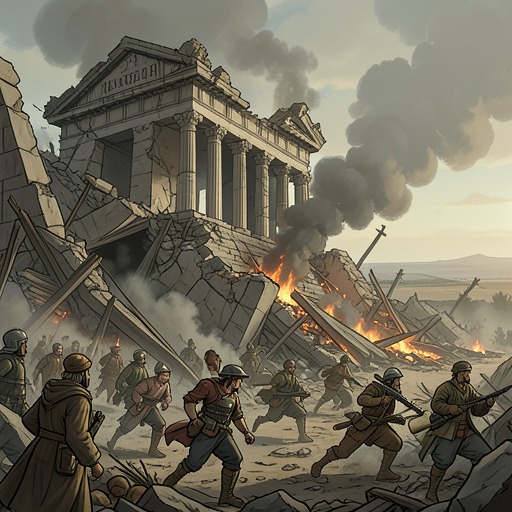
Awakened forces are indispensable when the enemy’s numbers exceed conventional military capacity. During the final defense, millions of demonspawn charge through a breach while thousands of defenders struggle to hold them back. Air support falls from the sky, MECHs break down, and the miasma worsens. A Paladin chaplain rallies the exhausted defenders by insisting that the fight is not over and that the angels need their support. The scene makes Awakened power part of a larger assemblage of soldiers, machines, faith, and environmental corruption: no single group can prevail alone, yet the angels’ presence gives the defense its central hope.
Their political value does not end with battlefield strength. After Jack kills Dorian Jazz, he considers using Jazz’s prisoners rather than treating them as an irredeemable enemy force. Selfia objects that they cannot be trusted, especially after Jack has killed their beloved general. Jack answers that they want purpose and places Jena Leslie’s journal and Dorian Jazz’s letter before Selfia as evidence that purpose might be offered to them. This proposal reframes Awakened warriors as people whose allegiance can be rebuilt through meaning rather than coercion. It also distinguishes Jack’s approach from the purges and extermination schemes elsewhere in the story: he still accepts lethal necessity in Jazz’s case, but he does not assume that every subordinate must share the same fate.
Awakened status also shapes the danger of encounters with hostile creatures. When Sahaqiel scouts ahead and detects fifteen Rithorns accompanied by a Nest agent, Jack immediately stops the group. The moment is brief, but it shows how Awakened perception and combat readiness structure movement through dangerous territory. In another confrontation, Jack attempts to reach Jill through her mask and is met by pain, screaming voices, and a blast of putrid energy, followed by a warning of corrupted data. Here the Awakened body becomes a contested site rather than a dependable weapon: its power can be altered, invaded, or made unreadable.
Suppression, Restoration, and Significance
The largest change in the category comes after Jack activates the Infinity Machine’s kill switch. Ada Nguyen asks what the switch means as the Holy City Flying Fortress crashes into the sea. Selfia observes that the corruptive purple smog has vanished and that the surrounding crowd contains thousands of people in outdated uniforms and armor. The scene suggests that the machine’s shutdown has altered the conditions under which people live and returned long-displaced lives to a changed world. Awakened existence is no longer governed by the same active system, and the immediate loss of strength confirms that the shutdown has material consequences for bodies as well as institutions.
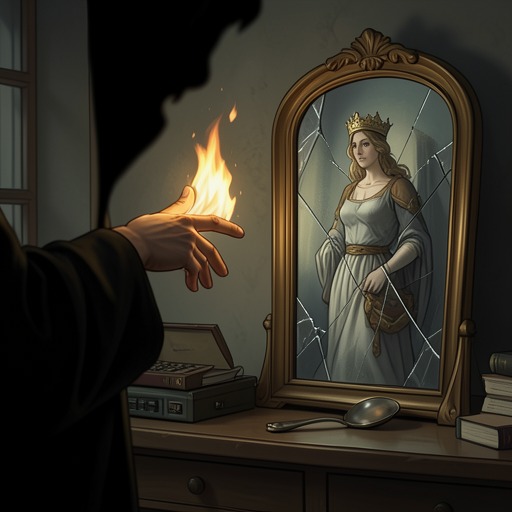
The ending then reverses the apparent finality of that loss. In the ruins, Jack raises his hand and causes the surrounding structures to glow gold as mana responds. He commands the Angel System to awaken, and translucent interfaces appear before everyone present. Unlike the interfaces beside him, Jack’s is labeled Administrator. Selfia recognizes the resemblance to the system and to abilities that she lost five years earlier. Jack’s new authority therefore does not simply restore an old power; it places him in a position to address the system directly and potentially govern its operation.
Awakened are consequently the clearest expression of the book’s conflict between human agency and administered power. Their strength can be demonstrated against pellet guns, concentrated into claws or vines, displayed through levels and titles, targeted by genetic policy, corrupted by machine failure, and transformed into an anti-army capability. They are repeatedly spoken of as a population to be managed, yet the plot keeps returning to individual decisions: Jack’s refusal to accept indiscriminate murder, Sahaqiel’s attempt to distinguish targets, and his willingness to offer defeated fighters a purpose. The final Administrator interface leaves the category open to renewal, but under a new question of authority: whether the system will again treat Awakened people as data to suppress, or whether its power can be placed under a more accountable human will.