Battle for the Holy City
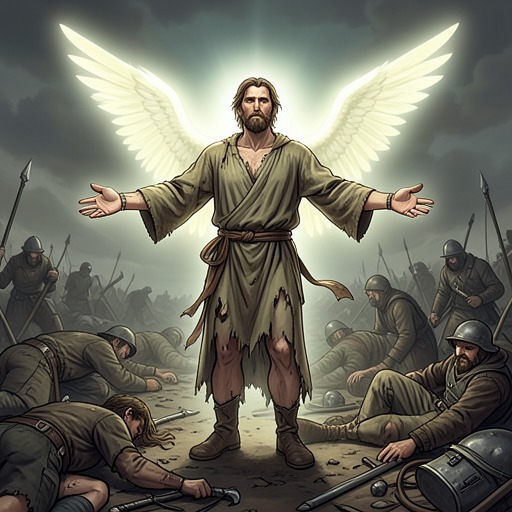
Awakening the Angel System: Apocalypse: A LitRPG Progression FantasyThe Battle for the Holy City is the major coalition assault on the Theocracy’s frozen capital, where Imperial commandos, Templars, Paladins, rebels, and allied air and armor units attack the High Table and its Cintelli collaborators. Planned as a rapid strike, the operation becomes a three-day battle across streets, bridges, airspace, and the citadel itself. The assault transforms former enemies into an uneasy military coalition while forcing Jack to confront a city whose religious authority is inseparable from military power, sacred symbolism, and clandestine experimentation.
Causes and Sacred Foundations
The battle is directed against High Table forces entrenched within the Holy City and supported by traitorous Cintelli elements. The city is not merely a strategic settlement. Its ice-covered churches, armed clergy, Paladins, and Templars embody a political theology in which sanctity functions as defense. Beneath one church stands a human-sized statue identified by Lita as the statue of Saint Citri, founder of the Theocracy. According to her explanation, the presence of the Theocracy’s patron saint limits demonspawn power when they attack the city, while traitors search for the statue because they understand its military value. The supposed holy image is also charged with a disturbing personal revelation: Jack recognizes the likeness as Sahaqiel, and Sahaqiel is unable to explain why her own form has become the object of worship.
The coalition therefore enters a space where sacred identity, military infrastructure, and supernatural force cannot be separated. Around the statue, armed Paladins and Templars carry submachine guns and staves while black-robed clergywomen defend the chapel. Religion is presented as an organized war apparatus, and the city’s sanctity is made tangible through weapons, guarded access, and the supernatural effects attributed to the saint’s presence.
Opening Assault and Coalition Tension
Before the attack, a dozen figures in white-patterned armor wait beneath a sewer grating leading toward the sprawling metropolis of ivory and stone. Jack’s Imperial commandos stand apart from the Templar soldiers, with the two groups segregated on opposite sides despite their alliance against the High Table. Their palpable tension preserves the memory of former enmity: cooperation is necessary, but it has not produced trust.
Jack waits for the appointed assault time, his head-up display reading 1859 as he prepares for the attack at 1900. Timed detonations then shatter the pause. Jack leaps through the paved road with his wings protecting his head and emerges onto a city street already engulfed in flames and explosions. Aircraft, tanks, and irregular rebels pour from concealed positions into the Holy City, while the cries of thousands of combatants catch the papal soldiers off guard. The attack is framed by a liberation imperative, but its immediate form is mechanized devastation.
The operation quickly expands beyond a street assault. Three days later, the city lies beneath fire and ash as lead and ionized bolts pass between massive machines fighting for control of the air. Jack, wearing white armor with silver wings and wielding a silver gunblade stained with black ichor, urges the coalition forward from atop bodies and wreckage. What was intended to be a blitz becomes a brutal, drawn-out clash throughout the ruined city, involving both urban combat and air warfare.
The Battle Widens
The coalition’s initial advance is complicated by the arrival of Roland airships. Roland forces reinforce the Cintelli traitors, while demonspawn commanded by the Green Bishop emerge from laboratories beneath the city. The apparent assault has become a trap: the enemy is not simply defending a capital but releasing additional horrors from an underground complex. Jack responds with extreme violence, using his wings as weapons while continuing to direct the broader operation.
The battle nevertheless produces visible breakthroughs. Jack rescues three Templar pilots and sends them, together with a prisoner, to Lita. Lita reports that Roland air support is withdrawing toward the citadel and that the 8th Armor and 14th units are advancing. Imperial and Theocracy forces then move together through the city, an image Jack finds strange because his distrust of the Templars remains intact. The political meaning of the alliance is unresolved, but battlefield necessity overrides personal apprehension.
Lita later arrives atop a Templar battle tank and reports that the 9th, 12th, and 56th units have secured their sectors. Roland air support is fleeing from Jack’s King’s Raven, and the remaining objective is the citadel. Jack boards an Empire-supplied Eclipse-Class battle tank and advances with the Paladins, recognizing that the true target is not only the visible fortress but the facility beneath it.
The Citadel and the Green Bishop
Inside the citadel, the defenders create a golden barrier through their choirmen. The barrier resists the Theocracy’s own assault, while two hellspawn have already killed scores of Paladins. Superbia remains engaged with General Cerda, leaving Jack to push toward the inner chambers. The siege thus combines conventional military resistance with ritualized sound, mana, and demonic guardianship.
When the barrier finally falls, nuns and clergywomen kneel and plead before Jack. Years of warfare and bloodshed have stripped away his sympathy for the enemy, yet he does not kill them indiscriminately. Instead, he leaves the prisoners for Lita to handle, tears a vault door from its hinges with enhanced strength, and orders Jessica and Commander Verlance to remain behind and contact Colonel Python. His stated objective is the Green Bishop, but his thoughts turn to his wife and child as he looks into the abyss below, linking the military operation to private fear and responsibility.
The confrontation below reveals another layer of the city’s horror. Jack is blasted into a wall and shields himself with his feathers before concentrating on a choir of children singing in a language he cannot understand. Sahaqiel understands the language of the angels and weeps because she has not heard it since childhood. Through Jack, her grief becomes present in the battle, turning the choir from an enemy device into an echo of an ancient, lost world.
Jack ultimately captures the Green Bishop in mana-suppressant shackles and has Imperial commandos carry him to a gray-metal transport. The capture is strategically valuable because Jack needs information about what happened to his sister. It also exposes a conflict within Jack’s own forces: Lilith demands the Bishop’s immediate death, accusing him of using and deceiving them in the name of ascending humanity, but Jack discovers that her powers now answer to him and orders her to stand down until the information is obtained. The Bishop is therefore defeated as a military commander but preserved as a source of knowledge.
Consequences and Narrative Significance
The immediate result of the battle is the coalition’s penetration of the Holy City, the retreat of Roland support, the securing of multiple sectors, and the capture of the Green Bishop. Yet the victory is deliberately incomplete. The city is devastated, the High Table’s underground operations have been exposed rather than erased, and the children left motionless after their master orders them to stop singing remain as evidence of an enemy whose violence has turned innocence into an instrument.
The battle also alters the meaning of alliance. Imperial and Theocracy troops fight side by side against a common enemy, even while Jack continues to regard the Templars with apprehension. The former division between political and religious forces is temporarily displaced by a broader struggle against the High Table, but the uneasy arrangement suggests that military unity does not amount to reconciliation.
In the wider political arc, the assault foreshadows Jack’s later public appeal to Roland citizens to surrender and his rejection of the old Imperial war doctrine that forbids surrender while resistance remains possible. It also anticipates Selfia’s later call for a vast expedition against the demonspawn, in which survival is framed as a collective human destiny requiring attack. The Holy City thus stands at the intersection of sacred kingship, revolutionary coalition, and total war: its defenders invoke sanctity, its attackers invoke liberation, and both claims are tested by the ruined streets beneath them.