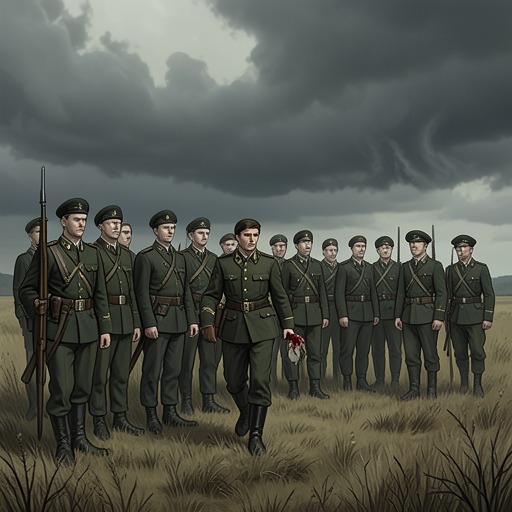
Battle of Gamma Station
Awakening the Angel System: Apocalypse: A LitRPG Progression FantasyThe Battle of Gamma Station, also remembered as the Gamma Station Raid or Gamma Outpost Raid, is a decisive military action whose importance is measured through its survivors and its aftereffects rather than through a single narrated battlefield account. It transforms a group of personnel into experienced operatives, places them within Queen Selfia’s wider war effort, and becomes a shorthand for the kind of sudden, unseen penetration that repeatedly threatens the protagonists’ defenses. Its legacy reaches from personal trauma and battlefield injuries to the formation of the coalition that later fights for Earth.
Origins and Military Context
The battle belongs to the larger conflict involving Queen Selfia, the High Table, Cintelli forces, and the competing fronts of the Roland–Selfian war. The available account does not present the engagement as an isolated clash. Instead, it is recalled as the point after which Gamma Station personnel became part of a continuing operational network. Jessica explains that, after the Gamma Outpost raid, her group began working with Queen Selfia on a number of operations. Their subsequent service therefore emerges directly from the battle’s reorganization of loyalties and military roles.
The survivors were not treated as ordinary civilians or incidental witnesses. Yun emphasizes that everyone from Gamma Station possessed combat experience and that the group had completed SERE, OCDTS, and STARs training, with Leona clarifying that STARs meant Special Tactics and Rescue training and that all Checkmate agents underwent it. The battle thus functions as both a violent encounter and a credentialing experience: surviving it helps define the personnel as operatives capable of being absorbed into Checkmate’s protection and intelligence apparatus.
Survivors and Immediate Legacy
When Jack encounters Yun, Jessica, and Leona again, the old battle is present beneath the casual reunion. Jessica identifies the group’s post-raid work with Selfia, while Jack realizes that nearly everyone from Gamma is now assigned to his protection detail. Elena is absent on maternity leave and has been replaced by a Saber Team operative, but the basic arrangement remains: the Gamma survivors have been converted from the personnel of a past crisis into Jack’s continuing security structure.
The battle’s human cost is visible in the bodies of those who lived through it. Yun displays a prosthetic leg while describing the group’s subsequent service, making the consequences of the conflict materially present rather than merely historical. Jena’s reunion with Jack carries another reminder of the station’s danger: during an earlier encounter, she gave him a grenade so that he could kill himself if the monsters took him. The memory links Gamma Station to a battlefield where survival itself could become morally and physically intolerable.
The same network includes Yun, Elena, Jessica, Tyrah, and Jena, who served aboard The All Under Heaven after the battle. The tactical command airship had been scuttled after the Battle of Frelia and the fight with the former Queen’s Flying Fortress, so Gamma Station’s survivors continued their work amid a sequence of disasters rather than returning to security. Their path ran through the Battle of Frelia, the Roland–Selfian front lines, and raids on High Table facilities. A chance encounter with a teenage boy altered their destinies, suggesting that the battle’s consequences are not limited to military promotion: they redirect the personal histories of the people who emerged from it.
Recurrence as a Tactical and Psychological Threat
Gamma Station returns later as a comparison whenever the characters confront an enemy who has bypassed ordinary defenses. During a search through a dark stairwell, Yun asks where everyone has gone and remarks that the situation is Gamma Station all over again. The circumstances are defined by absence: a team expected in the corridor is missing, communications are down, the defenses have been penetrated, and the guards cannot be found. Tyrah’s immediate request not to be reminded reinforces that the comparison is traumatic, not merely technical.
The recollection gives the later scene a specific emotional charge. Gamma Station has become a template for invisible collapse, in which the apparent strength of a fortified installation conceals the fact that its defenders have already been isolated or removed. Yun’s unease is therefore based on experience. The battle has trained her to read silence, missing personnel, and failed communications as signs of an attack already underway.
The same pattern appears in intelligence concerning Cintelli territory. High-orbit imagery reveals an undetectable transponder strobe surgically attached to Major Taya Domino, while Paladin Lita reports that people have disappeared as her resistance forces encounter the black MECHFrame. Intelligence officers believe the facility beneath the snow may be holding Jack’s sister. Although these later disappearances are not identical to Gamma Station, the narrative places them in the battle’s shadow: covert abduction, concealed facilities, compromised defenses, and uncertainty over who remains alive all repeat the earlier crisis’s defining structure.
Political and Personal Consequences
The battle helps convert local military experience into broader political alignment. Gamma personnel work with Selfia, join Checkmate, serve aboard Selfia’s tactical command airship, and eventually become part of the forces assembled against the escalating threat. Their movement illustrates how the war recruits people through survival: those who endure one operation are drawn into the next, carrying their training, injuries, memories, and loyalties with them.
The event also exposes the instability beneath official alliances. Mi’shka’s office contains a photograph of a younger Mi’shka in dress blues beside Eleanor, a woman Jack knew well. Mi’shka explains that Eleanor died because of a High Table plot and that this history made him unwilling to remain a pawn in struggles whose true threat lay elsewhere. Leona supplies another account of Eleanor’s death, identifying her as a MECHFrame pilot who died saving Jack. These connected memories place Gamma Station within a chain of sacrifices shaped by military technology, political manipulation, and personal obligation.
The battle’s effects eventually feed into a war whose scale exceeds any one station or state. Selfia later governs from a displaced base after Lunacrypt Capital becomes a wasteland of dead bodies, demonspawn, and abandoned debris. Millions of Imperial citizens and their infrastructure must be relocated, with the Theocracy’s floating city providing housing and protection to thousands. By the time Jack returns from combat, the surviving armies are being organized under the name Coalition to Free Earth. Gamma Station is consequently an early node in a widening military network: a raid that begins as a localized disaster becomes part of the history through which scattered forces are gathered for planetary survival.
Narrative Significance
The Battle of Gamma Station is significant because the book treats battle as an enduring condition rather than a completed episode. Its details are distributed through reunions, reports, tactical comparisons, memories of the dead, and the altered bodies of survivors. This fragmented presentation makes the battle’s meaning cumulative. The reader learns what it was by observing what it did to Yun, Jena, Leona, Jessica, Tyrah, Elena, Mi’shka, Eleanor, and Jack.
Its dominant narrative pattern combines military action, rescue, pursuit, and survival. It creates trained agents, protective alliances, and later missions while also establishing a vocabulary of dread: a quiet corridor, failed communications, missing guards, and an enemy that has already crossed the perimeter. The battle’s decisive value shift is from presumed security to exposed vulnerability, followed by a partial recovery in which survivors gain purpose but never regain the innocence of those who entered the station.
Gamma Station therefore operates as both event and wound. It explains why Checkmate’s agents are capable, why their humor often borders on nervous bravado, why Jack’s protection detail is drawn from people who already know the cost of failure, and why later infiltrations feel like repetitions of an unfinished catastrophe. Even after the world’s surviving forces unite as the Coalition to Free Earth, the battle remains embedded in their methods and memories: the past is not behind them, but a warning system still sounding inside the present.