Corporate Alliance
Awakening the Angel System: Apocalypse: A LitRPG Progression FantasyThe Corporate Alliance is a major political and economic power in the novel, defined less by a single battlefield than by the infrastructure, industry, and supply networks that keep war and ordinary life functioning. Its territory contains Eden City and Cordell Plaza, while its institutions are entangled with the High Table’s projects. As the global crisis intensifies, the Alliance shifts from an apparently prosperous corporate order into a besieged society whose leaders, soldiers, resources, and civilians are drawn into Jack’s campaign against the systems behind the catastrophe.
Territory and Corporate Power
The Alliance’s principal setting in the supplied material is Corporate Alliance Territory, specifically Eden City and the central territory of Cordell Industries. Cordell Plaza is described as Eden City’s crown jewel and as the home of Cordell Engineering, an organization controlled by the Black King and responsible for engineering components used in High Table projects. The connection makes the Alliance more than a neutral commercial state: its industrial capacity has been absorbed into the machinery of a hidden power structure, and the parts produced there helped create the monster Jill became.
The Alliance is also connected to transregional trade. Jack examines files on the High Table showing money transfers, liquid-nitrogen shipments, and large movements of apples between cities in the Empire, the Corporate Alliance, and the Theocracy. The apple trade initially appears mundane, but its recurrence suggests how commercial logistics can conceal political finance. The High Table’s activities are not separated from ordinary markets; they move through the same routes, warehouses, and supply chains on which states depend.
Eden City and the Alliance’s Collapse
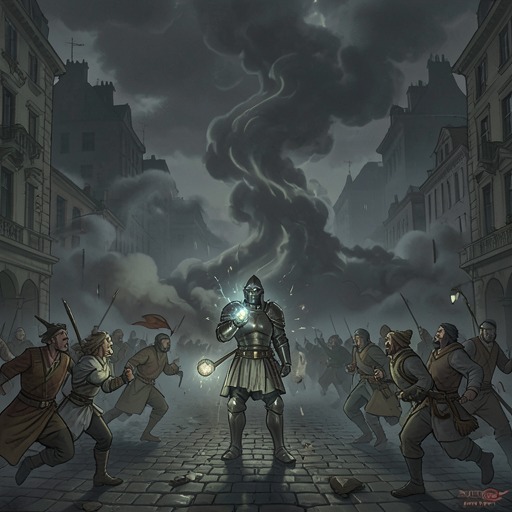
By the time the narrative reaches Eden City, the Alliance’s territory has become a site of open devastation. Cynthia Rockefeller, identified as the leader of the Corporate Alliance, is killed by Jack while Armageddon unfolds around him. Her final warning is that Michael will always remain a step ahead. Jack answers not with reconciliation but with a threat to kill everyone Michael knows, and he denies Cynthia the mercy she requests by treating her rapid death as the only mercy available to her.
Jack’s violence is immediately tied to the Alliance’s institutional landscape. He points toward Cordell Plaza, insisting that the people he loves will have no life unless he continues the struggle. The building is not merely a corporate landmark: because Cordell Engineering supplied parts for High Table projects, it represents the industrial chain that produced Jill’s transformation. Jack therefore reads the destruction around him through both personal grief and structural responsibility. The Alliance’s corporate center becomes a target because its technology has been made complicit in the creation of an atrocity.
Military and Logistical Role
The Alliance’s military importance becomes clearest during the planning of the Zanzibar expedition. Selfia’s forces identify Zanzibar as a place where equipment and personnel have been concentrated after contact with the city was lost. They also identify Dorian Jazz, the High Table’s chief enforcer, as the Red Rook. The proposed operation requires the seizure of Zanzibar, interrogation of the Red Rook, and capture of the boats there, because seafaring craft are essential for reaching the Forgotten Continent.
The Alliance is asked to provide supplies. This request exposes the practical basis of the coalition: victory depends not only on awakened powers or strategic intelligence but on food, ammunition, vehicles, ships, filters, and replacement parts. The Forgotten Continent’s corruption and demonspawn make ordinary equipment fail. Non-Awakened soldiers need filters or die within seconds; obsifiter generators and mana-dependent systems are starved; MECHFrames shut down, airships stall, Awakened soldiers suffer prolonged poisoning, and even robots short out. The Alliance’s contribution is therefore measured through material capacity rather than symbolic allegiance.
Its technology also supplies the connective tissue of military movement. A ray shift beacon, a tripod-mounted crystal orb, can call a Selfian airship to a designated city within minutes, although civil war has caused many such navigational systems to be turned off. The device illustrates the Alliance’s wider predicament: advanced infrastructure exists, but war has disabled or fragmented the networks that make it useful. In this world, logistical power is always conditional on political stability.
Technology, War, and Human Cost
The Alliance’s industrial and military systems are repeatedly shown as extensions of a larger technological order. During one battle, Tangerine’s Damocles MECHFrame tears open a Khloros cockpit, exposing the enemy pilot. The scene makes mechanized warfare brutally intimate: a machine that appears to be armor or equipment becomes the immediate instrument through which one human body reaches another. The Alliance’s technological world does not keep violence at a distance; it gives violence new shells, new interfaces, and new ways to conceal responsibility.
The wider explanation of the Infinity Machine deepens this connection. Sahaqiel states that the machine reads all data flow and translates what people call mana into data, functioning like a gigantic server and router that connects the world. During the original outbreak, it halted and reversed the flow of mana, drawing in a particular spectrum of data and eliminating those who possessed mana capability. Although the Corporate Alliance is not the machine’s creator, its factories, engineering firms, military hardware, and political networks exist within the same technological civilization. The Alliance thus stands inside the novel’s central ethical problem: systems presented as tools for coordination and survival can classify bodies, distribute power, and erase lives.
Refugees, Scarcity, and Political Reordering
After Lunacrypt Capital becomes a wasteland of corpses, demonspawn, and abandoned debris, Selfia moves her base of operations. The floating city of the Theocracy provides housing and protection for thousands who follow her, but the displacement of millions of Imperial citizens and the movement of infrastructure create severe shortages. Food becomes scarce, while ammunition and replacement parts run low. Nomad, Paladin, and Imperial survivors fight among themselves over distribution, and tribal leaders object when their supplies are diverted to the Paladins.
This crisis places the Corporate Alliance within a broader coalition whose survival depends on forced redistribution. The Alliance’s earlier identity as a territory of industry and commerce is transformed by the collapse: its resources are no longer circulating primarily through markets but are being redirected toward refugees, expeditions, and resistance. The resulting conflicts show that military unity cannot erase differences in citizenship, class, faction, or local custom. Aid is necessary, yet every shipment also creates a new dispute over who has the right to receive it.
Narrative Significance
The Corporate Alliance functions as the novel’s clearest meeting point between capitalism, technology, and war. Its corporate structures provide the factories and logistics needed to sustain resistance, but those same structures have been linked to the High Table and to the machinery that deforms human beings. Eden City’s destruction therefore carries a double meaning: it is the ruin of a political territory and the exposure of an economic system’s entanglement with hidden violence.
Its decline also parallels the novel’s movement from organized institutions toward emergency alliances. The Alliance can offer supplies, military force, and industrial infrastructure, but it cannot by itself explain or control the Infinity Machine, the mana system, or the supernatural powers that now determine survival. As Jack advances toward the sealed source of immense mana and Eve’s account reveals the machine’s original purpose, the Alliance becomes part of a much larger historical chain. It is both victim and participant: a society endangered by forces beyond its control, yet implicated in the production and circulation of the technologies that made those forces possible.