Days of Decimation
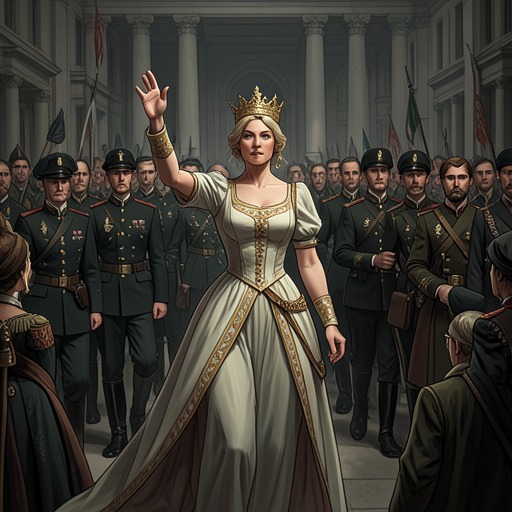
Awakening the Angel System: Apocalypse: A LitRPG Progression FantasyDays of Decimation is the regime-wide purge that transforms Selfia Cordelica’s attempt to secure a new political order into an atrocity that Jack Cordelica cannot accept. The event combines secret executions, the destruction of opposition, attacks across the empire, and a public language of survival. Its decisive significance lies in the struggle over what the killings mean: Selfia calls them the unavoidable foundation of humanity’s future, while Jack sees the deaths of dissidents, bystanders, children, and entire bloodlines as a choice for which no political program can provide absolution.
Causes and Political Background
Days of Decimation emerges from the collapse of the old imperial order and Selfia’s effort to replace it with the New Republic. She tells Jack that the purge removed political opponents, rivals, and dissidents who would obstruct the new government, while also eliminating the remaining structures of resistance. The operation therefore has both an ideological and an immediate political purpose: Selfia claims to be defending the continuity of mankind, but she also openly acknowledges that removing her enemies creates a power vacuum that she intends to fill.
Selfia’s explanation reveals that the operation was concealed from Jack precisely because she knew he would oppose it. She had presented the names on her list as people who would be arrested, allowing him to believe that their removal from political life would occur through detention rather than execution. When Jack confronts her, she admits that she did not lie about wanting to solidify her power; she lied about the method. Her justification is paternalistic as well as political: she says the truth would have damaged his sanity and that the deception gave him a target to blame. The claim only deepens the betrayal, because it treats Jack’s moral resistance as a weakness to be managed rather than a judgment to be respected.
The purge is also inseparable from the violence already spreading through the empire. News reports describe attacks associated with the High Table and call the preceding days the Days of Decimation, while Selfia frames the disorder as the opening through which democracy can be built. Later, she argues that the empire’s enemies will exploit the chaos created by collapsing military forces and simultaneous operations. Her proposed response is to strike everywhere and leave no place unsearched, turning uncertainty into a reason for escalation. The event thus grows from a state of emergency in which ordinary restraints are repeatedly displaced by claims of necessity.
The Purge and Its Immediate Human Cost
Selfia gives the scale of the operation with a precise figure: three hundred and sixty-nine lives are being extinguished, with the possibility of more deaths if the operation continues. Those targeted include political opponents, rivals, and dissidents, but the violence does not remain confined to identifiable enemies. Jack points to the deaths of roughly three hundred people shown on the news and emphasizes that some were bystanders and innocents. Selfia’s political arithmetic cannot erase that distinction; the purge’s stated targets and its actual victims occupy different categories.
The personal stakes become unavoidable when Jack learns that the danger reaches his own family. He accuses Selfia of placing Ada Nguyen and his unborn child at risk, asking what would have happened if Ada had miscarried or if the child had been harmed by the queen’s actions. Selfia insists that Ada and Kamila were never in genuine danger because Jack is too valuable to alienate permanently, but this assurance does not repair the breach. For Jack, deliberately creating danger around the people he loves is itself an act of violence, regardless of whether the threatened outcome was intended to occur.
Selfia does not retreat from the moral implications. She declares that she would repeat the purge without hesitation because the fate and continuity of humanity are, in her view, at stake. Her imagined future is one in which monsters like herself no longer need to exist, yet she accepts becoming monstrous as the route toward it. She extends the logic to its most extreme form, saying that infants, cities, and thousands of lives may be sacrificed if millions survive. The event’s horror therefore lies not only in the number killed but in the conversion of every limit into a negotiable cost.
Jack’s Rejection of Necessity
Jack’s confrontation with Selfia is the event’s central moral collision. He rejects her attempt to rename murder as an act that simply had to be done, insisting that another path existed and that uninvolved people should not have been killed. His anger is intensified by the discovery that the list included children and entire bloodlines. What Selfia describes as the removal of obstacles appears to Jack as an attack on families, including the family he is trying to protect.
The disagreement is not a minor dispute between political allies. Jack had entered public life through imperial ceremony, escorted by Duchess Belia Bell as the nearest surviving parent-figure and presented before hundreds of strangers in the formal world of power. That ceremonial image of legitimacy is later inverted by the purge: the same political order that dresses authority in ritual and public dignity operates through concealed killing. Selfia’s transformation from queen and ally into the architect of mass violence makes Jack’s earlier participation in that order feel compromised by knowledge he did not possess.
Jack’s response is also shaped by the broader evidence of institutional cruelty. In the Theocracy, a bishop defends the abuse of orphaned children by claiming to have fed, clothed, and given them purpose; Jack answers that the supposed care is sickness. In another facility, he finds children confined in cages as test subjects, some starving, decomposing, or already dead. These discoveries provide a material counterpart to the political purge: both systems use protection, purpose, or survival to justify the destruction of vulnerable people. Days of Decimation places Jack between competing forms of sanctioned violence and forces him to decide whether victory can remain meaningful when its methods reproduce the enemy’s crimes.
Public War and the Expansion of the Logic
The purge’s language later becomes the language of war. Jack broadcasts an offer to surrender, declaring that the old imperial doctrine forbidding surrender while resistance remains possible belongs to a dead imperium. He promises humane treatment and citizenship in the Cordelica Democracy to those who lay down their arms. The speech presents a contrast with the indiscriminate violence associated with the purge, but it also shows how the new regime seeks legitimacy through a carefully staged promise that political submission can produce safety.
Selfia’s own speeches make survival the central political myth of the period. She names fallen strongholds and ruined monuments, warns that humanity will be exterminated, and concludes that the only option is to attack. The expedition she announces is described as the greatest since humanity went to space, an action that will end the demonspawn threat and place the future back in human hands. This rhetoric converts collective fear into mobilization. It also preserves the structure Jack had condemned: catastrophe is invoked to make violence appear not merely permissible but obligatory.
The operation’s consequences extend beyond its initial killings. Reports continue to circulate about attacks on Frelia and experimental facilities where kidnapped people were held, while Selfia describes documents being leaked, dissidents being silenced, and the High Table being confronted through a coordinated political offensive. The Days of Decimation therefore functions as both purge and information war, combining physical elimination with control over the narrative that explains it. Its perpetrators seek not only to remove opponents but to determine which account of the removals will survive.
Consequences and Historical Meaning
The immediate consequence is a permanent fracture between Jack and Selfia. Jack’s love of family and his resistance to the murder of innocents become incompatible with Selfia’s willingness to sacrifice anything for a projected human future. Their argument exposes the instability of their political and personal alliance: Selfia believes Jack must eventually understand the necessity of her mission, while Jack sees that understanding as a demand to surrender his moral judgment.
The event also establishes a recurring pattern in the wider conflict. Religious authorities defend cruelty as care; military leaders defend annihilation as protection; Michael later invokes twenty millennia of suffering and insists that every crime was worth committing if it could save humanity from its cycle of war. Jack rejects that argument as well, answering Michael’s appeal to the greater good with the question of whether all of Jack’s suffering was necessary. The same justification returns across different institutions, and each recurrence makes the original purge less an isolated excess than a template for the world’s political violence.
Days of Decimation finally becomes a foundational contradiction of the new order. Selfia wants the purge to clear the path toward democracy and a future without monsters, yet the path is built through secret execution, threatened families, civilian deaths, and the abandonment of moral restraint. The event’s lasting importance is therefore not reducible to its casualty count. It marks the moment when the promise of human survival is openly separated from the obligation to preserve individual lives, leaving every later claim of protection shadowed by the question Jack asks through his anger: whether a future purchased by killing the innocent can still be called a future for humanity.