Heaven’s Rise
Awakening the Angel System: Apocalypse: A LitRPG Progression FantasyHeaven’s Rise is the apocalyptic ascension of a buried fortress that turns a battlefield into the threshold of a new catastrophe. The emergence of Heaven exposes the scale of the threat facing Jack, Sahaqiel, Selfia, and the surviving forces of humanity: an ancient stronghold, larger than the Imperial capital, rises beyond ordinary military control while the Black King’s plan advances toward its intended culmination.
Causes and Background
The action occurs amid a wider struggle in which political authority, military doctrine, and claims of human survival have repeatedly been used to justify extraordinary violence. Selfia has already defended a purge across the empire as necessary to secure mankind’s future, admitting that 369 lives, or possibly more, were being extinguished among political opponents, rivals, and dissidents. Jack rejects that logic, pointing out that the operation has produced chaos, killed bystanders and innocents, and endangered Ada’s pregnancy. His objection establishes the moral pressure surrounding later appeals to necessity: survival is not merely a strategic objective, but the language through which rulers attempt to make mass death acceptable.
That rhetoric continues through the war. Jack offers Imperial citizens a chance to surrender, promising humane treatment and citizenship in the Cordelica Democracy, while Selfia later tells humanity that the ruins of Lunacrypt, Soldaer, Clausterfiell, and Solarus demonstrate the need to attack. Her speech presents the coming expedition as the greatest undertaken since humanity went into space and frames victory over the demonspawn as the condition of species survival. Heaven’s Rise violently confirms the scale of the danger invoked by those speeches, but it also makes their confidence look fragile: the enemy possesses a power that conventional political and military systems cannot easily contain.
The Emergence of Heaven
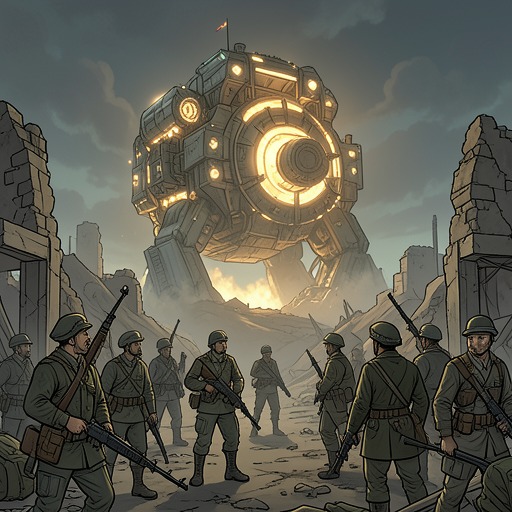
The ascent begins with a disturbance rather than a clearly announced attack. The air vibrates, the earth shakes, and miasma and Mana swirl together as the ground ruptures beneath the blood-soaked soil. A massive structure then rises from the opening, converting the landscape itself into a wound. Jack initially cannot identify what he is seeing; Sahaqiel recognizes it with immediate dismay as Heaven and understands that they are too late.
The revelation carries both physical and historical weight. The structure is not simply a ship arriving from elsewhere. It has been concealed beneath the earth, and its ascent tears the land apart, replacing the terrain before Jack with a gap in the ground and an ancient bastion rusted and caked with demons and soil. The fortress therefore appears as something excavated from a buried past, but its movement is directed toward an imminent future. Its age does not make it inert. Instead, the ancient stronghold becomes newly active at the exact moment when the surviving human forces believe they are still capable of deciding the war.
As Heaven rises, hundreds of thousands, perhaps millions, of demonspawn fall from its edges. The image changes the threat from an army that can be counted and engaged into a descending multitude attached to a structure whose dimensions overwhelm ordinary comparison. Jack tracks the vessel as it climbs, its massive thrusters lifting a hidden fortress that dwarfs even the Imperial capital. The ascent is consequently both a military maneuver and a spectacle of impossible scale: a city-sized remnant of an older power becomes airborne while the ground beneath it collapses.
The Failed Counterattack
Jack immediately seeks a practical response. He flies upward to follow Heaven, and Sahaqiel orders him to get onto the structure and try to prevent it from rising farther. Her warning is unfinished when detonations begin. Hundreds of explosives strike the fortress, followed by another barrage from satellites in orbit. The coordinated attack represents the fullest available answer from modern warfare: direct assault from the air, heavy explosives, and weapons positioned beyond the battlefield itself.
The result is not merely limited success but complete negation. A magical barrier of intense energy reflects even the orbital beams, leaving the ancient structure undamaged. The contrast between technological force and supernatural defense defines the action’s central reversal. Humanity’s weapons can reach Heaven, but reaching it does not mean being able to harm it. The fortress rises through the bombardment as though the attack confirms rather than interrupts its supremacy.
The narration therefore moves from anticipation to visible horror and then to strategic despair. Jack first witnesses the rupture, then the monstrous flood of demonspawn, and finally the failure of explosives and satellites. The threat is no longer hidden, but its full meaning remains beyond the defenders’ control. When the assault proves useless, the battlefield’s value shifts from a place where humanity might stop the enemy to a place from which humanity can only react.
The Black King’s Victory
The immediate judgment is stark: the Black King has won. Heaven’s successful ascent is treated as the decisive completion of the enemy’s operation, not as one setback within a continuing exchange. The fortress has escaped the defenders’ ability to damage it, its demonspawn have been released in overwhelming numbers, and its rise has altered the physical and strategic conditions of the war.
Yet the action does not end with Jack’s submission. Although the narration recognizes the Black King’s victory, Jack refuses to lose quietly. He turns and sees Selfia and dozens of others disembarking from several MECHs to assess the situation. Their arrival does not undo the failed bombardment, but it prevents the scene from becoming an uncomplicated declaration of surrender. The surviving leaders are forced to appraise a new reality together, while Jack’s refusal preserves a narrow distinction between defeat and capitulation.
That distinction echoes the earlier political conflict over surrender. Imperial war doctrine had forbidden surrender while a force retained the means to resist, whereas Jack’s broadcast tried to separate the dead Imperium from a future in which citizens could live freely. Heaven’s Rise places the question in a harsher register: resistance may be nearly impossible, but Jack’s response insists that moral and personal agency are not identical to military advantage.
Narrative Significance
Heaven’s Rise functions as a turning point built from scale, revelation, and reversal. The statue of Sahaqiel in the Theocracy had already shown how an individual could be transformed into a sacred public image: the statue was presented as the likeness of a patron saint whose presence limited demonspawn power, while Sahaqiel herself reacted with bewilderment to seeing her own form represented as holy. Heaven reverses that kind of controlled religious symbolism. It is not a statue or an institution preserving a sanctioned image; it is a buried, moving monument that erupts into the world and carries the enemy’s power with it.
The action also exposes the limits of political promises. Wedding and coronation ceremonies can turn private lineage into public legitimacy; speeches can promise survival, surrender, or a future shaped by humanity; emergency purges can claim to protect that future. Heaven’s ascent answers all such declarations with an event too large for rhetoric to master. Its barrier reflects satellites, its body dwarfs the Imperial capital, and its emergence produces a landscape in which familiar structures of command appear temporary.
Most importantly, the scene converts an expected military engagement into an encounter with the unknowable. Jack and Sahaqiel can name the fortress only after it has already broken the earth, and their plan is interrupted before it can become action. The repeated movement upward gives the event its inexorable rhythm: the more Heaven rises, the less accessible it becomes, until the defenders’ weapons fail and the Black King’s victory is acknowledged. The final image of Jack refusing to lose quietly does not diminish the catastrophe; it gives the catastrophe its human counterpoint, preserving resistance as an ethical posture even after victory has passed to the enemy.