Heaven's Fall
Awakening the Angel System: Apocalypse: A LitRPG Progression FantasyHeaven's ascent and fall is one of the war's decisive reversals. What first appears to be a battlefield already turning in humanity's favor becomes the emergence of an ancient flying citadel, carrying hundreds of thousands or even millions of demonspawn, and then a desperate operation to stop it before it can complete its ascent. The fortress is slowed by attacks on its engines and ultimately thrown from the sky when Python Est rams the FYR into it, making victory inseparable from sacrifice.
Emergence of the Hidden Fortress
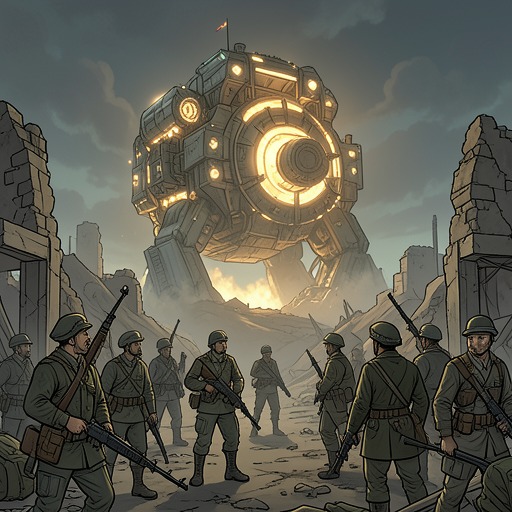
The event begins with the battlefield itself becoming unstable. The air vibrates, the earth shakes violently, and miasma and mana swirl together as the ground ruptures. From the blood-soaked soil rises a structure so immense that Jack has never witnessed anything comparable. Sahaqiel recognizes it immediately as Heaven and realizes that the coalition is too late. The delayed recognition intensifies the scene's terror: the threat is not merely an enemy force approaching across open ground, but an ancient bastion concealed beneath the battlefield and capable of becoming airborne.
Once Heaven clears the earth, its scale becomes a strategic catastrophe. The citadel is larger even than the Imperial capital, lifted by massive thrusters, while hundreds of thousands or possibly millions of demonspawn spill from its edges. The landscape is torn apart, replaced by a gap in the earth and the rusted, demon-caked fortress. The image joins military technology to grotesque organic invasion: a ruined bastion rises like a buried corpse, and its ascent releases an army rather than simply transporting one.
The Coalition's Counterattack
Jack asks for a plan while flying upward to track the vessel. Sahaqiel identifies the immediate weakness: Gehenna can breach Heaven's barrier, allowing Selfia to coordinate artillery against the fortress's six main thrusters. Destroying those engines would stop its ascent and break its link to the power sustaining the citadel. Jack agrees to work with Lilith while Sahaqiel returns to Selfia and orders the Imperial forces to prepare.
The attack is conducted under relentless pressure. Jack must analyze and tear through Heaven's mana barrier while fighting bonebats and mutant slicers. Selfia sends her MECHFrames into the struggle, and coalition airships bombard the exposed propulsion systems. Each engine disabled visibly slows the fortress, turning the battle into a race between Heaven's rising momentum and the defenders' ability to expose and destroy its means of flight. The operation therefore shifts the value at stake from ordinary battlefield advantage to the survival of everyone beneath the citadel.
The miasma worsens as the battle continues, making failure increasingly fatal for Selfia and the forces around her. On the King Raven-class airship, Python Est exhausts his ammunition and mana while Lieutenant Harper, after handing him another shotgun, collapses against a bulkhead. When the exhausted crew can no longer operate the vessel, Python takes command of the FYR. He understands that its weapons cannot destroy Heaven, but that the carrier can slow it through impact, and he broadcasts an order for all coalition forces to prepare for collision.
Python Est's Sacrifice and Heaven's Fall
The decision turns the counterattack into an act of deliberate self-sacrifice. Jack sees the familiar airship, already coated with demonspawn, race toward Heaven and collide with the floating structure. The FYR's detonation creates a brilliant explosion, while Sahaqiel pulls Jack away and their wings shield them as they fall. Jack's repeated cry for Python carries rage, grief, and frustration, but the shockwave overwhelms it before the loss can be answered.
The collision completes what the engine attacks began. With half of its engines gone and the air carrier embedded in its assault, Heaven lists and rotates as its propulsion fails. The citadel flips, loses control, and begins to fall. Sahaqiel notices that she can breathe more easily, a physical sign that the immediate pressure of the fortress has broken. Jack's scream becomes the emotional counterpart to the structure's collapse, and the fortress finally smashes into the earth, releasing a shockwave across the ruined landscape.
Political and Religious Echoes
Heaven's fall resonates with the wider conflict's repeated use of ceremony, sacred authority, and survival rhetoric. Earlier, Jack entered a political chamber in a formal black uniform with Duchess Belia Bell, whose red heels kept time with his boots as she led him into a room of strangers. The Empire's ritual treated lineage and maternal authority as public symbols. In the Theocracy, Lita identified a statue of Sahaqiel as the image of Saint Citri, founder of the Theocracy, whose presence was believed to limit demonspawn power. The later emergence of Heaven grotesquely overturns that sacred order: a hidden fortress rises from the earth with a demonspawn host, and faith, warfare, and ancient power become physically indistinguishable.
The event also exposes the danger of political language that makes violence sound necessary. Selfia declares that attacking is humanity's only option in its darkest hour and presents the expedition as a means of securing survival. Jack has already condemned her earlier purge, in which 369 lives or more were killed to consolidate power, and he rejects the claim that mass death can be disguised as necessity. Against that background, Python's death is deliberately different in moral shape: it is not an unseen purge of opponents or bystanders, but a conscious choice made in the open to prevent Heaven from escaping. The contrast does not make the sacrifice easy; it makes the story's question of legitimate violence sharper.
Consequences and Narrative Significance
Heaven's ascent changes the battlefield from a conventional advance into an emergency against a mobile fortress and an apparently inexhaustible enemy population. Its fall prevents the citadel from completing its escape and gives the surviving coalition forces a moment of relief, but the victory is permanently marked by Python Est's loss, the wreckage of the FYR, and the devastation caused when Heaven hits the earth.
The event's structure is a classic reversal: defenders appear capable of managing the threat, the buried fortress reveals that the apparent situation was incomplete, coordinated attacks produce measurable progress, and the final solution requires abandoning the possibility of survival for one airship and its commander. Heaven rises as an image of enemy power becoming almost cosmic in scale; it falls only when human cooperation, technological force, supernatural ability, and personal sacrifice converge. Its descent therefore does more than remove a fortress. It establishes that the war cannot be won through spectacle or slogans alone, because every claim to humanity's future is tested by the lives demanded to preserve it.