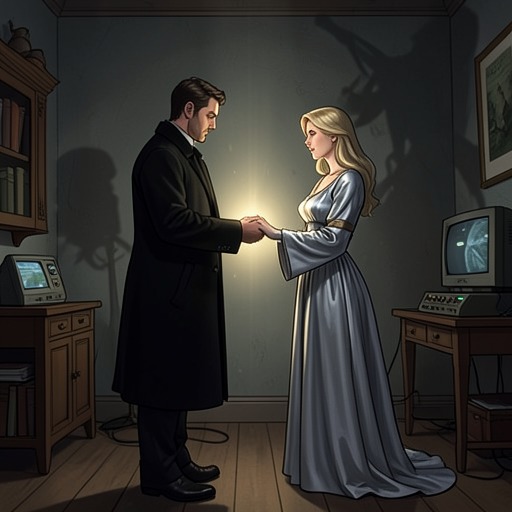
Jill’s Sacrifice
Awakening the Angel System: Apocalypse: A LitRPG Progression FantasyJill’s Sacrifice is the tragic climax of Jack Tanjihiro Chae-wong’s confrontation with his sister after her transformation into a Khloros pilot. What begins as a rescue turns into an enforced act of mercy: Jill’s remaining humanity briefly breaks through the machine, but the corruption surrounding her leaves Jack no viable way to bring her home. Her death saves the battlefield from the Khloros while permanently deepening Jack’s guilt, grief, and fear of failing everyone he loves.
Causes and Background
Jill’s condition is presented through the body of the machine itself. When Tangerine reaches the cockpit, he finds a green-haired girl, not even a teenager, strapped into wires, machinery, and fleshy tendrils. Black veins mark her convulsing body, making the Khloros less a vehicle than an apparatus consuming and incorporating its pilot. The sight reveals the violence of the transformation before Jack fully confronts it: Jill is simultaneously the person trapped inside and the living core of the weapon attacking the Selfian lines.
The confrontation becomes more dangerous when Jill’s distress triggers a further mutation. After she screams, the Khloros expands, black flesh swelling from the cockpit while tentacles bind the metal frame in muscle. Its energy rivals that of a Nest Heart, and corruptive smog spreads through the battlefield until nearby plants wilt. Jack is therefore not facing an ordinary enemy combatant whom force might disarm. He is facing Jill’s captured body, a machine whose corruption has become an environmental threat and whose destruction is inseparable from the destruction of the person inside it.
What Happens
The Khloros initially appears ready to kill Jack, but it stops only inches from tearing him apart, visibly straining against an unseen force. Jill whispers “Brother…” before the machine turns away and races toward the Selfian lines, leaving corruptive smoke behind. The moment is a reversal: the weapon that had been about to destroy Jack recognizes him, yet that recognition cannot restore Jill or halt the danger. Jack reaches after his sister but cannot stop her departure.
Jack later approaches Jill again and tries to touch her mask. The contact brings pain and a storm of voices, while Jill opens her mouth to release another blast of putrid energy. The Angel System responds with the warning “[-ERrOr Data corrUption. WaRning! WARNING!]” The system’s failure gives the scene a mechanical form for the ethical impossibility before Jack: neither ordinary power nor the world’s governing interface can simply calculate corruption away or separate Jill from the weapon consuming her.
Jack begs Sahaqiel and Lilith for a solution and forces his way toward Jill through the malevolent energy. Jill then provides the last sign that her identity remains intact, whispering, “Jack… I can walk,” and briefly giving him hope that she can still be saved. Jack answers by promising that everything will be all right, that he will take her home, and that she will meet her niece and nephew. Jill rejects the promise with the request “Kill. Me.” Her words transform the encounter from a battle over victory into a conflict over dignity, suffering, and bodily autonomy.
Sahaqiel makes the decision to enact Selfia’s plan B. Speaking through Jack’s mouth and piloting his body, she apologizes before plunging his hand into Jill’s heart. With Lilith’s assistance, the pair pierce the veil of corruption and attack the machine’s source from within; the source does not resist. Jill’s final words, “Ah… was I help..ful?”, frame her death as an attempt to have contributed rather than merely endured. Her body goes limp as the Khloros releases her, while Sahaqiel carries her away from the exploding machine.
The explosion throws Jack through the sky and costs him consciousness. When he awakens, his mind is disordered, his body burning, and his vision blurred. He eventually fixes on Jill’s body among the debris and crawls toward her with broken arms, calling her name. After his arms heal, he drags himself upright and holds his sister. The aftermath therefore refuses any clean separation between physical survival and loss: Jack lives, but the first action he takes after recovering is to reclaim Jill’s body from the wreckage.
Consequences and Aftermath
Jill’s death becomes one of the central accusations haunting Jack. Later, Leona and Celeste confront him by asking why he killed Jill. In the same hallucination or traumatic confrontation, the dead also ask why he allowed them to die or killed them, turning individual losses into a crowd of witnesses against him. Jill’s sacrifice is thus not contained within the battlefield; it returns as a charge against Jack’s identity as protector and warrior.
Jack himself places Jill among a growing list of losses: Eleanor, Mike, Mai, Fujimaru, Itadori, Hoffman, Yun, Tyrah, Jena, and Jill. He says that since meeting Sahaqiel, everyone he cares about keeps dying or being injured, and that no increase in strength has been enough to prevent failure. He fears losing Ada, Leona, Kamila, his children, and his home as well. Jill’s death consequently changes the scale of his fear. It is not only grief for a sister but evidence, in Jack’s traumatized interpretation, that every bond around him is moving toward disappearance.
The sacrifice also alters the moral meaning of Jack’s power. Jack confesses that he is filled with fear and hatred, can see what he is becoming, and has reached the point where he no longer cares that he has killed thousands or consigned them to fates worse than hell. Jill’s death is especially corrosive because Jack did not simply defeat an enemy: his hand became the instrument of killing a loved one while Sahaqiel controlled the action and Lilith helped reach the corruption’s source. The scene binds mercy to violence so tightly that Jack can no longer regard strength as uncomplicated protection.
Yet the event does not end Jack’s movement toward greater power. Earlier, his transformation is registered through the Angel System, which identifies him as a Nephilim and grants him enhanced regeneration and mana synthesis. Later, when he again needs a means to save those facing destruction, the system unlocks a Radiant Skill and makes an Anti-Army Class Skill available. At the end of the larger trajectory, Jack commands the Angel System to awaken and reveals an interface marked Administrator. Set against Jill’s death, these developments carry an unmistakable irony: the system continues to reward escalation, classification, and authority, while the wound that most defines Jack arose from the failure of power to preserve one human life.
Narrative Significance
Jill’s Sacrifice is the clearest instance of the story’s recurring collision between intimate family loyalty and militarized technological power. The Khloros converts Jill’s body into weaponry, corruption, and battlefield infrastructure; Jack’s rescue attempt confronts that conversion not with a clean cure but with a choice imposed by the limits of the situation. Jill’s request restores a degree of agency to a body that has been wired, penetrated, and overtaken, but the agency is expressed through self-erasure because no other escape remains visible.
The event also crystallizes Jack’s trauma narrative. Its images recur in fragments: the sister transformed into a monstrous machine, the whispered recognition of “Brother…”, the impossible promise of taking her home, the command to kill her, and Jack crawling through debris to hold her afterward. The later accusations and Jack’s catalogue of the dead show how the sacrifice repeats psychologically even after the Khloros has exploded. His suffering is not presented as a completed lesson; it becomes a continuing pressure that shapes his relationships, his fear, and his increasingly indifferent approach to violence.
Finally, the sacrifice marks a tragic reversal in the value at stake. Jack enters the confrontation seeking to preserve Jill and reunite her with family. Jill’s recognition briefly makes that hope seem possible, but the mutation of the Khloros and the system’s corruption warning turn rescue into imminent mass danger. The outcome is therefore both a victory against the weapon and a defeat of the brother’s defining objective. Jill is saved from the Khloros only through death, and Jack’s later ascent toward Administrator-level authority stands over that contradiction: he can command systems, unlock skills, and reshape the world, but he could not bring his sister home.