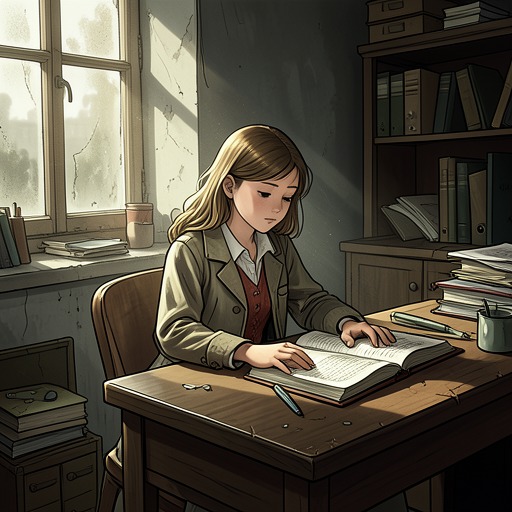
Leona and Celeste
Awakening the Angel System: Apocalypse: A LitRPG Progression FantasyLeona and Celeste are bound by a relationship that combines practical caregiving, private affection, and fierce physical protection. Leona is not simply present in Celeste’s household; she helps organize the child’s daily life, supervises her education and behavior, shares her playtime, and responds instinctively when Celeste is threatened. Their bond is complicated by Selfia’s public role as Celeste’s mother and by the political machinery surrounding the child, but the narrative repeatedly makes Leona’s attachment visible through what she does rather than through any formal title.
Daily Care and Private Intimacy
Leona is one of the few people permitted to visit Jack while he is confined to his luxurious room after his marriage to Selfia and coronation as king. Jack’s scheduled playtime with Leona and Celeste gives the child a protected family routine inside a household otherwise controlled by security and royal restrictions. During one such visit, Jack carries Celeste across the room while Leona enters, and the three move naturally into the rituals of play. Jack asks what game Celeste wants, opening a cabinet filled with expensive consoles and board games, while Leona’s arrival shifts the scene from recreation to adult business without removing the child from its center.
Leona’s care also extends beyond amusement. In the secluded courtyard garden, she takes responsibility for Celeste’s education, telling Jack that the girl receives private tutoring and that she is handling all of it herself. Jack’s suggestion that Celeste be enrolled in preschool therefore meets an already established caregiving structure: Leona has been directly managing the child’s learning, not merely supervising her in passing. The garden becomes a private refuge where Celeste can play in a sandbox and open a chest of toys while Leona and Jack discuss how her future should be organized.
The relationship is also expressed through ordinary correction. Before a public appearance, Leona takes an Intellipad away from Celeste after the child begins playing a video game, enforcing the rule that there will be no electronics before noon. Celeste reaches for the tablet and protests, but Leona refuses to soften the boundary. The moment gives their bond a parental texture: Leona is affectionate, yet she is also the adult who imposes routine, protects the child from indulgence, and expects obedience.
The Pain of Maternal Recognition
Leona’s attachment becomes most vulnerable when Celeste addresses Selfia as “Mommy.” Selfia pauses to check whether the girl remembers her lines, and Celeste answers that she does before receiving a pat on the head. Leona’s lip quivers and her heart suddenly feels heavy as she watches the child call another woman her mother. She clenches her jaw and holds in her emotions, then helps Selfia zip the back of her dress. Her response is not an open challenge to Selfia, but neither is it emotional indifference. The gesture exposes a conflict between the care Leona provides and the maternal identity publicly granted to Selfia.
That conflict is intensified by the political setting. The day’s official program includes the announcement of the First Public Academy, a museum opening, a meeting with investors, and a visit to El Negro Gato, but the central public revelation is that Celeste will be presented as heir to the throne. The royal schedule transforms the child into a dynastic symbol, while the adults around her must perform coordinated roles, lines, and assignments. Leona’s private pain therefore occurs within a ceremony of institutional family-making: Selfia is displayed as queen and mother, while Leona’s actual emotional investment remains largely unacknowledged.
Celeste’s legal status further complicates this arrangement. Selfia gives Jack a birth certificate bearing Celeste’s name, Jack’s name, and Selfia’s name, formally reshaping the girl’s position and future. The document promises recognition and succession, but it cannot erase the lived history of who has cared for Celeste. Leona’s relationship with the child thus exists in the gap between biological or legal designation, public maternal language, and the repeated labor of everyday protection.
Separation, School, and the Protective Bond
When Celeste begins attending the academy, Leona accompanies the transition and reassures Jack that the child will be safe because an entire army protects her. Her words acknowledge the scale of the security surrounding a royal heir, yet the scene also shows Leona’s role as the emotionally immediate guardian. Jack watches Celeste until she passes within the academy walls, and Leona places a hand on his shoulder while promising that the girl will be safe. The reassurance is directed to Jack, but it also reveals Leona as someone who shares responsibility for the child’s separation from the family home.
Afterward, Jack enters a black sedan and asks to be taken to Yun and Tyrah’s apartment. As the car moves through the city, he reflects on the privileges and burdens that have accumulated around him: personal security, a child, a chauffeur, and the last wills and testaments of people connected to his life. He feels hollow and notices that guilt and remorse have disappeared, perhaps because of Lilith’s tampering, while eagerness takes their place. Against this emotional estrangement, Leona’s concern for Celeste remains concrete. Her attachment is not presented as an abstract claim but as a continuing presence in school arrangements, supervision, and moments of physical closeness.
Celeste likewise seeks bodily reassurance from Jack, closing her eyes and cuddling against him rather than sitting up when he tries to wake her. Leona’s place in this family is part of the same intimate network: she helps construct the conditions in which Celeste can sleep, play, learn, and move through danger, even when the child’s formal language assigns motherhood elsewhere. The narrative repeatedly contrasts the public spectacle of royalty with these smaller acts of care.
Violence and the Instinct to Defend
The decisive proof of Leona’s bond with Celeste comes during an attack. The Purple Pawn enters the room, flips the bed, and exposes Celeste. Ho-sook immediately places herself between the frightened child and the intruder with a kunai, but the threat escalates when the Purple Pawn leans toward her and prepares to break her. Leona then comes through a nearby wall, driven by fury, and attacks the Purple Pawn while shouting, “STAY AWAY FROM MY DAUGHTER!!!”
The wording is significant because Leona’s earlier pain has concerned Celeste calling Selfia “Mommy.” In the crisis, however, Leona names Celeste as her daughter without hesitation. The declaration is not a legal claim or a ceremonial role; it is an immediate ethical and bodily response to danger. Leona tackles the attacker and continues punching even as the Purple Pawn laughs. Her intervention allows Ho-sook to carry Celeste away, but it also exposes Leona to the enemy’s counterattack: the Purple Pawn opens her mouth and releases a shrill scream that shatters the windows and sends Leona through the roof.
The scene makes protection the clearest language of their relationship. Leona’s attachment does not depend on Celeste recognizing her as mother, and it does not wait for permission from the royal household. Faced with the child’s endangered body, Leona crosses walls, confronts overwhelming force, and accepts the consequences. Her care is therefore both nurturing and combative, joining the domestic work of education and discipline to the violent defense expected of a soldier.
A Family Under Threat
Celeste’s vulnerability continues in the wider atmosphere of war and emergency. During a nationwide attack alert for the Empire of Cordellica and its territories, Jack carries a struggling, half-dressed Celeste under one arm while cradling a crying baby boy with the other. The exhausted household is disordered, and even the children’s ordinary routines become difficult to maintain. Leona’s role must be understood within this recurring instability: Celeste is at once a child who resists school, a princess whose movements require military protection, and a target whom enemies can reach inside supposedly secure spaces.
The family’s instability also appears in the next generation’s unruly imitation of adult conflict. Later, when Celeste and Ito are questioned about setting off a smoke bomb, Ito declares that Daddy told them to do it. The accusation draws uncomfortable silence and forces the adults to confront how parental authority, play, and dangerous behavior have become entangled. Although Leona is not the speaker in that exchange, the incident reinforces the conditions under which she has been caring for Celeste: the child grows up amid royal performance, military threats, technological controls, and adults whose authority is itself unstable.
Leona and Celeste’s bond consequently stands apart from the formal structures that surround them. Selfia’s title, the birth certificate, the succession announcement, the academy, and the army all define Celeste institutionally. Leona’s relationship is defined through presence: arranging education, enforcing limits, sharing protected play, enduring the pain of displaced maternal recognition, and throwing herself into danger when the child is attacked. In a world where family can be rewritten by law, ceremony, and power, Leona’s repeated acts make care into the most durable form of kinship available to Celeste.