Lita von Strongarm
Awakening the Angel System: Apocalypse: A LitRPG Progression FantasyLita von Strongarm is the Lord-Commander of the Reclaimers, a Theocracy military faction composed of partisans, rebels, and Paladins. Her decisive importance lies in the way she converts a defeated religious state’s scattered resistance into an organized political and military force: first by helping Jack’s coalition strike the regime’s hidden center, then by defending the refugees and soldiers who survive the Theocracy’s collapse, and finally by governing a new frontier whose alliance with the empire remains uneasy.
Identity and Resistance Background
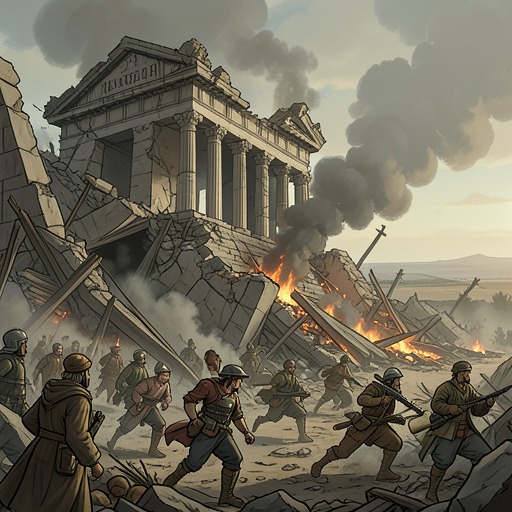
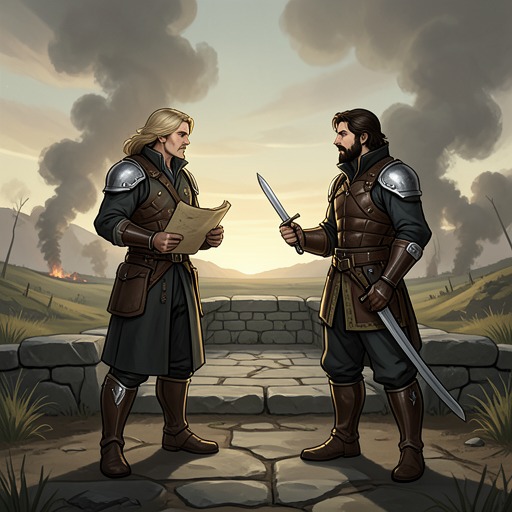
Lita leads the Reclaimers when Jack’s team prepares to assault the fortified heart of the Theocracy’s capital. The mission is designed as a decapitation strike against a hidden facility and the Green Bishop, the High Table member who created Lilith and became the de facto leader of what remained of the monster-infested state. Because even a full army could not safely attack the papal nation’s center without local support, Jack’s team must link up with Lita’s partisans, rebels, and Paladins. The intended political result is equally important: after the Green Bishop is removed, Lita’s faction is to replace the remnants of the Theocracy’s government. Lita’s first physical appearance reflects the character she has become. She emerges from the snow in gold-and-white armor, moving with the gait of a seasoned warrior, while her helmet peels back its visor to reveal a sharper version of the woman Jack remembers. Jack approaches intending to shake her hand, but Lita instead kneels before him. The gesture establishes both her martial discipline and her recognition of Jack’s authority, while also making their alliance ceremonial rather than merely tactical. Her connection to the wider conflict predates this meeting. Lita explains that the Green Bishop’s attack cost the Theocracy seventy percent of its total population; survivors were forced either to submit or face execution by his Neo-Crusaders. She escaped that fate because, as a Judicator-in-training, she had been sent to the Imperium by Cardinal Veltrilli to solicit aid. That assignment explains her earlier presence at the academy and reveals that her apparent deception was an undercover diplomatic mission rather than simple treachery. Lumenese Selfia heard Lita’s proposal and promised assistance, and Lita’s time with Selfia exposed both the scale of Mr. Fritz’s threat and the organization connected to it.
Military Leadership and the Capital Assault
Lita’s leadership becomes visible in the assault’s operational phase. She appears atop a Templar battle tank and reports that the 9th, 12th, and 56th units have secured their sectors, while Roland air support is retreating from Jack’s King’s Raven. Her report reduces the battle to its final objective: the citadel and, beneath it, the facility that remains the true target. Jack boards an Eclipse-Class battle tank while Paladins move past him, placing Lita’s forces at the point where conventional warfare gives way to the hidden strike the coalition has come to execute. This role distinguishes Lita from a symbolic claimant to power. She directs formations, coordinates armor and sector control, and understands that victory over the visible citadel is incomplete while the underground facility survives. The Reclaimers’ purpose is therefore both military and constitutional: they fight to destroy the machinery behind the Theocracy’s catastrophe and to create a government capable of replacing the authority that machinery corrupted.
From Conquest to Political Negotiation
After the fighting, Lita is involved in a radically different kind of command. Jack proposes that Superbia and her people load into the city and move into Imperial territory, effectively offering them Imperial citizenship. Lita immediately recognizes the political meaning of the proposal and asks whether Jack is offering to make them Imperial citizens. Her question places the displaced Theocracy population at the center of the postwar settlement. The issue is no longer how to defeat a regime, but whether survivors can enter a new political order without being treated as conquered subjects. Lita’s authority also requires her to negotiate with populations that do not share her assumptions. In the Hoshido settlement, food is scarce, ammunition and replacement parts are limited, and nomad, Paladin, and Imperial survivors are already arguing over resources. Lita insists that her Paladins need food because they form the bulwark against the demonspawn threat and must continue fighting the Apostles probing the city’s defenses. Kenichi answers that the land’s miners and workers need food to produce ammunition and materials, warning that demands for tithes make the Paladins resemble invaders. Lita counters that the Paladins offer protection and that Jack’s request is what keeps Hoshido safe from the poison blighting the world; the city’s Saint Citri blessing is presented as a protection on which the wider population depends. The dispute does not end in simple triumph for either side. Selfia asks whether Lita’s men can accept reduced rations if the Apostles threatening the defenses are eliminated. Lita bows and agrees, provided logistics can be opened to Commandant Victoria’s wall. Her response shows a commander adapting military need to civilian scarcity: she does not abandon the Paladins’ claim to sustenance, but accepts a negotiated reduction in exchange for a concrete improvement in supply access.
Discipline, Strategy, and the Final Campaign
Lita’s military usefulness persists after the immediate political settlement. When Jack prepares to gather prisoners and develop a plan involving the knowledge contained in Jena’s notebook and Jazz’s letter, he orders Lita to keep her Paladins on standby with the prisoners. The instruction includes a contingency in case the plan fails, and Lita’s forces therefore serve as both security and controlled reserve. Her position in the chain of command is clear: she is trusted to hold a volatile group, prevent an unexpected break in the operation, and act without being given the central explanation behind Jack’s plan. During the beachhead battle, the scale of the threat again forces Lita’s forces into a defensive role. Selfia reports that three Apostles—a speedster, a knight, and an assassin—are attacking the forward frontline. Mi’shka and Superbia are engaging them with a squad of Awakened and need help, while other troops are diverted to the western flank and to the mass of wounded. Lita is not merely an administrator behind the lines; her Paladins are part of the military structure that must remain ready while the coalition distributes its limited fighters, medics, scouts, and defenders across several simultaneous crises.
Postwar Leadership and Unresolved Divisions
After the Shutdown, Lita’s career reaches its political culmination. The loss of mana renders airships, mechs, power generators, and other technological advances inoperable, while hundreds of thousands of resurrected people appear across the world in unpredictable places, including bathrooms, ship engine compartments, water wells, and abandoned military installations. Selfia and the surviving leaders manage to quell most of the ensuing chaos, but the world does not return to its previous unity. The new order divides into two nations run by different systems. Selfia governs her Republic, while Ada governs the Frontier under the appointed Speaker Lita von Strongarm, with Kenichi and the other tribal chiefs serving as a council. Lita’s appointment transforms her from resistance commander into a constitutional leader, but it does not erase her identity as a Paladin or resolve the distrust surrounding her. Lita and her Paladins remain hostile toward the empire, just as Kenichi and many nomads continue to distrust the Imperials. The old coalition had been held together by Jack; after his absence, that binding force weakens as resurrected people struggle to find their place in a world that has moved on. Lita’s ending is therefore a form of return without full reconciliation. She helps overthrow the Theocracy’s corrupted center, protects the people displaced by its collapse, and receives responsibility for a new frontier, yet the political future she inherits is marked by scarcity, competing loyalties, and memories of blood and betrayal. Her arc replaces the fantasy of a clean liberation with the harder work of governance after victory: feeding soldiers without starving workers, defending sacred protection without reproducing imperial domination, and building institutions among communities that have not forgiven one another.