Republic
Awakening the Angel System: Apocalypse: A LitRPG Progression FantasyThe Republic is the successor government associated with the New Frontier and led by Ada Nguyen, functioning as one of the two major political orders that remain after the old imperial world collapses. Its significance lies in the contradiction at its center: it represents a new civic future beyond the Empire of Cordellica, yet it must govern populations shaped by war, authoritarian emergency measures, mass death, and the sudden return of the dead. The Republic therefore embodies reconstruction without reconciliation, and political renewal without a clean break from the institutions and wounds that preceded it.
Formation and Political Identity
The Republic emerges from the conflict that destroys the imperial order. During the war, Selfia’s government presents the struggle as a fight for humanity’s survival, claiming that devastated cities and the advance of the demonspawn leave no alternative but attack. Jack’s later appeal to imperial citizens similarly promises that those who surrender will be treated humanely and allowed to live as free citizens in the Cordelica Democracy. These competing political languages—survival, freedom, and the future of humanity—show how the transition from empire to republic is framed through declarations of necessity rather than through a simple institutional handover.
The Republic is also defined against the violence used to secure the new order. Selfia admits that a purge is taking place across the empire, with 369 people already targeted and potentially more to follow, including political opponents, rivals, and dissidents. Jack condemns the operation as murder, stressing that bystanders and innocents have been placed in danger and that Ada’s pregnancy and his unborn child were also endangered by the plan. The Republic’s later existence consequently carries the memory of a state that claimed to protect humanity while suspending ordinary protections for those deemed obstacles to political consolidation.
Leadership and Institutions
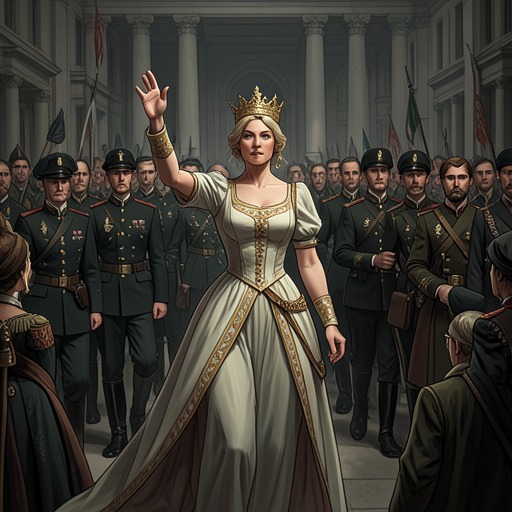
Ada Nguyen is the Republic’s political representative in the postwar world. Three years after Ruby Viole Lamperouge became her bodyguard in physical form, Ada receives a delegation at the remains of Heaven. She meets Selfia, now the sleep-deprived president of the Republic, while Violet accompanies the president in a black suit rather than her customary armor. The scene places the Republic within a formal diplomatic structure: Ada is addressed as a councilwoman, Selfia as president, and their meeting is conducted through protocol, security details, and an agreement between separate nations.
The Republic’s leadership is not presented as isolated civilian administration. Selfia arrives in a black-armored limousine with green-haired guards, while Ada is surrounded by Ruby and later by Yun, Tyrah, and Jessica. Their convoy passes large statues of Jack and Sahaqiel, turning political space into commemorative space. The Republic thus governs through both practical apparatus—delegations, guards, vehicles, and official titles—and public memory, preserving figures whose lives and sacrifices have become part of the symbolic foundation of the new order.
Governance After the Shutdown
Every year, Ada and Selfia meet at the remains of Heaven under an agreement between their two nations. The recurring meeting confirms that the Republic is not merely a temporary rebellion or an informal frontier settlement; it is a durable state engaged in regular diplomacy with Selfia’s government. At the same time, the meeting place is a ruin, and that setting makes the political arrangement inseparable from the devastation left by the previous age.
The Republic shares the post-Shutdown crisis with the other surviving governments. Technological advances—including airships, mechs, and power generators—become unusable without mana. The resulting breakdown produces widespread chaos, intensified by the appearance of hundreds of thousands of resurrected people across the world. The revived emerge in arbitrary and disruptive locations, including bathrooms, ship engine compartments, water wells, and abandoned military installations. The Republic’s historical task is therefore not simply to establish constitutional legitimacy but to administer a world in which infrastructure has failed and the boundary between past and present has become physically unstable.
Despite disputes among groups over how the world should be governed, the Republic and its counterparts manage to quell most of the violence and disorder. That achievement comes at the cost of a divided political geography: the Republic stands on one side, while Ada Nguyen’s Frontier stands as the other major successor system in the postwar arrangement, led by the appointed Speaker Lita von Strongarm with Kenichi and other tribal chiefs serving as a council. The division reflects different governmental traditions rather than a restored unity. The world’s governments had cooperated during the final expedition, but that shared purpose does not erase the resentment and bloodshed accumulated over the preceding years.
Social Conflict and Family Politics
The Republic’s political tensions are inseparable from the family relationships through which succession and legitimacy are expressed. Celeste’s birth certificate lists her name alongside Jack’s and Selfia’s, establishing her as First Princess Celeste Cordelica and making a private document an instrument with consequences for her future. Selfia later directs Celeste during a formal performance, and the child calls her “Mommy,” a moment that exposes how political motherhood, legal parentage, and everyday care overlap without perfectly coinciding. The Republic inherits this complicated kinship structure rather than replacing it with an impersonal civic identity.
The same tension appears in the children’s later domestic life. During a nationwide attack alert, Jack struggles to prepare Celeste and a crying baby boy for school while wearing a wrinkled, vomit-spattered uniform. After the Shutdown, the children remain connected to the political figures and conflicts of the old order: Ito invokes “Daddy” while admitting that Jack told him to set off a smoke bomb in his aunt’s face. Such incidents make the Republic’s future visible in miniature. Its citizens are not abstract beneficiaries of reconstruction but children raised amid inherited loyalties, family rivalries, political myths, and the casual remnants of wartime behavior.
Memory, Distrust, and Historical Burden
The Republic’s agreement with the Frontier cannot dissolve older antagonisms. Lita von Strongarm and her Paladins remain hostile to the empire, while Kenichi and many nomads continue to distrust the Imperials. The coalition that had united the world for the final expedition begins to fragment after Jack is no longer present to hold it together. Thousands of resurrected people must find their place in a world that has moved on, creating a population whose legal and social status cannot be settled merely by declaring a new political era.
The Republic therefore functions as both promise and unfinished settlement. Its institutions succeed in reducing immediate chaos, but the underlying pain, loss, betrayal, and political suspicion remain active. The statues at Heaven, the annual meeting between Ada Nguyen and Selfia, the division between the Republic and the Frontier, and the revived people appearing in impossible places all point to the same condition: the new state has organized survival, but it has not mastered history. Its deepest challenge is to turn an emergency coalition and a landscape of ruins into a legitimate community without reproducing the exceptional violence that made its birth possible.