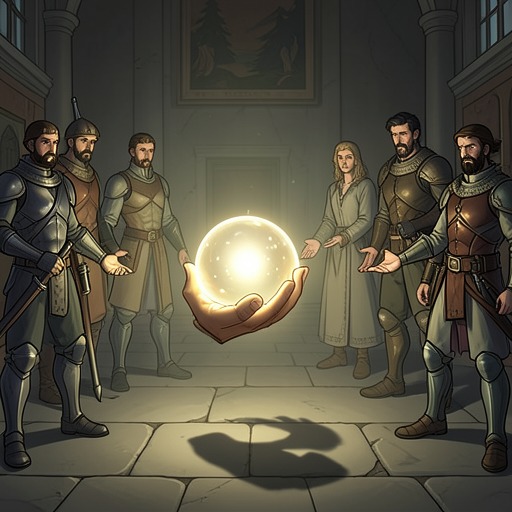
Royal Guard
Awakening the Angel System: Apocalypse: A LitRPG Progression FantasyThe Royal Guard is the armed institution attached to the imperial monarchy, functioning simultaneously as ceremonial escort, personal protection detail, urban security force, and instrument of exceptional political authority. Its gold-armored presence gives royal power a public image of order, yet the narrative repeatedly places that image beside locked rooms, concealed information, emergency measures, and lethal violence. The Guard therefore embodies the monarchy’s promise to protect while also revealing how protection can become surveillance, confinement, and coercion.
Ceremonial Authority and Public Visibility
The Royal Guard first appears as part of the monarchy’s public theater. During the preparations surrounding Jack’s marriage and coronation, the city is placed under visible royal security. News reports describe the streets of Lunacrypt being patrolled in force for the Magna Galla, with the guards making their presence known before the prestigious royal event begins. Their patrols reassure the population, but they also turn the city into a stage on which the Queen’s authority is constantly displayed.
The Guard’s ceremonial function is inseparable from the dynasty’s rituals. Jack enters the imperial chamber beside Duchess Belia Bell while orchestral music plays and hundreds of strangers watch him, a formal procession that transforms a private family absence into a public symbol of legitimacy. The Guard is not foregrounded in that entrance, but its institutional world surrounds the ceremony: the monarchy’s rituals depend on disciplined bodies, controlled access, and the visible promise that the royal order is being defended. Later, when Jack becomes king, that promise follows him into daily life rather than ending with the coronation.
Protection, Surveillance, and Confinement
After his marriage to Selfia Cordelica and coronation, Jack discovers that royal protection has also become a form of imprisonment. He remains confined to his luxurious room for two weeks, forbidden to leave and allowed only a narrow circle of visitors, including Kamila, Ada Nguyen, and scheduled time with Leona and Celeste. The city below is busy and alive, but Jack can observe it only from a balcony. The separation makes the Guard’s protective role spatially legible: the institution preserves the king by placing him behind barriers and controlling who may approach him.
The same logic governs the royal household’s handling of information. Jack notices the use of paper folders rather than tablets because tablets can be hacked and Intellipads compromised, whereas documents remain secure if kept away from inquisitive observers. His movements are organized through schedules and prompts on an Intellipad, while a specially constructed black armored limousine transports him under heavy protection. The vehicle is made from Armytheum to cancel mana attacks, reinforced with reactive armor over a carbon-fiber titanium-alloy shell, and equipped with hidden weapons; Jessica claims that it can stop anything short of an Anti-Army Skill. The Guard’s power thus extends beyond soldiers at doors or in streets: it is built into vehicles, documents, routes, escorts, and the management of royal visibility.
Jack’s later drive through the city makes the cost of that protection more personal. He now has security, a chauffeur, a child, and access to the privileges of kingship, yet he feels hollow rather than safe. The Guard’s apparatus has converted his former freedom of movement into managed mobility. Even when he travels through the grand structures of the city, his passage is defined by the institution surrounding him and by the knowledge that other people’s lives and information are being held within the same system.
Response to Threat and Use of Force
The Guard’s protective identity becomes violent during the attack associated with the Magna Galla. Jack confronts a Purple Pawn in the midst of chaos, and a dozen royal guards land nearby in gold boots. A dome of blood rises from the ground to push spectators away, creating a sealed zone around the confrontation. Jin approaches Jack and urges him to step aside so the defeated attacker can be taken into custody and interrogated. The scene presents two competing models of royal security: Jack’s immediate, uncontrolled violence and the Guard’s attempt to reassert custody, intelligence gathering, and institutional procedure.
That procedural claim is unstable, however, because the Guard is not merely responding to threats from outside the state. Selfia reveals that royal forces have killed hundreds of political opponents, rivals, and dissidents across the empire as part of a purge. She gives the figure as three hundred and sixty-nine lives, possibly more, and explains that the killings are intended to remove obstacles to the advent of the New Republic and consolidate her power. Jack is horrified because the operation has also endangered bystanders and innocents, as well as Ada Nguyen’s pregnancy and the child she carries. The language of survival and political necessity therefore collides with the concrete consequences of state violence.
Jack rejects Selfia’s attempt to describe the purge as something that simply had to be done. For him, the deaths demonstrate that the monarchy’s emergency logic has abandoned the distinction between protection and murder. The Guard’s capacity to defend the crown is inseparable from its capacity to enforce decisions made without Jack’s consent and without meaningful protection for those classified as obstacles. In this sense, the organization represents a state of exception: ordinary safety, due process, and bodily security are suspended in the name of preserving the political order.
Collapse of the Security Order
The political crisis also exposes the Guard’s limits. Selfia explains that the reason guards and Awakened personnel were absent from a crucial confrontation was that they had been killed while the purge unfolded throughout the empire. The institution that should have surrounded the monarch has been hollowed out by the very policy meant to secure the regime. Its apparent omnipresence in public patrols and royal ceremonies conceals a fragile structure vulnerable to internal conflict, factional violence, and deliberate reorganization.
This vulnerability becomes especially clear during the attack in the royal ballroom, when the Jester appears despite the location supposedly being guarded. Jack looks around for his gold-armored cousins and finds none. His alarm comes before the full nature of the threat is understood: the failure is not simply that an enemy has entered, but that the protective system has failed to make the intrusion visible in time. The Guard’s absence converts the ballroom’s ceremonial grandeur into a trap and strips the monarchy’s public assurances of their force.
The Guard’s authority also intersects with wider military and political emergencies. Jack and Selfia discuss striking the High Table’s forces everywhere and leaving no place unturned, while the Theocracy faces starvation, inadequate shelter, insufficient ammunition, and the approaching threat of demonspawn. Jack orders an evacuation of the remaining Theocracy citizens to the Flying City and offers settlement inside imperial territory, presenting the choice as one between relocation and death. Although the Royal Guard is not named as the sole executor of this policy, these scenes clarify the environment in which it operates: protection is increasingly defined through evacuation, occupation, coercive directives, and the management of populations under threat.
Relations with Other Powers
The Royal Guard’s institutional world overlaps with several competing forms of authority. Its patrols support the Queen’s public legitimacy, its custody practices compete with Jack’s personal judgment, and its security failures expose the monarchy to attacks by factions such as the High Table and the Purple Pawn. It also exists within a society where political leaders, military forces, Awakened individuals, and sacred institutions all claim the right to determine who may be protected and who may be sacrificed.
The contrast with the Theocracy is particularly revealing. The Theocracy possesses a statue of Sahaqiel, revered as its patron saint and believed to limit demonspawn power in the city. That sacred object offers spiritual protection, while the Royal Guard offers military protection; both rely on visibility, restricted access, and stories of legitimacy. Yet the Guard’s protection is materially enforced through patrols, armor, confinement, and lethal action, whereas the statue’s power is tied to reverence and an ancient resonance that even Sahaqiel cannot fully explain. The juxtaposition makes security a political and theological language shared by rival regimes.
The organization’s final significance lies in this contradiction. The Royal Guard is necessary because the monarchy is surrounded by assassination attempts, armed factions, political rivals, and supernatural threats. At the same time, its presence cannot guarantee safety, prevent infiltration, or preserve moral boundaries once the crown authorizes mass killing. It makes sovereignty visible through gold armor and controlled movement, but the narrative repeatedly asks what that visibility conceals: a king kept under guard, information locked away from ordinary technologies, enemies converted into prisoners or corpses, and a political order that damages the people it claims to save.