Solomon Expeditions
Awakening the Angel System: Apocalypse: A LitRPG Progression FantasySolomon Expeditions is an Imperial-led coalition of corporations, military industrialists, and nations organized to navigate and scout the continent known as the Lost Lands. Although presented as exploration, the expeditions are inseparable from military power and state ambition: their records connect them to Project Solomon, while later revelations place the enterprise within the long chain of decisions surrounding mana, the Infinity Machine, and the survival or destruction of humanity.
Nature and Strategic Purpose
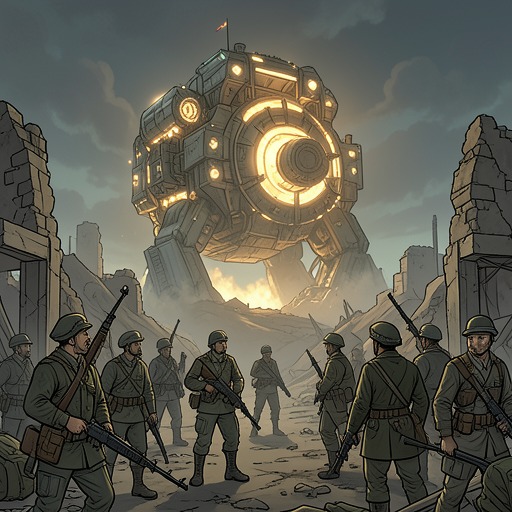
Solomon Expeditions function as a multinational expeditionary apparatus rather than a purely scientific venture. Their participants include the Empire, corporate interests, military industrialists, and other nations, combining logistical reach with armed force. The continent they entered had been overrun by demonspawn and enveloped in seemingly endless corruptive smog, the same kind of contamination that transformed the citizens of Frelia into mindless beasts. Exploration therefore meant entering a hostile region whose geography and biological danger demanded military organization.
The expeditions also served a concealed strategic purpose. Jack’s investigation of the Seventh Solomon directory reveals that the Black King repeatedly ordered expeditions into the Lost Lands because he believed the object of his search lay buried beneath the cradle of humanity. The organization’s public function was reconnaissance and discovery; its deeper function was to locate something capable of changing the balance of power on a global scale. That double identity—expeditionary science on the surface, political and technological pursuit beneath it—defines the project’s importance.
Political Economy and Suspicion
The scale of Solomon Expeditions makes them an instrument of state and industrial finance as much as an exploration program. An old man named Happy denounces the war as a means of filling bureaucrats’ pockets, arguing that without the Solomon expeditions the industrial military complex would need another conflict in which to pour its money. His accusation does not establish every motive behind the project, but it places the expeditions inside a political economy where research, procurement, military mobilization, and war funding reinforce one another.
That criticism also complicates the project’s official language. The expeditions can be described as attempts to chart dangerous territory, yet the surrounding institutions treat them as a source of contracts, military purpose, and strategic leverage. The result is a recurring tension between the rhetoric of human advancement and the material systems that profit from permanent emergency. Solomon Expeditions do not merely respond to danger; they help organize the machinery through which danger becomes governable, profitable, and politically useful.
Discovery, Archives, and Technological History
Project Solomon survives in the archives Jack searches aboard an airship. When he opens the directory labeled Project Solomon, the scattered references become a historical network: the expeditions were not isolated ventures but an Imperial-led coalition moving through the Lost Lands under orders connected to the Black King. The act of searching the files changes the project from rumor into institutional evidence and makes archived data itself a battlefield.
The project’s historical significance expands when Sahaqiel explains the Infinity Machine. She states that the machine reads the flow of what people call mana as data, translating the molecular world into a connected information system. During the original outbreak, its operators halted the flow of mana and reversed it, drawing in a specific spectrum of data and eliminating those who exhibited mana capability. This revelation gives Solomon Expeditions a larger technological context: the exploration of the Lost Lands belongs to a civilization whose wars and salvation projects are built upon systems that turn bodies, souls, abilities, and catastrophe into readable information.
Jack’s own Angel System registers him as a Nephilim with enhanced regeneration and mana synthesis, while elsewhere Tangerine’s Damocles tears open a Khloros cockpit during combat. These connected examples show the world in which Solomon Expeditions operate: exploration is supported by machine intelligence, altered bodies, MECHFrames, and the conversion of supernatural capacity into technical systems. The expeditions’ apparent search for territory thus participates in a broader struggle over who can classify, control, and weaponize the underlying data of life.
From Expedition to War Doctrine
The project’s legacy reaches its clearest political expression when Selfia calls for a new offensive against the demonspawn. She describes cities such as Lunacrypt, Soldaer, and Clausterfiell as destroyed monuments, declares that Solarus has fallen, and presents attack as humanity’s only remaining option. Her speech frames the campaign as the greatest expedition since humanity went into space, promising that it will end the demonspawn threat and secure humanity’s survival.
Jack’s own broadcast uses the same conversion of military action into political destiny. Identifying himself as the son of the Queen Slayer and King Consort of Selfia Cordelica, he offers Imperial citizens the chance to surrender before the coming battle. He rejects the old Imperial war doctrine that forbade surrender while an army retained the means to resist, promising humane treatment and citizenship in the Cordelica Democracy instead. In this transformation, the expeditionary vocabulary becomes a tool for remaking sovereignty: a campaign that began as a search across the Lost Lands is reinterpreted as a war to determine who may belong to the future.
Legacy and Narrative Significance
Solomon Expeditions bind together the book’s central contrasts: exploration and conquest, scientific inquiry and industrial militarism, archival knowledge and deliberate secrecy, and the promise of human survival with the elimination of human difference. Eve’s recorded testimony says that she created the Infinity Machine to resuscitate those who had fallen in the great war and to guide lost souls back to the living. The same technological order, however, is associated with the deliberate removal of people who possessed mana. Solomon Expeditions therefore stand within a history where rescue and extermination can emerge from the same infrastructure.
Their significance is ultimately revealed through consequence rather than institutional closure. The expeditions lead attention toward the Lost Lands, toward the immense sources of mana and sealed structures Jack and Sahaqiel encounter, and toward the buried history that explains the world’s disasters. They are remembered not simply as journeys into an unknown continent, but as the mechanism through which governments and industries pursued the foundations of human existence. In that sense, Solomon Expeditions are the book’s emblem of organized discovery: the map is also a weapons plan, the archive is also a chain of command, and the search for humanity’s origin becomes inseparable from the attempt to decide humanity’s future.