Castle Rock Town Common
Bag of BonesCastle Rock Town Common is a public gathering place where ordinary town life becomes the setting for several private turning points in Mike Noonan’s relationships with Mattie Devore and Kyra Devore. Its open, social character matters: children play, music draws a crowd, and people from the surrounding communities may be watching. On that common ground, grief, affection, and the risk of local gossip become impossible to keep wholly separate.
Setting and Public Life
As Saturday afternoon gives way to evening, the common is crowded with people enjoying the warm midsummer weather. Children swarm over the playground equipment; older men in bright red vests play chess; and young people lie on the grass listening to a teenager with a guitar. A juggler performs nearby, while the Castle Rockers interrupt the music with a loud brass flourish. The scene establishes the common not as an isolated refuge but as a lively shared space where private encounters unfold amid the town’s ordinary recreation.
That public setting is important to Mike and Mattie. Mike considers how people from the TR might see them, including anyone who has come to Castle Rock for ice cream, fresh vegetables, or conversation. His list of familiar local places—the Tas-T-Freeze, the Lakeview General Store, and the All-Purpose Garage—makes the potential audience feel close at hand. The common’s openness gives their actions a social consequence: affection shown there can become visible to the same network of neighbors whose opinions already weigh on Mattie’s life.
Mike, Mattie, and the Custody Conflict
The common also stands near the beginning of a wider public commitment. Mike tells another person that he is not entering a relationship with Mattie as part of a bargain; he compares his involvement instead to seeing a large man beating up a smaller one and deciding to intervene. Mattie and her lawyer plan a barbecue at her home for Tuesday at noon, and Mike intends to join them. His concern is whether the town will interpret their presence as celebrating Max Devore’s death. The exchange places his support for Mattie within the hostile social atmosphere surrounding the custody dispute, while his blunt dismissal of the critics signals that their judgment will not determine his choice.
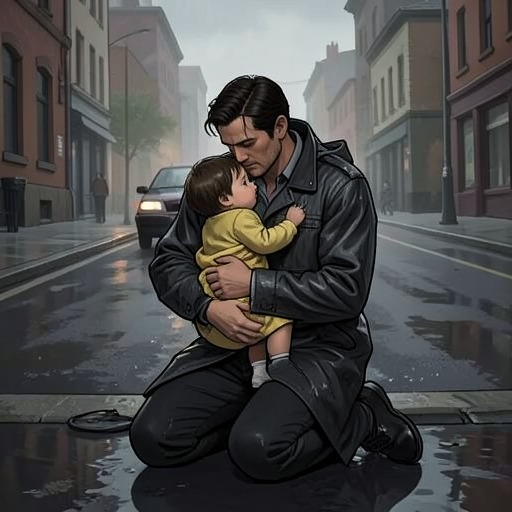
The common brings that involvement into a more intimate register. When Kyra playfully tackles Mike, he drops the grease-spotted McDonald’s bag he is carrying and lifts her. The gesture feels natural and wonderful to him, but it also opens a painful comparison: holding a healthy child makes him think of Jo and of the child she was carrying when she fell in a parking lot. The public play therefore carries two emotional currents at once—joy in Kyra’s living presence and renewed awareness of the pregnancy lost with Jo.
Kyra’s laughter and the joking exchange that follows make the moment both affectionate and specific. Her hair hangs in two clumps, held by Raggedy Ann and Andy barrettes; Mike invokes a warning about tackling one’s own quarterback, and she repeats it with her characteristic mispronunciation. The small joke is not an abstract sign of closeness: it gives their connection a shared language, made in the middle of an ordinary afternoon and in front of other people.
A Kiss in Public
Later, Mattie tells Mike she had wanted to kiss him ever since Kyra tackled him and he picked her up. The remembered scene thus becomes the emotional lead-in to a new action. Mattie and Mike kiss briefly on the common, and Mike describes the physical intensity of that seven-second kiss while recognizing the social risk around them. He notes that John Storrow would disapprove—not only because the kiss is public, but because John is attracted to Mattie.
Mattie answers that she knows John’s feelings and that she herself is attracted to Mike. She checks that Kyra is still standing by a tree watching the juggler, but the couple cannot know whether anyone from the TR has noticed them. Mike calls their conduct indiscreet and warns that their picture could belong beside the word in a dictionary. Mattie steps back, yet does not look away; she acknowledges the danger without claiming ignorance or innocence. The exchange shifts their relationship from attraction privately recognized to affection enacted in a place where it may be observed.
Music, Storytelling, and the Common’s Significance
The common’s entertainment also joins the town’s present to its buried history. A teenager’s guitar song is identified as “Fishin Blues,” written by Sara Tidwell and originally performed by Sara and the Red-Top Boys, before later covers made it familiar to other audiences. Its bawdy lyrics are interrupted when the Castle Rockers launch into a forceful march. The sequence moves from an older song associated with Sara to the noisy performance of a local band and back to the immediate scene of families and spectators, placing cultural memory within everyday public life.
When the juggler finishes, Kyra runs back to Mike and asks him to tell her the story of “Hansel and Panzel.” He corrects the title to “Hansel and Gretel” and suggests going somewhere quieter because the band is giving him a headache. Her question and his willingness to tell the story extend the earlier physical play into a moment of care and shared attention. The common is therefore more than a backdrop: its crowd, music, and open visibility frame the relationships developing there, while the movement toward a quieter place marks the limit of how much intimacy the public setting can hold.