Ghosts of Sara Laughs
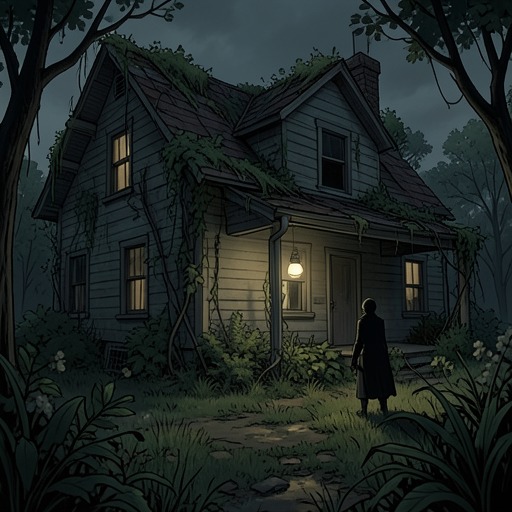
Bag of BonesThe Ghosts of Sara Laughs are the dead presences associated with Sara Laughs, appearing in Mike Noonan’s experience as a phantom child’s sobs, a disturbing sense that someone is waiting inside the house, and the dead men who confront him and Kyra Devore in a time-slip vision. Their manifestations connect the house’s supernatural unease to its buried history, but they do not all act as a single hostile force: some are spectral witnesses, while the dead figures in Mike’s vision threaten to take Kyra. Their presence also unfolds alongside Mike’s grief for Johanna Noonan, making the haunting a disturbance of both place and memory.
Forms of Presence
One of the most persistent manifestations is the phantom child whose sobbing wakes Mike at night. After a day of physical exhaustion and a headache, he hears the child again and tells it to stop, reassuring it that Kyra is safe and no one will take her away. The episode joins the haunting to a specific fear of separation, while Mike’s instinctive answer is protective rather than investigative: he speaks to the unseen child as someone who needs comfort.
A second sign is less audible than felt. When Jo secretly visits Sara Laughs with Frank Arlen, Frank senses that someone inside the house has been waiting for her and does not like her; he imagines that the presence might want to hurt her. He cannot explain the impression and calls it a bad vibration. The account leaves the presence indistinct, but the unease is attached to Jo’s visible nervousness and repeated glances toward the house, suggesting that the haunting is registered through bodily apprehension before it can be named.
The haunting also communicates through the house’s ordinary surroundings. After refrigerator letters spell CARLA DEAN, Mike concludes that Jo wanted him to know something, while something else tried to scatter the letters before he could read them. His recognition is stark: Jo and the weeping boy are both present, but he cannot yet tell what else shares the house with him. The sequence distinguishes communication from interference; the house is not a single voice, and its supernatural signs do not all serve the same purpose.
The Dead in the Vision
In the vision at the Fryeburg Fair, Mike and Kyra emerge from Freak Alley and encounter seven long-striding men in cutters’ clothes. Four appear faded, white, and ghostly, like old daguerreotypes; they seem sick or dead and are described as less dangerous than images. The remaining three appear as real as the rest of the vision. Their difference in appearance makes the encounter more than a simple gathering of apparitions: spectral dead and forceful figures occupy the same scene, but carry different degrees of threat.
The leader is an old man in a faded blue Union Army cap. Mike recognizes his eyes as the ones that had measured him over the top of an oxygen mask. The detail links the vision’s threatening figure to an earlier encounter with Maxwell Devore, making the dead man’s appearance a return of an already established personal menace rather than an anonymous ghostly image.
The leader offers Mike more children in exchange for Kyra, and Mike is nearly hypnotized by the proposal. Kyra interrupts his fixation by crying that something smells; Mike then detects the odor of spoiled meat, swamp gas, burst tissue, and simmering guts. As Maxwell Devore approaches, tiny bugs feed in his nostrils and at the corners of his eyes. The scene makes the deadness of the attackers physically undeniable within the vision, while their offer turns supernatural threat into a direct attempt to take Kyra from Mike.
More ghosts emerge from broken windows and red-brick chimneys as Mike retreats with Kyra in his arms. He runs toward the Ghost House, while Jared Devore calls after him and orders the others to pursue. The vision therefore gathers the dead around the child’s attempted seizure: Mike’s protection of Kyra is tested not by one apparition alone but by an advancing group that closes in from the surrounding structures.
Grief, Memory, and Protection
The ghosts’ presence is set against Mike’s continuing grief for Jo. A paperback copy of The Moon and Sixpence finally makes Jo’s death emotionally real to him in a way that the sight of her body, the funeral, and the graveside service had not. The book becomes the object that breaks through his disbelief. This scene is not itself evidence that Jo is a ghost; it establishes instead the depth of loss against which later presences and communications acquire their force.
When Mike returns to Sara Laughs at night, he speaks to Jo and asks whether the decision to stay is all right. There is no response, and he explicitly notes that he does not yet feel a presence in the apparently empty room. The silence matters because it marks a limit: his longing for Jo does not make every room answer him, and the supernatural relation develops over time rather than appearing fully formed at the moment of grief.
Later, after a frightening episode has passed and Mike has resumed writing, he cries on the railroad-tie steps leading down to the lake. He names several causes at once: grief for the years lived without Jo, friends, or work; gratitude that his work might be returning; and fear after realizing that he had been walking a white line since Jo’s death and had somehow been carried out of danger. He does not know who carried him. The passage leaves the agency unresolved, but it shows how the supernatural and the emotional converge in his experience: relief does not erase grief, and rescue does not supply an explanation.
What the Haunting Leaves Behind
Near the climax, after Sara’s hatred has been burned away with lye, a cry of grief and longing gives way to the plaintive, almost human sound of a bird. Mike awakens from the zone and sees Jo as a dim form through which the lake and storm clouds remain visible. She looks exhausted and diminished, while the Outsider is gone. The scene separates Jo’s appearance from the hostile force that had been present, and presents her arrival as assistance that has cost her something.
The encounter’s importance lies in its relational character. Mike understands Jo’s words despite being unable to hear them clearly, and interprets their continued bond as a kind of shared zone. The ghosts are therefore not reduced to a catalogue of frightening effects: the narrative contrasts an antagonistic presence with Jo’s exhausted help, while leaving the mechanics of that help partly beyond ordinary explanation.
Afterward, Mike thinks of haunting as something that might recur: the Outsider may remember him and return. Yet he chooses not to preserve every painful experience as an invitation to further torment. He closes his book of dreams of his own free will and refuses to pour lye over those dreams, even as he decides not to keep dwelling in them. His attachment to Kyra, whom he calls his little guy, gives his life a present responsibility beyond the shadows. The Ghosts of Sara Laughs thus belong to a story in which the dead remain consequential, but the living must still choose what to remember, whom to protect, and how to go on.