Hei'an Sūfū Ruo
Bag of BonesDark Score Lake is both the landscape around Sara Laughs and the setting through which the novel’s private grief, local history, and supernatural unease converge. The lake gives a home to memories of Johanna, marks the route toward Sara Tidwell’s former settlement, and becomes an image of how easily the solid present can seem to open onto what has been buried.
Setting and connection to Sara Laughs
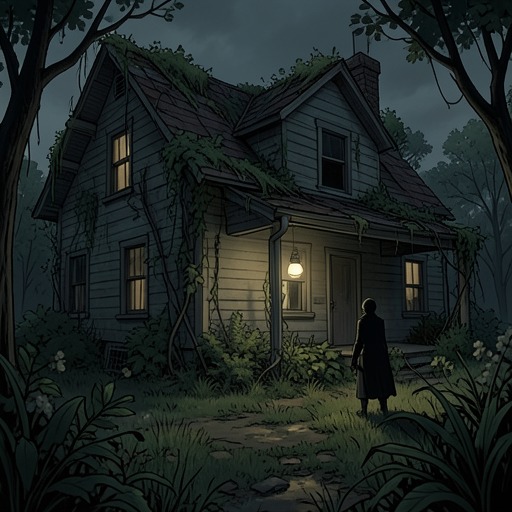
Dark Score Lake lies in western Maine, beside the log home called Sara Laughs. The house stands in RR-90, an unincorporated area so remote that it is not really within a town. It is almost large enough to be called a lodge, with fourteen rooms and sections added over decades. Its central portion dates to around 1900; additions followed in the 1930s, 1940s, and 1960s. The grounds lead toward the lake, where a small beach and a swimming float sit offshore.
The lake is not merely a view from the house. Its shoreline and approaches organize movement through the setting: the driveway descends to Sara Laughs, while the road bends past Tidwell's Meadow, a field sloping toward the water. The water’s shifting appearance—gray from one angle, blue from another—makes the landscape feel changeable even before the story’s stranger events begin.
The lake in memory and dream
For Michael Noonan, Dark Score Lake is bound to the loss of Johanna. He imagines that if he were drowning there, he would die without calling for help, even within sight of the public beach. The image makes the lake a measure of his habitual isolation: love and affection are possible for him, but asking someone to rescue him is not.
During the fall of 1997 and winter of 1998, Michael repeatedly dreams not of Manderley but of Sara Laughs, which Johanna sometimes called the hideout. In those dreams the lake belongs to an atmosphere of uneasy recognition. Michael wakes wanting to switch on the light and confirm that he is still in ordinary reality; sometimes he imagines Rebecca de Winter drowning in Dark Score Lake instead of a bay. The novel thereby folds an imagined literary death into the local landscape, letting the lake’s familiar presence carry an uncanny, recurring image of drowning.
That dream pattern acquires force when Michael approaches the house in waking life. In a dream, he walks down the lane and stops at the driveway sign for Sara Laughs without going down to the lodge. Later, on his actual return, he recognizes details from the dream: Johanna’s planters beside the path to the beach and the black square of the swimming float about fifty yards from shore. The anticipated coffin is absent, but the correspondence between dream and place unsettles the distinction between remembered, imagined, and present experience.
Tidwell's Meadow and the community’s past
Tidwell's Meadow, also known as the Old Camp, lies along the road between Michael’s car and the Sara Laughs driveway. According to Marie Hingerman, and confirmed by Bill Dean when Michael asks him, Sara Tidwell and her community built their cabins there. The site’s quiet view down to the lake thus conceals a history that local knowledge preserves only unevenly: Bill confirms the location but does not want to continue the conversation.
At the turn of the twentieth century, more than forty Black people settled in the area. Most were related, many were talented musicians, and members of the group performed as The Red-Tops and later as Sara Tidwell and the Red-Tops. They bought the meadow and a substantial tract of lakeside land from Douglas Day; Son Tidwell negotiated the purchase with money saved over ten years. The cabins were arranged around a larger building that may have served as a meeting place, rehearsal room, or performance hall.
The settlement was preceded by a protest meeting against what one account called the arrival of Black people in a horde. The feared shantytown did not appear: the community built neat white cabins instead. Local acceptance remained conditional, however. The town’s self-congratulatory measure of tolerance was that Black residents paid their bills, kept to themselves, and did not accept charity. The lake’s apparently peaceful social landscape therefore carries the pressure of racial exclusion and a local code that treats isolation as proof of good conduct.
Departure, erasure, and narrative significance
Sara and the Red-Tops performed around western Maine for more than a year, perhaps nearly two, and were popular on the regional circuit. Their posters could still be found at barn bazaars and junk shops. After playing one or two county fairs in the late summer of 1901, the community moved on; the evidence does not establish why. The Day family subsequently earned summer-rental income from the cabins until the 1933 fires burned them.
The remains of the settlement and its records do not make the past easy to recover. Michael later encounters clippings that describe the musicians through racist praise, praising them as quaint entertainers while reducing Sara to racialized features and supposedly animal high spirits. Bill’s account likewise calls the group wanderers from away, while Michael recognizes the slur Bill has avoided saying. Such language exposes a gap between the community’s surface friendliness and the prejudice shaping whose story can be told.
Dark Score Lake’s narrative force comes from that conjunction of landscape and unresolved history. Its calm water and familiar shore are repeatedly set against drowning, disappearance, and the incomplete account of Sara’s community. The lake remains at once a real place in Michael’s life, the setting of his dreams, and a local archive whose silence is part of what makes the past feel alive.