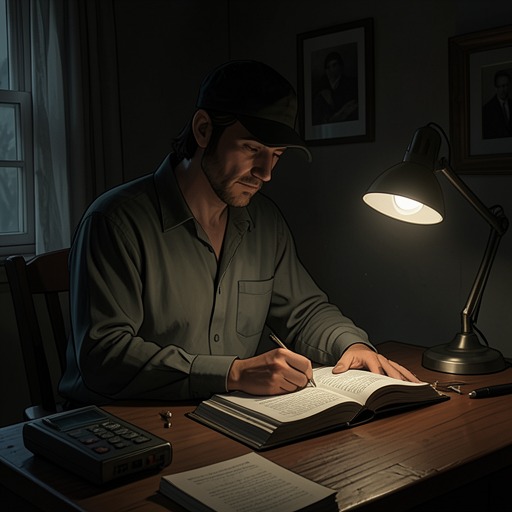
I prefer not to
Bag of Bones“I prefer not to” is Bartleby’s signature refusal in Herman Melville’s story, and, in Michael Noonan’s conversation with Mattie, a compact expression of the story’s deepening withdrawal from ordinary life. The phrase begins as a response to work; as Bartleby refuses more and more, it marks the loosening of the last bond that holds him to the world. Mattie’s dream carries the refrain out of literary discussion and into the uncanny, while Michael’s later use of it to address an empty house gives it another, more uncertain setting.
The Phrase in Melville’s Story
Michael presents Bartleby as a copyist, or scrivener, with neither past nor family life. Unlike Bob Cratchit in A Christmas Carol, he has no ties beyond the work he performs. Michael describes work as the one remaining connection between Bartleby and life, then compares that dependence to a tether: as Bartleby increasingly says “I prefer not to,” the rope steadily rots until it breaks and he floats away. The phrase’s force therefore lies in its repetition and escalation. It is not simply a refusal of an individual task; in Michael’s account, each refusal registers the weakening of the relationship that has kept Bartleby connected to existence.
That reading gives the line a distinctly social as well as existential dimension. Michael calls work the god of middle-class American males and places Bartleby’s questioning of it beside more familiar twentieth-century types, including the protagonist of The Man in the Gray Flannel Suit and Michael Corleone in The Godfather. The comparison makes the scrivener’s refusal more than an eccentric verbal habit: it unsettles the assumption that work can supply a sufficient purpose or identity. At the same time, Michael’s balloon image preserves the disturbing ambiguity of the story’s ending. Bartleby’s release from his tether is figured as floating away, not as a clear or comforting escape.
Mattie’s Dream
Mattie recognizes the refrain as the answer to Bartleby’s progressive refusals, then reveals that she has dreamed about him. In the dream, she opens her trailer door and finds him sitting on the steps in an old black suit, thin and with little hair. When she asks him to move so she can go outside to hang the clothes, he answers with the familiar refusal. The phrase has crossed from the printed story into Mattie’s dream, where Bartleby appears not as an abstract literary example but as an unexpected presence obstructing an ordinary errand.
The dream extends Michael’s interpretation without resolving what it means. Its domestic details—the trailer steps and the laundry—set the famous refusal against everyday work, making the encounter quietly unsettling. Mattie agrees that the story remains disturbing, and Michael replies that if it can still disturb her, it still works. Their exchange links the phrase’s literary effect to its power to persist in a reader’s imagination, but the scene supplies no further explanation for the dream or for Bartleby’s appearance.
The Phrase Beyond the Lesson
Elsewhere, Michael uses the refrain while considering an ambiguous arrangement of refrigerator letters. He moves a letter into place, producing “god” or perhaps an abbreviated “good,” and wonders what the message means. Rather than settle on an interpretation, he tells the empty house that he could speculate about it but prefers not to. Here the line is Michael’s own, not Bartleby’s: it turns a familiar literary quotation into a response to a domestic mystery that remains unresolved.
Together, the lesson, Mattie’s dream, and the letter-message scene show the phrase changing contexts while retaining its central tension. In the discussion, it names Bartleby’s growing detachment from work and life; in the dream, it makes that detachment intrude upon an ordinary household scene; in Michael’s remark, it registers an unwillingness to interpret an uncertain sign. The refrain connects literary reading and the novel’s uncanny events, but it does not make those events fully legible. Its repeated appearance keeps refusal, interpretation, and uncertainty in the same frame.