IBM Selectric Typewriter
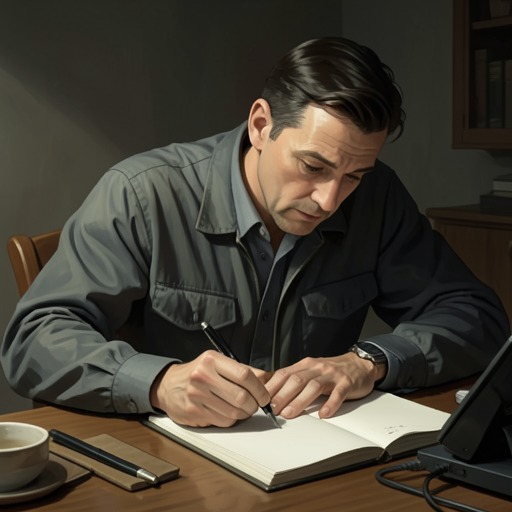
Bag of BonesThe IBM Selectric Typewriter is the object Michael Noonan retrieves during a night of sleepwalking and places back into service as he attempts to write again. Its return makes the possibility of work tangible: after four years in which ideas came but novels did not, Michael rolls paper into the machine, types “Chapter One,” and produces eight pages. The Selectric is not merely a tool in this scene; it is the hard, physical threshold between fearing that he cannot write and discovering that he has begun.
Identity and Return
When Michael wakes on the upstairs hall floor at Sara Laughs, the Selectric is sitting outside his office door with paper rolled into it. He has no clear memory of bringing it there. His feet are dirty, pine needles cling to his soles, and one toe is scratched, evidence that his night has carried him outdoors. The machine’s unexplained arrival is part of a larger disorientation: he cannot account for his movements, and the house still holds the disturbing traces of his recent experiences.
The typewriter is an old possession stored in Jo’s studio. Michael recognizes that he must have gone out to retrieve it, though he does not yet understand why. Once his thoughts return to the machine, the reason becomes plain to him: there is only one purpose for bringing a typewriter to his office. The recognition turns an unexplained object into a decision he has made before he can consciously explain it. Whatever the night’s other uncertainties mean, he has moved toward writing.
The Paper and Its Residue
Before he begins, Michael examines the sheet already in the Selectric. It is the blank side of an old pink-carbon receipt from Click!, the photo shop in Castle Rock where Jo bought supplies when they were staying at the lake. He had typed on it a sequence of names—Jo, Sara, and Mattie—repeated and interwoven, followed by the phrases “normal sperm count,” “sperm norm,” and “all’s rosy.” Michael reads the list as an attempt, made while the dream was still in progress, to record its three-sided pattern.
The receipt links the machine to the confused, intimate material of the night: Jo, his dead wife; Sara, the figure associated with the haunting; and Mattie, the living woman toward whom he feels an attraction. But the slip is only a residue of that dreamlike state, not the work he is about to undertake. Michael carries the Selectric into his office, puts it in its old place beneath a poster of Richard Nixon, pulls the receipt from the roller, crumples it, and throws it away. The discarded page separates the machine’s nocturnal record from the blank page on which a deliberate beginning can be made.
The Attempt to Write
Michael chooses to work in his office even though he expects the room beneath the roof peak to become intensely hot—possibly reaching 120 degrees by midafternoon. He could take the machine downstairs or put it on the deck, where a breeze comes over the lake, but refuses those alternatives. The Selectric has been brought to the office, and that is where he intends to use it if he can. His resolve is practical and exposed at once: he has arranged the instrument, but cannot yet be sure that the ability it represents will return.
The moment recalls an earlier fear of commitment. Michael compares plugging in the typewriter to his childhood attempts to climb the high diving board at the Y-pool: at twelve, he climbed the ladder three times only to retreat; at thirteen, he felt he had to go through with it. He remembers that confidence has failed him before, giving way to the pressure he describes as iron bands around his chest. Even the prospect of fetching a fan from the closet is enough to make him hesitate; he worries that preparing the room will only make the eventual failure more humiliating.
He switches on the IBM. Its Courier type-ball turns in a preliminary spin, and he feeds in a sheet of paper. His fingers are sweaty enough to mark it, but he no longer cares. He types “Chapter One” and waits for the storm to break. The opening is deliberately modest: it is only a chapter heading, not yet proof that a novel can be completed. But it converts the test from an imagined possibility into an action performed on the page.
Writing Resumed
Later, Michael has written eight double-spaced pages. He turns the roller until the IBM ejects the page, stacks it on the manuscript, and writes himself a reminder to call Ted Rosencrief, a retired Navy man in Derry who has worked as his research assistant. Michael needs information about Florida’s Raiford Prison and the psychology of serial killers for the novel. His note marks a further change: he is no longer only testing whether he can type. He is planning research for a developing piece of fiction.
The first pages surprise him because they exist at all. During the four-year sabbatical, he had not lacked ideas. One seemed strong enough to become a novel; half a dozen to a dozen others seemed promising, while many more arrived as brief “what-ifs” and disappeared. The obstacle had not been the absence of material but the inability to turn it into a book. The Selectric’s return therefore does not supply Michael with ideas so much as give them a route back into sustained work.
That route remains associated with the machine’s particular material setup: the old IBM, its Courier type-ball, paper fed into its roller, and the physical sequence of switching it on, typing, and retrieving pages. Michael wonders whether this old apparatus was the secret all along, but the passage establishes the possibility rather than explaining it. What matters is the concrete result: after years of stalled writing, the Selectric carries a new chapter heading into eight pages of manuscript and gives Michael a reason to resume his working relationship with his research assistant.
Narrative Significance
The typewriter’s importance lies in the contrast between its ordinary function and the uncertainty surrounding its return. It is simply a machine Michael owns, yet it appears at the office door after a night he cannot clearly remember and bears a page that records his dream in repeated names and fragments. That sequence gives the object an uncanny edge without establishing that the machine itself has acted supernaturally. The evidence points instead to Michael’s sleepwalking and to the unsettled state in which he retrieved it.
Once he is awake, the Selectric becomes a measure of agency. Michael can discard the dream’s pink receipt, carry the machine into the office, endure his familiar fear of failure, and begin. The transition is not from uncertainty to certainty: the chapter heading is followed by waiting, and the eight pages leave open how much work remains. It is a narrower but decisive change, from a four-year inability to write novels to the physical fact of a manuscript in progress. The Selectric makes that change visible, one typed page at a time.