Jo's Studio
Bag of BonesJo’s Studio is the separate workspace where the absence of Jo becomes tangible to Mike Noonan and where a violent supernatural episode leads him to a concealed archive. The studio’s desk, photographs, crafts, and hidden storage preserve different layers of Jo’s life: intimate traces of their marriage, the work she left behind, and evidence she had gathered about the TR’s buried history. Its revelation makes the room both a memorial and the threshold to Mike’s investigation.
Setting and Personal Meaning
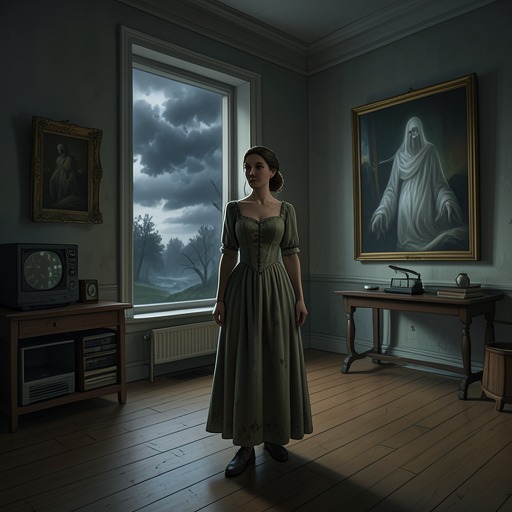
After returning to Sara Laughs, Mike goes to the studio rather than entering the house. Heat lightning intermittently lights the path, and inside he finds a room that is hot but not stale, with an air conditioner that still works and a peppery smell he wonders may come from Jo’s herbs. The details belong to a functioning workspace, but for Mike they sharpen the contrast between the wife he has lost and the things of hers that remain there.
Mike imagines their marriage as a playhouse that has been lifted at one corner: his possessions stayed where they were, while Jo’s seemed to slide out of the house and into the studio. That image gives the separate room a particular emotional geography. It holds what the main house no longer seems to contain, making the studio less a simple annex than a concentrated remainder of Jo’s presence.
He sits in Jo’s chair and addresses her, but receives no answer: no knocks on the wall and no calls from crows or owls in the woods. His hand passes over the desk where her typewriter had stood and comes away with a film of dust. The gesture meets absence in material form. Nearby are a picture of Sara Tidwell and an old sepia photograph of a man-high birchwood cross in a clearing above the lake, a landscape feature Mike thinks may since have disappeared beneath trees.
Jo’s Errand and the Owls
The studio’s connection to Jo’s unfinished business reaches back to her appointment calendar. Ward Hankins finds an entry for Tuesday, November 16, 1993: “S-Ks of Maine, Freep, 11 A.M.” Mike identifies the first abbreviation as Soup Kitchens of Maine, whose board Jo had served on from 1992 until her death, and Freep as Freeport. He reasons that she probably attended a board meeting and then drove roughly seventy miles to the TR to collect two plastic owls. The calendar establishes a route and a date, but does not answer why she made the detour.
Later, while warning Mike away from Mattie Devore, Bill Dean recalls Jo’s errand. She had apparently made the trip specifically to collect the owls; Bill’s practical explanation is that they kept crows from fouling the woodwork. Mike accepts that explanation at the time. Only afterward does he consider that owls are also said in Indian folklore to ward off evil spirits, and that Jo, who habitually gathered and retained useful information, might have known this too.
Mike’s continued uncertainty about the owls is resolved in the studio during the storm. After going to look for them, he finds one in the hidden storage area and recognizes it as the object that concealed Jo’s tin box. The owl’s everyday appearance had allowed the archive to remain overlooked; its unusual second function is as the container for evidence Jo had deliberately hidden.
The Storm and the Hidden Room
During the July storm, Mike takes a lantern down the hill to the studio, telling himself that Kyra is his responsibility. The door initially resists him, and he calls on Jo for help before forcing his way inside. After a moment of stillness, the door slams shut and a poltergeist attack begins. Crafts and keepsakes associated with Jo are hurled around the room: a framed afghan square tears from the wall, the heads come off dolls in baby collages, and the hanging light breaks. Two opposing currents of air sweep through the studio, echoing the larger storm outside.
A wooden head representing Sara Laughs explodes, and a kayak paddle rises and launches at Mike. He throws himself down to avoid it. When the attack stops, he is left among the ruined objects, with no immediate explanation that the struggle is over for good. The scene makes the studio’s contents more than a still-life of bereavement: the keepsakes become entangled in the supernatural conflict unfolding around Mike.
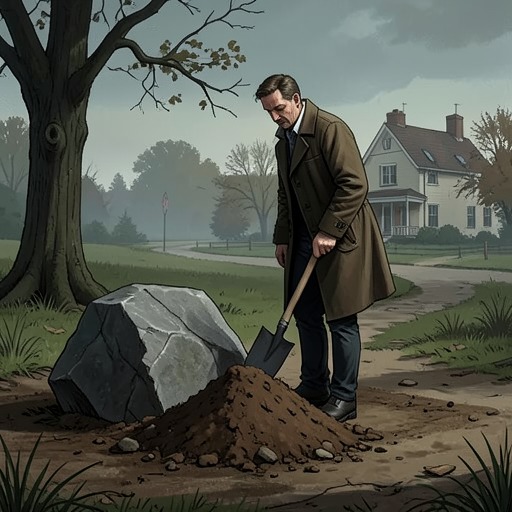
As he gathers broken glass into the green rag rug, Mike finds a trapdoor beneath it. He already knew of the storage area but had meant to search it for the owls and then forgotten. A recessed ring lifts the trapdoor easily. Below are steep steps, an old toilet, filing-cabinet drawers wrapped in plastic and stacked on pallets, and protected recording equipment. The hidden space is a practical store for old records and papers, but its concealment also explains how Jo could keep her collected materials out of view.
The Archive and Its Historical Evidence
In the storage area, Mike finds the owl and draws a small tin box from inside it. He recognizes the gilt-script label, JO'S NOTIONS, and opens the box to find folded papers, two wirebound steno books, and a photographic negative. The negative shows Jo in a gray two-piece bathing suit, standing on the swimming float. Holding it, Mike understands that these are the materials she came to Sara Laughs to collect and conceal in July 1994. He imagines her removing the owls from the deck, hiding the box inside one, wrapping them, and bringing them to the studio while her brother Frank was nearby.
Mike cannot know all of Jo’s reasons or her state of mind when she hid the evidence. He nevertheless concludes that she likely expected him to find it eventually, and wonders whether the negative was left as a clue. The archive therefore offers neither a complete explanation nor an impersonal cache: the image of Jo and the materials she assembled make her private research persist into Mike’s present.
The papers include photocopied clippings from the Castle Rock Call and the Weekly News, with dates marked in Jo’s neat handwriting. The oldest clipping is from 1865 and concerns Jared Devore. Its date helps Mike make sense of a generational discrepancy that had puzzled him. Other clippings about Sara Tidwell and the Red-Tops frame the performers in openly racist language; the reviews’ praise depends on degrading descriptions, so their genial tone does not make them neutral records. Mike finds no explanation in those clippings for the group’s departure.
Instead, he finds a July 19, 1933, Call report on a wildfire threatening Halo Bay. The story recounts how a sudden change in the wind sent the fires toward the north end of the lake, where local families had fishing and hunting camps. Jo’s archive thus connects the room’s intimate evidence to public records of the region’s past. Those records make it possible for Mike to begin tracing events the newspapers recorded selectively, while their gaps remain part of the history he must confront.
A Workspace That Becomes a Threshold
The studio gathers several kinds of evidence without resolving them into a single, complete account. The calendar offers Jo’s appointment and an unexplained errand; Bill supplies a mundane explanation for the owls; folklore suggests another possibility; the hidden tin box reveals that the owls also concealed documents and a photograph. Each clue changes the meaning of the previous one while leaving some of Jo’s intentions uncertain.
The room’s movement from intimate refuge to site of supernatural conflict and archival discovery gives its objects a double force. Dust on Jo’s desk registers the lapse of time, while the hidden papers carry her inquiry forward. The studio becomes where Mike encounters both the limits of what he can know about his wife and the evidence she preserved about the TR—an inheritance concealed not in a formal archive, but in the belongings of a private workspace.