Jo’s research notebooks and notes
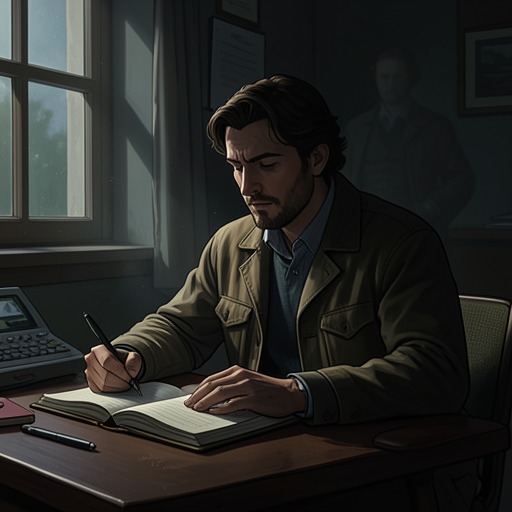
Bag of BonesJo’s research notebooks and notes are the hidden record of her investigation into the TR’s past and the history of Sara Tidwell and the Red-Tops. Compiled during secret visits in 1993 and 1994, the papers turn fragments that local histories leave out into an evidentiary trail: dates on a calendar, old newspaper clippings, handwritten notes, and transcriptions of recorded conversations. Their recovery gives Mike a way to understand both the history Jo uncovered and why she concealed her work at Sara Laughs.
Origins and Method
Jo began with research for an article, initially treating the project as a lark. Rather than relying only on books, she spoke with residents, listened to accounts of the old days, and persuaded people to look for letters and diaries. Her brother Frank later described her as particularly good at drawing out such material. The investigation was conducted without Mike’s knowledge; Frank believed Jo first kept it secret because she intended it as a surprise, though he thought she had eventually stumbled onto something more serious.
The notebooks preserve the uneven texture of that work. They are largely filled with Jo’s handwriting and include fragmentary notes as well as typed transcriptions of tapes. The tapes might still have been stored elsewhere, but Mike recognized that the surviving notebooks were likely to contain most of the story: what had happened, who was responsible, and how it had been covered up. Their incompleteness matters. They offer a working record assembled from conversations and documentary traces, not a polished account that claims to settle every question.
The Hidden Archive
The notebooks were concealed with papers in a small tin box marked JO'S NOTIONS. Jo had hidden the box inside a plastic owl, and Mike found it in the studio at Sara Laughs. The cache included folded papers, two wirebound stenographic books held together with rubber bands, and a photographic negative of Jo at the swimming float. The arrangement linked the archive to her July 1994 visit: Mike inferred that she had returned to Sara Laughs to gather and hide the materials, taking owls from the deck and placing the box inside one of them.
A calendar entry helped establish the pattern of her movements. Ward found one appointment for the second week of November 1993: a Soup Kitchens of Maine board meeting in Freeport on Tuesday, November 16. Jo had served on the organization’s board since 1992. Mike concluded that after the meeting she had driven roughly seventy miles to the TR to take delivery of two plastic owls. The entry did not explain all her reasons, but it tied a documented obligation in her public life to an otherwise puzzling visit to the lake.
Reconstructing a Suppressed History
Among the papers were photocopied clippings from the Castle Rock Call and its predecessor, the Weekly News. Jo had marked the dates in her firm handwriting. The oldest clipping, from 1865, concerned Jared Devore; it prompted Mike to reconsider the generations of the Devore family and how they related to the later history of Sara and the Red-Tops. A different kind of record, Edward Osteen’s local history, offered stories about the region and an old photograph believed to show the band at the Fryeburg Fair in 1900, but it did not provide the same account as Jo’s accumulated research.
The contemporary press clippings reveal the limits of public memory as well as its biases. Reports about Sara and the Red-Tops present them through racist descriptions, while treating those descriptions as praise. Mike recognizes that these are reviews, not a neutral record of the performers or their lives. The clippings also fail to explain why the group left. In Jo’s papers, newspaper material is therefore evidence of what the town said publicly, but its silences and prejudiced language have to be read alongside the testimony she gathered privately.
Jo’s notes supply what town histories do not: an account of the community’s response after Sara and her son were murdered. By September 1901, Mike explains, most people around the TR knew the pair had been killed and many had a good idea who was responsible. Reg Tidwell Jr. repeatedly pressed the county sheriff, first to search for the missing family, then to find their bodies, and finally to identify their killers. The Red-Tops’ community began to break apart, and, according to information Jo traced through Royce Merrill, harassment escalated after Labor Day. Reg remained because he wanted to learn what had happened to his sister and nephew. He was later injured by a trap on a path he regularly used and died from blood poisoning; after his death, Son Tidwell left with the remaining family and musicians.
The notes also help Mike explain how Sara and her son’s bodies were concealed. He reasons that those responsible first moved them deeper into the woods, covered them temporarily, and then transported and buried them elsewhere, possibly at Bowie Ridge, where they had spent much of the summer cutting. This is Mike’s reconstruction rather than a location Jo definitively recorded, and he presents it as a likelihood. The distinction underscores the archive’s evidentiary limits: it provides the testimony and clues from which a plausible sequence can be assembled, while leaving some particulars uncertain.
Discovery and Consequence
The notebooks’ significance becomes immediate when Mike finds them during the storm and realizes that Kyra’s safety is still the urgent concern. He begins opening them, but he does not yet pursue every revelation. A loose green slip falls from one book and provides a family connection: Mike’s great-grandfather James Noonan had an older sister, Bridget, who married Benton Auster. Their son Harry Auster was therefore Mike’s granduncle and Kenny Auster’s grandfather. The discovery links Mike’s family to the people involved in the old events, complicating Max Devore’s claim about shared ancestry without making Mike’s own role in that history identical to theirs.
Later, when Mike explains what Jo’s research showed, he identifies the notebooks as the source for the account of Reg’s search, the growing harassment, and the trap that ended in his death. He also uses the collected evidence to distinguish the public story from the events concealed behind it. The Red-Tops’ departure and Sara’s murder had disappeared from town histories, while the surviving records of their performances preserved a demeaning public image rather than the truth of what happened to them.
The archive is thus both a record and an act of concealment: Jo preserved evidence by hiding it, and Mike can recover the fuller story only by finding the container she left at Sara Laughs. Its papers do not erase uncertainty or restore an uncontested public history. They do, however, make the omissions legible, connect separate generations and sources, and give Mike grounds to understand the violence and silence surrounding the TR. The notebooks transform Jo’s private investigation into a testimony that can be read after her death.