Johanna Arlen Noonan
Bag of BonesJohanna Arlen Noonan is Michael Noonan’s wife, whose sudden death in August 1994 leaves him grieving and later drives a story of concealed evidence, continuing attachment, and supernatural intervention. She is absent from much of the novel’s present-day action, yet her everyday traces and private preparations repeatedly alter what Michael understands about her and about Sara Laughs.
Identity and Death
In August 1994, Johanna went from home to a Derry shopping strip to refill her sinus prescription and buy fish. Michael had offered to make the trip for her, but she chose to go herself, blowing him a kiss as she left. She died before returning. Michael first identified her on a television monitor, an impersonal procedure that the narrative sets against the intimate details of her ordinary departure and the items left behind in her handbag.
The autopsy established that her death was caused not by the heart problem initially suspected but by a brain aneurysm she may have had for as long as five years without knowing it. The vessel ruptured as she ran across a parking lot toward an accident. The assistant medical examiner told Michael that death had come swiftly and that she had not suffered. The discovery gives the death a medical cause while leaving the abruptness of her absence emotionally difficult for her husband to accept.
The autopsy also revealed that Johanna had been about six or seven weeks pregnant. Michael had not known, and the disclosure reaches him as another rupture in his understanding of their shared life. Later, while thinking about a home pregnancy test costing twenty-two dollars and fifty cents, he concludes that she had wanted to keep the pregnancy secret until she was certain. The test and her silence suggest a private intention interrupted before she could share it with him.
Memory and Mourning
Michael’s grief attaches itself to small, concrete objects. Among the contents of Johanna’s red handbag was a chocolate with marshmallow inside, shaped like a mouse. He ate it at the kitchen table among her tissues, makeup, keys, and partly used rolls of mints; the ordinary remnant brought on a sudden, childlike collapse into tears. The scene establishes how her belongings preserve not only the fact of her absence but the texture of their everyday life.
A passage in The Moon and Sixpence becomes another point at which bereavement turns undeniable. Reading the line in which Strickland calls Stroeve a funny little man, Michael realizes that Johanna will never turn the page and hear it. The recognition overwhelms him. Although he had already identified her, attended her funeral, and watched her burial, the paperback on her side of the bed makes her death feel real in a way those formal rites had not. The scene links reading, shared domestic space, and the irreversibility of loss.
Months later, Michael returns to his writing in his Derry office and raises a glass of champagne to Johanna, telling her he is done. On that occasion there is no reply and no sensed presence. He explicitly distinguishes this silence from what he experiences later, marking an early stage of mourning in which speaking to her is a human gesture rather than evidence of supernatural contact.
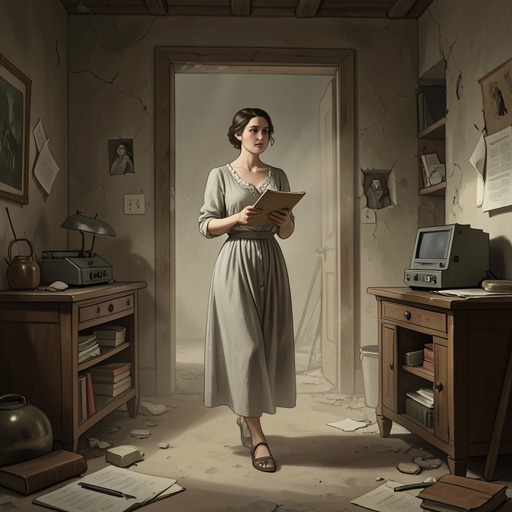
His later return to Sara Laughs brings a more difficult form of recollection. Entering Johanna’s studio, he feels that the house holds less of her than the studio does: he imagines their shared home as a playhouse disturbed so that his belongings remained in place while hers seemed to have slid away. The image makes the studio a concentrated remainder of her life and work, but the objects there also disclose that she had been doing more than simply occupying the space.
Unfinished Messages and Hidden Work
Johanna’s habits of attention are visible in the plastic owls she arranged to deter crows. She had traveled from Derry to Sara Laughs in November 1993 to take delivery of them, unpacked the pair for Bill Dean, and left shortly afterward. The specialness of the errand puzzled Bill, who did not know why she had made the trip. Michael recognizes the gesture as characteristic: Johanna collected unusual pieces of information and acted on them without necessarily telling him.
The owls acquire a second significance after Michael finds a concealed archive in the studio. Bill’s recollection of Johanna’s delivery and the objects’ connection to the house help Michael understand that she had come back to Sara Laughs in July 1994 to gather and hide material. He infers that she removed the owls from the deck, hid a tin box inside one, wrapped them, and carried them to the studio. The cache included papers, stenographic notebooks, and a photographic negative of Johanna in a bathing suit on the swimming float. The physical evidence makes the owls a means of concealment as well as a practical device, while the negative confirms that Johanna herself had been at Sara Laughs during the period associated with the hidden materials.
The papers included dated newspaper clippings, the oldest from 1865 and concerning Jared Devore. Reading the archive helped Michael make sense of generations whose chronology had seemed inconsistent. He also sees the coded phrase “Owls under studio” recurring across his manuscript, a pattern he interprets as a monument Johanna built into the text so he might find and understand her message. Her work thus reaches him through two kinds of trace: material objects hidden in the studio and words dispersed through a book.
Michael cannot know all the reasons for Johanna’s actions or exactly what she believed when she hid the box. He nevertheless concludes that she expected him to find his way to the studio eventually. This remains an inference rather than a complete explanation, but the concealment gives her a purposeful presence in the investigation: she had preserved evidence and left a route by which it could be recovered.
Continuing Presence and Narrative Significance
The novel keeps Johanna’s influence active without making every reminder a supernatural visitation. When an unexplained current of cool air and a whisper-like sound passes Michael’s face, he calls her name, but the event is not resolved simply by his hope that it was her. Elsewhere, memories of her voice arise in familiar settings, while objects and messages lead him toward discoveries she prepared before her death. The distinction between recollection, evidence, and apparition remains part of the story’s uncertainty.
That uncertainty changes in the final supernatural confrontation. After the hostile presence has gone, Michael sees Johanna as a dim figure, the lake and storm clouds visible through her. She appears exhausted and diminished, and she smiles at him. Her words are too distant to hear clearly, but he understands them, reading them as communication between the two of them. The scene presents her help as costly and partial rather than as a restoration of their former life: she can assist him, but her appearance also bears the signs of what she has endured.
Michael’s bond with Johanna finally becomes part of his capacity to care for Kyra. He remembers telling the child not to leave love letters where they might return to haunt her, while recognizing that he himself remains haunted by memory. Yet he chooses not to destroy those memories and instead directs his attention toward the child sleeping down the hall, whom he describes in affectionate parent-child terms. Johanna’s continuing importance therefore lies not only in grief or supernatural contact, but in the way her memory accompanies Michael as he assumes a new responsibility. The novel leaves her dead and irrecoverable, while allowing her concealed work, remembered presence, and final assistance to shape what he does next.